Cloud Services for Netherlands Businesses
The right cloud, set up the right way, makes everything downstream easier: faster releases, lower bills and room to grow without rebuilding. We design and run cloud infrastructure on all four major providers, and we recommend the one that fits your product, not the one we happen to know best.
Start Your Project- Senior engineer replies within 24 hours
- NDA on request
- No obligation
Describe your project
Share a few details and our team will reach out to you within 24 hours.
Your Cloud Is the Foundation Everything Else Sits On
Cloud Providers — the foundation your product runs on, from AWS and Azure to Google Cloud and Oracle.
Almost every decision you make about your product later is shaped by where it runs. The cloud determines how easily you can scale when traffic arrives, how much you pay each month, how quickly you can recover from a failure, and even which features are realistic to build. Get it right early and the rest of the work gets easier. Get it wrong and you spend the next two years fighting the foundation.
The trouble is that the cloud has become genuinely complicated. Each major provider offers hundreds of services with overlapping names and confusing pricing. It is entirely possible to spin up something that works, and to be paying three times what you need to, with data sitting in the wrong region for GDPR, on an architecture that will not survive your first real traffic spike. Most companies do not discover these problems until they become expensive.
Our job is to make those early decisions well, with the experience of having run production systems on all four major clouds as part of our broader DevOps services. We are not tied to one provider, we do not earn commission from any of them, and we have no incentive to recommend anything other than the cloud that genuinely fits your workload, your team and your budget.
What Cloud Services Include
Whether you are launching on the cloud for the first time, migrating off ageing on-premise servers, or trying to rein in a bill that has crept up over the years, the work falls into a few clear areas. We handle all of them, and we are happy to do just one if that is all you need.
Architecture for your needs
Cloud architecture designed for your traffic patterns and budget
Migration
Migration from on-premise servers or another cloud provider
Cost optimisation
Cost optimisation and right-sizing of over-provisioned resources
Security and compliance
Security hardening, access control and EU data residency for GDPR
Resilient infrastructure
Auto-scaling, automated backups and disaster recovery planning
Ongoing management
Monitoring, alerting and ongoing management after launch
The thread running through all of it is that we set the cloud up as code rather than by clicking through a console. That means the environment is documented, reproducible and reviewable, instead of being a fragile thing that only one person understands.
The Cloud Providers We Work With
We partner with leading cloud providers to build secure, scalable, and high-performance infrastructure tailored to your business needs.
Amazon Web Services (AWS)
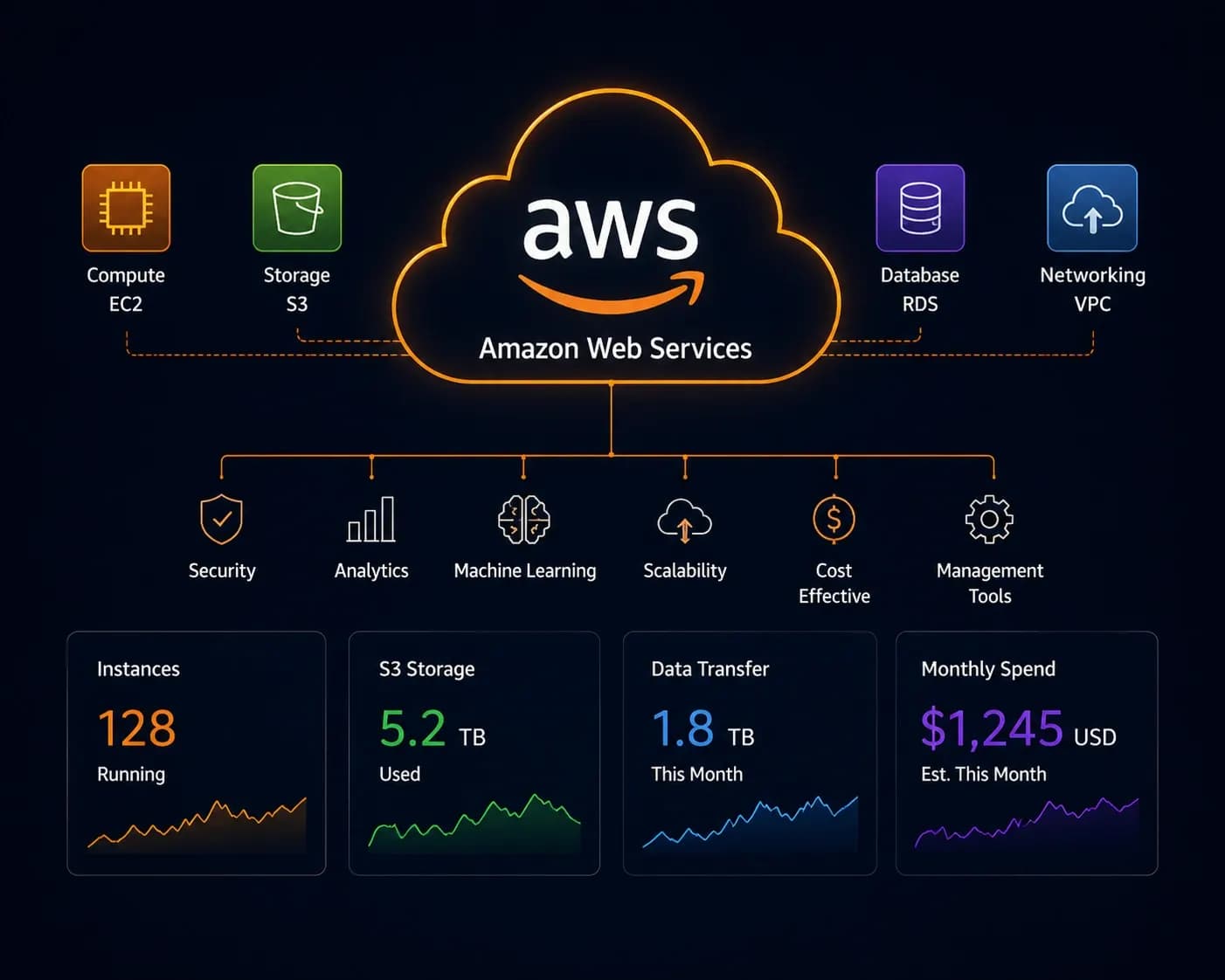
AWS is the most widely used cloud in the world, with the broadest range of services of any provider. For most products it is the safe default: if a capability exists in the cloud, AWS almost certainly offers it, usually in a mature, well-documented form. We use it for everything from simple application hosting to complex, multi-region production systems that have to stay up under serious load.
Ideal for: most general-purpose products, startups that want room to grow, and teams who value the deepest pool of documentation and hiring talent.
- The widest service range of any provider, by a clear margin
- EU regions including Frankfurt and Stockholm for GDPR data residency
- Strong serverless options with Lambda and managed databases
- Mature, proven tooling for scaling and high availability
Microsoft Azure
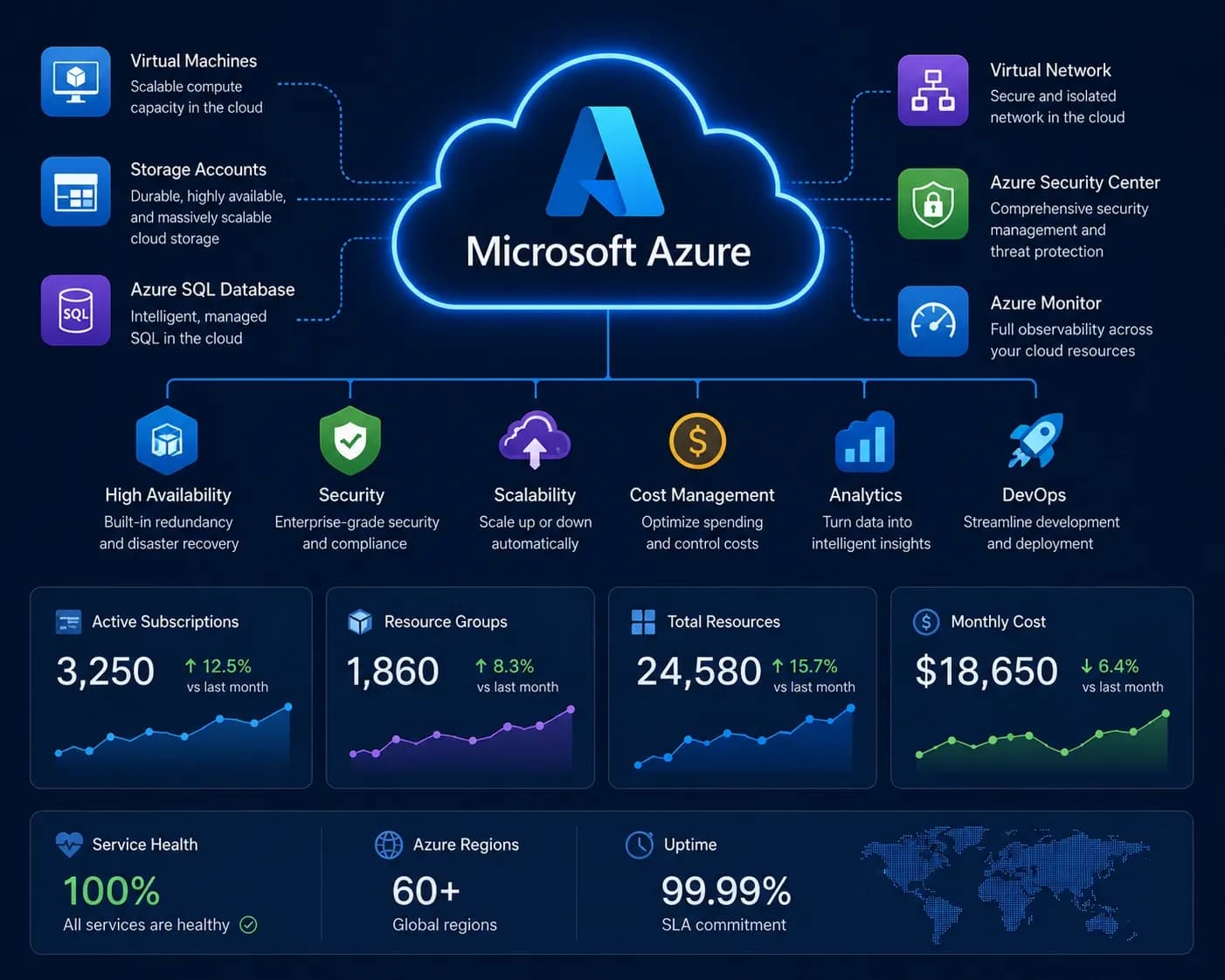
Azure is the natural fit for organisations already invested in the Microsoft ecosystem. It integrates tightly with Active Directory, Microsoft 365 and Windows workloads, which makes it the pragmatic choice for many enterprises and public-sector bodies in the Netherlands that already run on Microsoft. If your staff already log in with Microsoft accounts and your back office runs on Office, Azure removes a lot of friction.
Ideal for: enterprises and public-sector bodies already on Microsoft, and hybrid setups that mix on-premise and cloud.
- Seamless integration with Microsoft 365 and Active Directory
- Strong enterprise and hybrid-cloud support for mixed environments
- EU regions including Amsterdam for data residency
- Preferred by many regulated and government organisations
Google Cloud Platform (GCP)
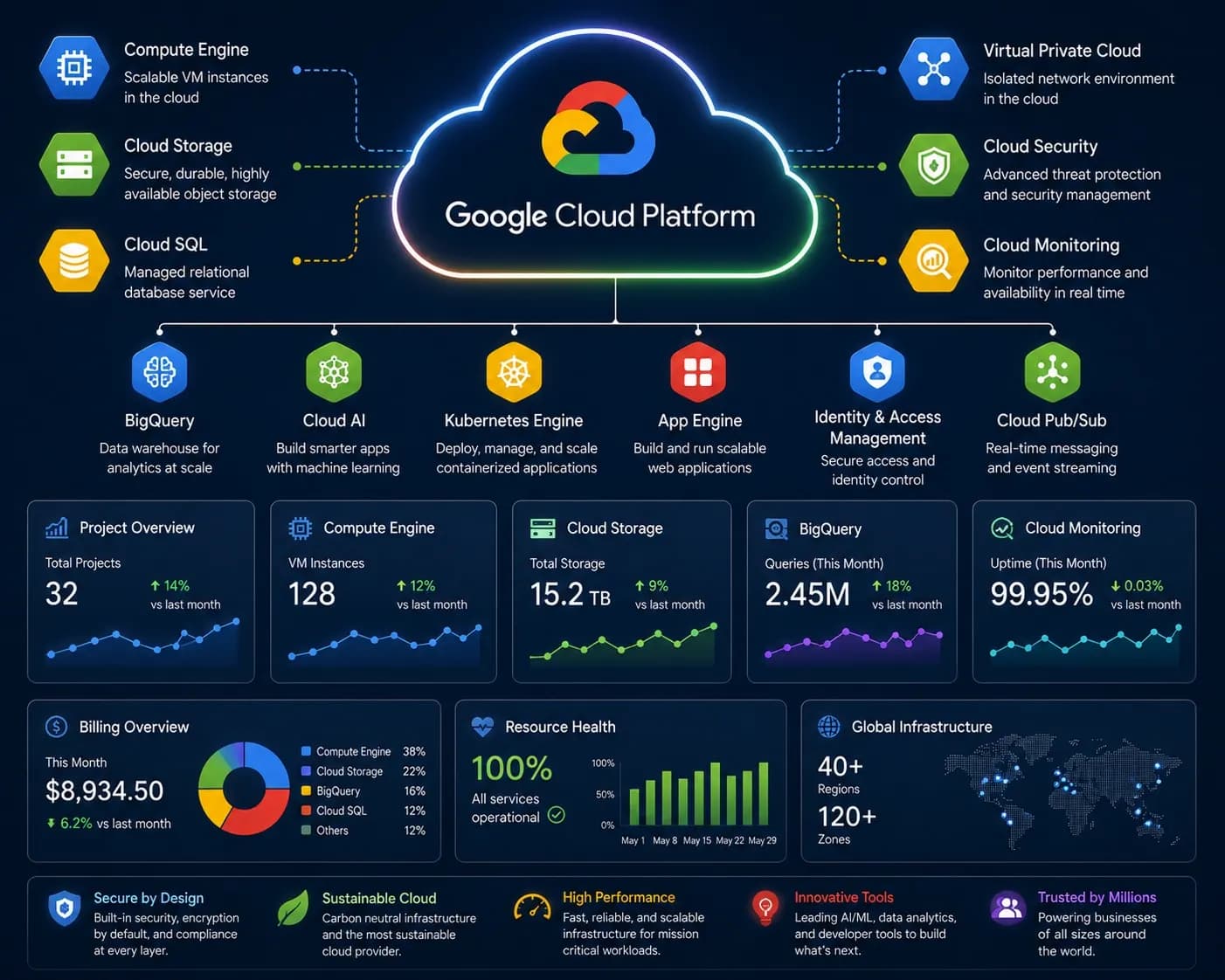
Google Cloud is the strongest provider for data, analytics and AI workloads. If your product leans heavily on big data, machine learning or real-time analytics, Google's tooling often makes it the best fit: BigQuery for analytics at scale, Vertex AI for machine learning, and a Docker & Kubernetes experience that benefits from the fact that Google created Kubernetes in the first place. For data-heavy and AI-first products, it frequently pulls ahead of the others.
Ideal for: data-heavy products, AI and machine-learning workloads, and teams building analytics into the core of the product.
- Best-in-class data and analytics with BigQuery
- Strong, mature AI and machine-learning tooling
- Kubernetes-native, since Google originally created Kubernetes
- EU regions for data residency
Oracle Cloud Infrastructure (OCI)
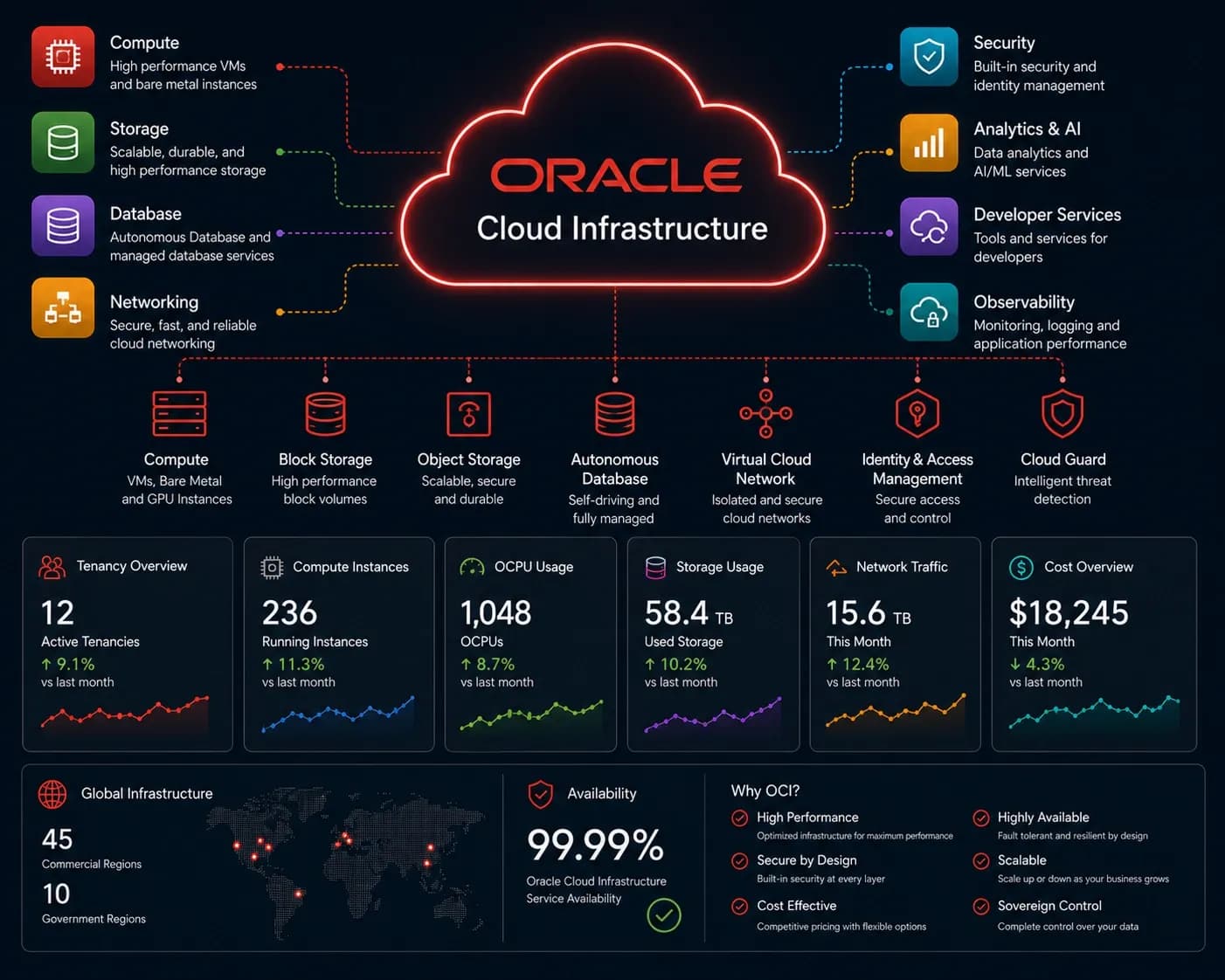
Oracle Cloud is often the most cost-effective option for database-heavy and enterprise workloads, and it is frequently overlooked for that reason. It is particularly strong for organisations already running Oracle databases or applications, where staying within the Oracle ecosystem removes licensing and integration headaches. For certain workloads, its pricing can meaningfully undercut the larger providers.
Ideal for: Oracle-based organisations, database-heavy systems, and workloads where compute cost is the deciding factor.
- Cost-competitive for database and enterprise workloads
- Strong for organisations already running Oracle software
- High-performance compute and networking
- EU regions including Amsterdam for data residency
Moving to the Cloud, or Between Clouds
Moving to the cloud is more than a migration—it's an opportunity to improve performance, scalability, and operational efficiency. We help businesses transition with confidence through careful planning, minimal downtime, and modern cloud architecture.
Migration Assessment & Planning
Gain a clear understanding of your current infrastructure before making the move. We analyze dependencies, identify potential risks, and create a strategic migration roadmap that ensures a smooth, efficient, and low-risk transition to the cloud.
Seamless Workload Migration
Migrate applications, databases, and critical workloads with minimal disruption. Our phased approach helps maintain business continuity while ensuring a secure and reliable transition to your new cloud environment.
Cloud Platform Transition Services
Whether you're moving between cloud providers or adopting a multi-cloud strategy, we help optimize performance, reduce complexity, and ensure a seamless migration experience.
Infrastructure Modernization & Optimization
Transform legacy infrastructure into a modern, scalable, and cloud-native environment. We leverage automation, Infrastructure as Code (IaC), and best practices to improve efficiency and long-term manageability.
Every Cloud We Build Is Defined in Code
We build cloud infrastructure as code, ensuring every environment is consistent, reproducible, version-controlled, and ready to scale as your business grows.
Reproducible and reviewable
Whichever provider you choose, we set the infrastructure up as code rather than by clicking through a console. This is not a stylistic preference. A console-built cloud is invisible: only the person who clicked the buttons knows how it was assembled, and when they leave or simply forget, rebuilding it after a failure becomes guesswork under pressure. Infrastructure defined in code is version-controlled, reviewable like any other change, and rebuildable on demand. The whole environment can be recreated, cloned for a staging copy, or moved without anyone reverse-engineering what exists.
Terraform at the core
The tooling behind that is primarily Terraform, the industry standard for defining cloud infrastructure as code, covered in depth on our dedicated infrastructure-as-code page. In short, Terraform turns your cloud from a fragile, hand-built thing into a documented, reproducible system. Every server, network rule and database is written in plain configuration files, so an infrastructure change is reviewed and applied just like a change to the software. Nothing is set up from memory or left undocumented, so the environment can be rebuilt, cloned or audited at any time without guesswork.
How We Help You Pick
Choosing the right cloud provider isn't about following trends—it's about finding the platform that best fits your workload, budget, and long-term goals. Our proven process helps you make informed decisions with clarity and confidence.
Understand Your Workload
We start by analyzing your applications, infrastructure requirements, traffic patterns, and business objectives to understand what your environment truly needs.
Evaluate Cost & Performance
We compare cloud providers based on real-world costs, scalability, performance, and operational requirements to identify the most practical solution.
Assess Integration & Growth Needs
We consider your existing tools, team expertise, compliance requirements, and future growth plans to ensure the platform supports long-term success.
Deliver a Clear Recommendation
We provide a transparent recommendation backed by technical analysis, business needs, and cost considerations, helping you move forward with confidence.
Frequently Asked Questions
Find answers to common questions about cloud platforms, DevOps automation, infrastructure management, and cloud migration services.
There is no single best provider; it depends entirely on your workload. AWS suits most general products, Azure fits Microsoft-based organisations, Google Cloud excels at data and AI, and Oracle Cloud is often cheapest for database-heavy systems. All four offer EU regions for GDPR data residency, including Amsterdam. We assess your specific needs and recommend the best fit rather than defaulting to one provider for every client.
Yes. Cloud migration is one of our most common engagements. We map your current setup, plan the migration to minimise downtime, move workloads in stages where possible, and validate everything in the new environment before switching traffic over. Because we define infrastructure as code, the new environment is reproducible and easier to manage than the one you left behind.
We choose EU data-residency regions, such as Amsterdam or Frankfurt, so data physically stays within the EU. We encrypt data in transit and at rest, configure strict access controls and audit logging, and document the setup. GDPR and AVG compliance is built into the architecture from the start, not added afterwards as a patch.
Frequently, yes. Most clouds we audit carry over-provisioned servers, idle resources and inefficient architecture that quietly inflate the bill. We review your spend, right-size resources, introduce auto-scaling so you only pay for what you actually use, and remove waste. A cloud cost review often pays for itself within a few months.
Yes, where it genuinely helps, such as for resilience, to avoid vendor lock-in, or to use the strongest service from each provider. But multi-cloud adds real complexity and cost, so we only recommend it when the benefit is concrete. For many products, one well-designed cloud is the better and cheaper choice, and we will say so rather than overselling.
Both options are available. We can hand over a fully documented setup for your own team to run, or manage it on an ongoing basis, covering monitoring, patching, scaling and cost control. The same engineers who built it keep it healthy, so nothing is lost in a handoff to a separate operations team who learn the system only when it breaks.
Usually, but not always, and we will give you an honest answer rather than a default yes. The cloud wins on scalability, reliability and not having to maintain hardware, and it often wins on cost once you stop paying for capacity you rarely use. But for some stable, predictable workloads, well-run physical servers can still be competitive. We assess your actual situation before recommending a move.