PWA vs Native App: Costs, Speed and When to Use Each
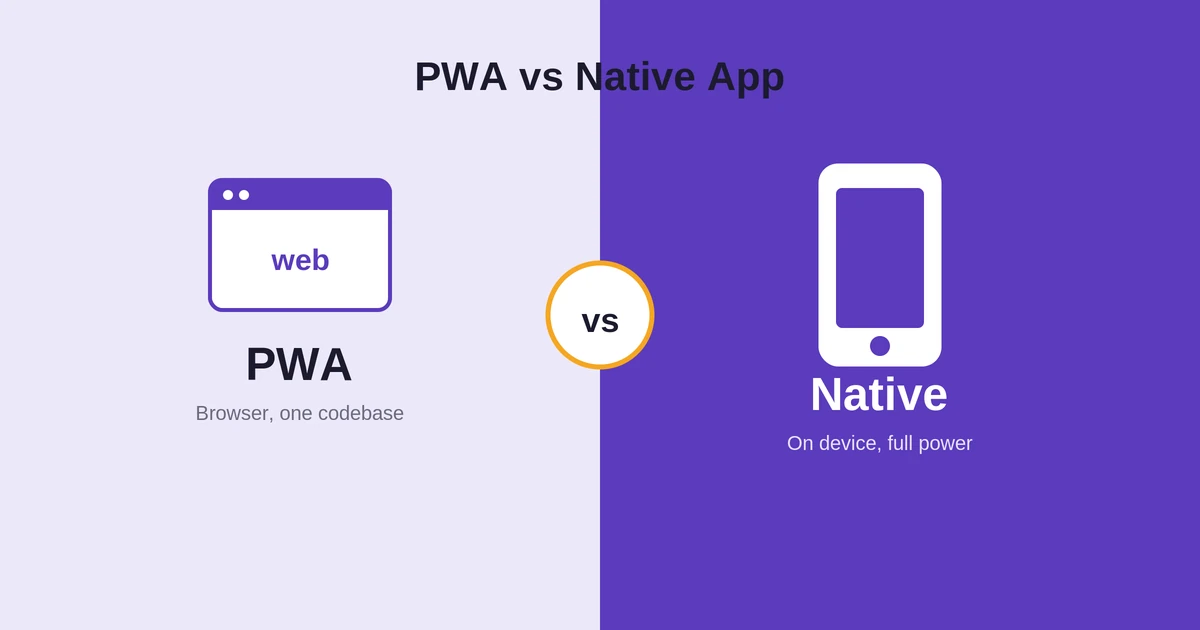
The PWA vs native app choice comes down to reach versus depth. A progressive web app runs in the browser, installs without an app store, and costs less to build. A native app lives on the device, uses the hardware fully, and performs best. Neither wins outright. The right pick depends on your users, your features and your budget, so the smart move is to match the model to the product rather than the trend.
This guide explains what each option is, compares them across the factors that actually matter, and gives you a clear rule for when to choose which. It is written for founders and product owners in the Netherlands and Europe who are deciding how to build their next app. By the end you will know which model fits your product, what it will take to build, and when to switch.
PWA vs native app: the short answer
Choose a PWA when reach, speed to launch and lower cost matter most, and your app does not need deep device features. Choose native when performance, offline power, app store presence or full hardware access are core to the product. Many teams start with a PWA to validate demand, then build native once the product earns it, which spreads cost and lowers the risk of building the wrong thing.
That rule covers most cases. The rest of this guide shows the trade-offs behind it, section by section, so you can defend the decision to your team and your budget holder.
Key takeaways
- A PWA runs in the browser, ships from one codebase, and costs less to build and maintain.
- A native app installs from an app store, uses full hardware, and delivers the best performance.
- Reach, budget and speed favour a PWA. Performance, offline depth and device access favour native.
- Cross-platform frameworks give you a real native app for both platforms from a single codebase.
- iOS support for some PWA features still trails Android, so test on real devices before you commit.
- Start with a PWA to prove demand, then move to native when the product clearly needs it.
What is a PWA?
A progressive web app is a website built to behave like an app. It loads in the browser, can be added to the home screen, works offline for cached content, and can send push notifications on most platforms. There is nothing to download from an app store, and one codebase serves every device. Google’s web.dev documents the standards behind it, so the approach rests on open, well-supported web technology rather than a single vendor.
How a PWA works
Under the hood, a PWA uses a service worker, a small script that sits between the app and the network. It caches files, serves them when the connection drops, and manages background jobs like push messages. A web app manifest then describes the icon, name and colours so the app can sit on the home screen and open full screen, looking and feeling much like a downloaded app.
What a PWA does well
A PWA shines when you want instant access with no install step. A user taps a link and starts using it straight away. Updates ship the moment you deploy, with no app store review to wait on. Search engines can also index the pages, so the same product can rank in search, be shared as a normal web address, and pull in visitors without an app store listing.
What is a native app?
A native app is built specifically for iOS or Android using each platform’s own tools. It is installed from the App Store or Google Play, runs directly on the device, and can use every hardware feature: camera, sensors, secure storage, background processing and more. It performs best, but you build and maintain a separate app per platform, or use a cross-platform framework to share most of the code across both.
How a native app works
A native app is compiled into code the device runs directly, so it talks to the operating system without a browser in the middle. That direct line is why native handles heavy graphics, animation and sensor data so well. In return, each platform needs its own build, its own review and its own release cycle, unless you use a shared framework to cover both from one project.
What a native app does well
Native is the choice when the experience leans on the device. Think smooth games, real-time video, precise camera control, Bluetooth accessories or background location tracking. It also carries the trust of an app store listing, which some users still expect before they install anything. For those audiences, that visible presence in the store can matter as much as the code running behind it.
PWA vs native app: full comparison
The PWA vs native app decision is easier once you see the trade-offs side by side. The table below sums up the factors that shape most projects, and the sections after it explain each one in plain terms so you can see where your product fits.
| Factor | PWA | Native app |
|---|---|---|
| Build cost | Lower, one codebase | Higher, per platform or cross-platform |
| Performance | Good for most apps | Best, especially graphics and heavy tasks |
| App store presence | None, found via the web | Listed in App Store and Google Play |
| Device features | Limited, improving | Full access to hardware |
| Offline use | Cached content only | Full offline capability |
| Push notifications | Supported on most platforms | Fully supported |
| Updates | Instant, server-side | Through the app store |
| Discovery | Search engines and links | App store search |
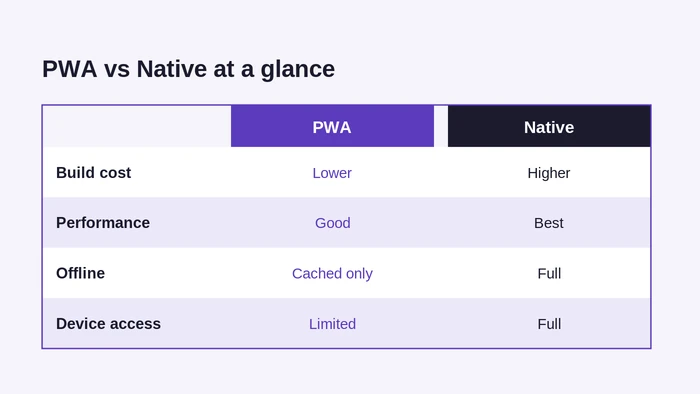
No column is all wins. A PWA trades some device power for reach and lower cost. A native app trades higher cost for performance and full access. Your feature list decides which trade you can accept, and the next four sections walk through the factors that most often tip the balance.
Build cost and time
A PWA usually costs less because one codebase serves every device and there is no app store process to manage. A native app costs more, since you build for each platform or invest in a cross-platform setup. Time to launch tends to follow the same pattern, with a PWA often reaching real users first while a native build is still in review.
Performance and experience
For content, commerce and most business apps, a PWA feels fast enough that users never notice a difference. Native pulls ahead when the work is heavy: rich animation, 3D, live video or constant sensor input. If your core screens are lists, forms, media and checkout flows, a PWA holds up well. If they are frame by frame graphics, native is worth the extra spend.
Device features and offline
Native has full access to hardware and deep offline support, including background tasks that keep running when the app is closed. A PWA covers cached content and basic offline actions, and its device access keeps growing, though it still trails native. If your app must run for long stretches with no signal, or lean on niche hardware, weigh that gap carefully before you commit.
Distribution and updates
A PWA is found through search and shared by link, and it updates the instant you deploy. A native app is found in the store, which aids discovery for some audiences, but every change waits for review. Neither route is better in the abstract. It depends on how your users find, trust and install apps, and how often you plan to ship changes.
Cost and effort: what shapes the budget
Exact prices depend on scope, so treat the figures below as ranges, not quotes. The pattern is steady across projects. A PWA sits at the lower end because one codebase does the work. Native rises with each platform and each advanced feature you add. Our app development cost in the Netherlands guide breaks the numbers down in more detail if you need firm planning figures.
| Factor | PWA | Native app |
|---|---|---|
| Relative build cost | Low to moderate | Moderate to high |
| Time to first launch | Weeks to a couple of months | Several weeks to several months |
| Ongoing maintenance | Lower, one codebase | Higher, per platform or one shared build |
| Reaching both platforms | One build covers both | Two builds, or one cross-platform build |
These ranges move with your feature list. A simple PWA can launch quickly and cheaply, while a feature-rich native app with custom hardware use sits at the top of the range. Match the spend to what the product truly needs at this stage, not to what looks impressive in a pitch deck or on a competitor’s website.
When to choose a PWA
A PWA is the stronger pick in several common cases, most of them driven by reach, speed and cost rather than raw device power.
- Reach matters more than depth: you want anyone to open it from a link, with no install friction.
- Budget or timeline is tight: one codebase costs less and ships faster.
- The app is content or transaction led: news, catalogues, booking, simple accounts.
- You want instant updates without waiting for app store review.
For content and commerce apps that do not lean on the camera or sensors, a PWA often delivers most of the value at a fraction of the cost. It is also a low-risk way to test an idea in the market before you invest in a bigger, heavier build.
When to choose native
Native earns its higher cost when the product genuinely depends on what the device can do.
- Performance is core: games, heavy graphics, real-time or intensive processing.
- You need full hardware access: advanced camera use, Bluetooth, sensors, secure device storage.
- App store presence is part of the strategy: users expect to find you there.
- Rich offline use and background tasks are essential.
If any of these sit at the centre of the experience, a PWA will feel like a compromise, and native is the safer investment. The extra cost buys capability you cannot fully match in the browser, and users will feel the difference in daily use.
When not to use each: the trade-offs
Every choice has a cost, so it helps to name when each model is the wrong one. This keeps the PWA vs native app decision honest rather than driven by preference or by whatever the last competitor shipped.
When a PWA is the wrong choice
Skip a PWA when your product lives on device power or on store trust signals. Heavy games, professional camera tools and apps that must run offline for hours will strain it. If most of your users are on iPhone and rely on push or hardware features, the gaps can hurt. A store listing you cannot easily get from a PWA may also matter for credibility with some buyers.
When native is the wrong choice
Skip native when speed to market and budget outweigh raw power. Paying for two builds to ship a simple catalogue or booking tool is hard to justify to anyone watching the budget. If you need to test an idea fast, or push frequent updates without waiting on review, a native-only plan can slow you down and cost more than the product warrants at this stage.
The middle path: cross-platform native
You do not have to choose between one PWA and two separate native apps. Cross-platform frameworks like Flutter and React Native build a real native app for both iOS and Android from one codebase, which keeps most of native’s power while cutting the cost of covering two platforms. If you are weighing the team side of that, our guide on the cost to hire a Flutter developer sets out the rates.
This middle path suits many businesses. You get app store presence and strong device access without paying for two fully separate builds. Weigh where cross-platform does and does not pay off for your feature set before you commit to it.
Matching the choice to your goals
Behind every build sits a business goal, not just a technical one. A marketing-led product that needs to spread by link and rank in search leans toward a PWA. A premium product that charges for a polished, device-heavy experience leans toward native. Naming the goal first stops the technical debate from going in circles.
Growth channel matters too. If most new users will arrive from search, social posts or ads that open a link, a PWA meets them with no install step. If they will come from app store browsing, or expect to find you there before they trust you, native or cross-platform gives you that shelf space. Map the channel, then pick the build that fits it.
How to decide, step by step
If the PWA vs native app choice still feels close, work through these steps in order. Each one narrows the field before you commit budget to a build.
- List your must-have features and mark which ones need device hardware.
- Check where your users are and which features they expect.
- Set your budget and launch date, then see which model fits.
- Decide whether app store presence matters for your audience.
- If native wins, choose cross-platform first to control cost.
- If it is still unclear, ship a PWA to learn, then revisit.
Most teams find the answer becomes obvious by step three or four. If two models still tie after that, pick the cheaper, faster one and keep the option open to grow into the other as the product proves itself.
A simple decision rule
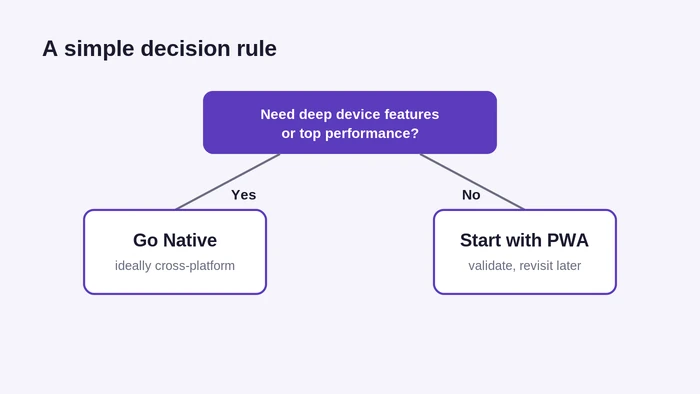
Ask one question first: does the app need deep device features or top performance? If yes, go native, ideally cross-platform to control cost. If no, start with a PWA, prove the demand, and revisit native later if the product grows into it. This keeps the PWA vs native app decision tied to real needs instead of hype or habit.
Common mistakes to avoid
A few recurring mistakes push teams toward the wrong build, or waste budget on the right one. Watch for these before you commit and during the project.
- Choosing native for prestige when a PWA would serve users just as well.
- Picking a PWA for a hardware-heavy product, then hitting limits late in the build.
- Ignoring iOS testing until launch, when some PWA features behave differently there.
- Building two separate native apps when one cross-platform build would do.
- Treating the decision as permanent instead of a stage in the product’s life.
Most of these come from deciding by habit or hype rather than by feature list and audience. Start from what the product must do and who will use it, and the mistakes mostly disappear on their own.
Myths and misconceptions about PWA vs native app
The PWA vs native app debate carries a few myths that lead teams astray. Here are the common ones, with the reality set beside each so you can judge for yourself.
Myth: a PWA is just a website.
A PWA can work offline, send notifications and sit on the home screen with its own icon. It is a website that behaves like an app, not a plain page you scroll and leave. The line between the two is thinner than many teams assume.
Myth: a PWA is always cheaper in the long run.
Usually it costs less, but a PWA that keeps bolting on native-style features can grow complex to maintain. At some point a native or cross-platform build may cost less to run and extend. Cheaper up front is not always cheaper over years.
Myth: native always feels faster.
For heavy graphics, yes. For lists, forms, media and content, a well-built PWA feels just as quick to most users. Perceived speed depends on the workload and the build quality, not on the label you put on the project.
Myth: you must pick one and commit forever.
Many products start as a PWA and move to native later, or run both side by side for different jobs. The decision is a stage in the product’s life, not a life sentence you sign at the start.
A real-world scenario
Picture a Dutch retailer launching a loyalty and booking app. Most customers browse on the move, the budget is tight, and the core features are accounts, a catalogue and simple bookings. None of that leans on advanced hardware or heavy graphics, so the technical bar is modest at this stage.
A PWA fits this stage well. It ships fast, works from a link, updates instantly and costs less to run. The team launches, sees real usage, and learns what customers actually want. Six months in, demand grows for in-store scanning, richer notifications and a smoother checkout that the browser cannot fully deliver.
Now native earns its place. The team moves to a cross-platform build, keeping one codebase while gaining full hardware access and store presence. The PWA proved the idea cheaply, and native scaled it once the numbers justified the spend. That sequence is common, and it beats guessing the answer up front.
One honest caveat about iOS
PWAs have historically worked less fully on iOS than on Android, especially for some notifications and hardware features. Support keeps improving, but if a large share of your users are on iPhone and you rely on those features, test carefully before committing to a PWA. This is the single most common reason a PWA plan changes to native partway through.
Summary
Here is the whole PWA vs native app guide in a few lines, so you can carry the decision without rereading the sections above.
- Pick a PWA for reach, speed and lower cost when device power is not central.
- Pick native for performance, deep offline use, full hardware and store presence.
- Choose cross-platform to get native strength for both platforms from one codebase.
- Test iOS early if your audience skews to iPhone and needs push or hardware.
- Treat the choice as a stage: start lean, then grow into native when it is earned.
Frequently Asked Questions
What is the difference between a PWA and a native app?
A PWA is a website that behaves like an app, installed from the browser with one codebase. A native app is built for iOS or Android, installed from an app store, with full device access and the best performance. The choice trades reach and cost against depth and speed.
Is a PWA cheaper than a native app?
Usually yes. A PWA uses one codebase and skips app store steps, so it costs less to build and update. A native app, or a cross-platform build, costs more but adds performance and full hardware access. Match the spend to the features your product genuinely needs.
Can a PWA work offline?
Yes, for cached content and basic actions once a service worker stores the files. A native app handles offline use and background tasks more fully, which matters when the app must run for long stretches with no connection. For light offline needs, a PWA is usually enough.
Do PWAs work on iPhone?
They do, but historically with more limits than on Android, especially for some notifications and hardware features. Support has improved over time, yet gaps remain. If your users are mostly on iOS and rely on those features, test them on real devices before you decide.
Should I build a PWA or native app first?
If you need to validate demand quickly and do not rely on deep device features, start with a PWA. It ships faster and costs less. If performance or hardware access is core to the product, build native from the start, ideally cross-platform to manage cost.
Can a PWA be listed in an app store?
It can, with extra steps that wrap the PWA for submission, though it is not the default route. Native and cross-platform apps list more directly. If store presence is central to your plan, factor that work in early rather than treating it as free.
Is a PWA good for SEO?
Yes. Because a PWA lives on the open web, search engines can crawl and index its pages like any website. A native app cannot rank that way. If organic search traffic matters to your growth, that visibility is a real point in the PWA column.
How do I choose between a PWA vs native app for my business?
Start from features and users. If the product needs deep hardware or top performance, choose native, ideally cross-platform. If reach, speed and budget lead, choose a PWA. When both tie, ship the cheaper option first and grow into native if real demand appears.
Tushar Patel is a software and AI strategist at Mobilions in Amstelveen, with 10+ years helping businesses build custom software, mobile apps and AI solutions. He writes practical, senior-level guides on development, hiring, and scaling products.