Claude vs Gemini vs ChatGPT for Business: Which AI Model Should You Build On? (2026 Guide)
Claude vs Gemini vs ChatGPT for business is not a question of which chatbot is best; it is a question of which model you build your software, agents and enterprise applications on. The honest answer is that there is no single winner. The right choice depends on your use case, your data, your existing stack and your compliance needs, and many businesses end up using more than one.
This guide is written for CTOs, founders, product managers and operations leaders choosing a large language model to build on, not for consumers picking a subscription. It skips version numbers and leaderboard scores on purpose, because those change monthly.
What does not change is how you make a sound choice, and that is what this guide gives you. Instead it gives you a durable way to decide, with a business decision matrix, use-case comparisons, and the security, cost and lock-in questions that actually matter when you ship a product.
Claude vs Gemini vs ChatGPT for Business: Short Answer
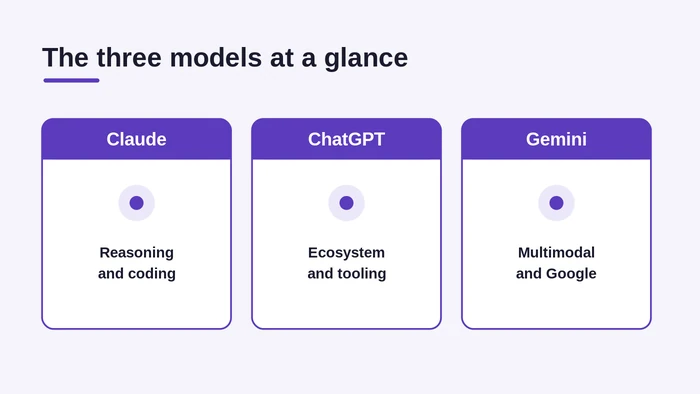
For business builds, choose Claude when reasoning quality, coding and careful, safe output matter most; choose ChatGPT when you want the broadest ecosystem, tooling and versatility; and choose Gemini when multimodal input and tight Google Cloud or Workspace integration are central.
None is best at everything, so match the model to the job, and consider a multi-model setup where different tasks use different models. In other words, Claude vs Gemini vs ChatGPT for business is a portfolio decision as much as a single pick, and the smartest teams keep their options open.
Understanding the Three AI Models
Claude is made by Anthropic and is known for strong reasoning, high-quality writing and code, long-context handling and a safety-first design that enterprises value. ChatGPT is built on OpenAI’s GPT models and offers the widest ecosystem of tools, integrations and developer tooling, which makes it a versatile default for many products. Gemini is Google’s model family, with native multimodal understanding of text, images and audio and deep ties to Google Cloud, Vertex AI and Workspace.
For a business, the important point is that you rarely consume these as a consumer app. You build on them through an API, and often through an enterprise cloud: OpenAI models via Azure OpenAI, Gemini via Google Vertex AI, and Claude via Anthropic, AWS Bedrock or Google Vertex.
That distinction matters, because the enterprise route is where you get data control, EU regions and the contractual terms your legal team needs. It also shapes cost and lock-in later, so decide the route, not just the model, early. A model reached through a cloud you already run often wins on integration and procurement even when another scores marginally higher in isolation.
Treat the three as capable, closely matched engines rather than a fixed ranking. Ranking them in the abstract is a distraction; ranking them for your specific task is the real work. The gap that decides your project is usually not raw model quality; it is fit with your use case, your data and the platform you already run.
This is also why a multi-model strategy is increasingly common. Rather than betting the company on one provider, teams route each task to the model that suits it and keep the option to switch.
Treat the models as interchangeable engines behind a stable interface, so a better or cheaper option next year is a configuration change, not a rebuild. This is the most valuable habit in the whole decision: design for change, because the leader today may not be the leader when your product scales.
Business Use Cases Compared
The clearest way to think about Claude vs Gemini vs ChatGPT for business is by use case, because each model tends to shine in a different kind of work.
| Business use case | Tends to fit best | Why |
|---|---|---|
| Long-form writing and reasoning | Claude | Natural output, strong reasoning, long context |
| Broad product features and tooling | ChatGPT | Widest ecosystem and integrations |
| Multimodal (image, audio, video) | Gemini | Native multimodal, Google integration |
| Coding and developer workflows | Claude | Accurate code, good at agentic tasks |
| Google Workspace and Cloud shops | Gemini | Native fit with existing Google stack |
| Rapid prototyping across many tasks | ChatGPT | Versatile default with mature tooling |
Use this as a starting hypothesis, not a rule. The right test is a small pilot on your own data and workflow, because a model that looks second best on a generic benchmark can be the clear winner on your specific task.
It also helps to separate the model from the surrounding system. Two teams using the same model can get very different results depending on their prompts, their retrieval, their guardrails and their evaluation. The model sets a ceiling; your engineering decides how close you get to it, which is why a use-case comparison is a starting point for a pilot, not a purchase decision on its own.
Coding and Software Development
If you are building developer tools, internal automation or a product with code generation, model choice affects real productivity. Claude has a strong reputation for accurate code, catching bugs on review and handling agentic, multi-step engineering tasks, which is why many teams reach for it in the build. ChatGPT and Gemini are also highly capable, and the difference on a given task is often smaller than the difference your own prompts and tooling make.
What matters more than any leaderboard is how the model fits your engineering workflow: the size of the context window, the reliability of tool and function calling, and how well it integrates with your codebase and CI. For a serious build, evaluate these against your real repositories rather than a demo. When AI is one part of a larger custom software project, the model is a component, and the surrounding architecture decides whether it delivers.
API integration is part of this. Check how the model exposes structured outputs, function calling and streaming, and how its SDK fits your language and framework. A model that is marginally stronger but awkward to integrate can slow a team more than a slightly weaker one that drops cleanly into your stack, and for long-lived products that integration cost compounds.
AI Agents and Automation
Building an AI agent is where model choice gets serious, because an agent does not just answer, it acts. It calls tools, updates systems and runs multi-step workflows, so reliability and controllability matter more than eloquence.
For agents, look at three things: the quality of tool and function calling, how well the model follows instructions without drifting, and how easily you can put a human in the loop for approval on sensitive actions. Claude is often favoured for careful, controllable agents; ChatGPT offers a mature tool-calling ecosystem; Gemini fits when the agent lives inside Google services.
In practice the model is only part of an agent. The AI automation around it, the guardrails, the retries and the monitoring, decides whether it is safe to run in production.
A practical recommendation: start with one model for the agent’s reasoning, keep the tool layer model-agnostic, and design so you can swap the model later. That keeps you flexible as the field moves.
On RAG suitability for agents the same rule applies: ground the agent in your own data through retrieval, and keep that retrieval layer independent of the model. An agent that reasons with one model today and a better one tomorrow should not need its knowledge base rebuilt. Design the memory, the tools and the data as stable services, and let the model be the swappable part.
Customer Support and Internal Knowledge
For customer support and internal knowledge, the model matters less than the retrieval around it. The pattern that works is RAG, or retrieval-augmented generation, where the model answers from your own documents and data rather than its general training. This is how you get accurate, current, on-brand answers instead of confident guesses.
All three models support RAG well, so the decision shifts to your data. Where does your knowledge live, how sensitive is it, and which platform keeps it in the right region under the right contract? A support assistant grounded in your help centre, or an internal assistant grounded in your policies, is usually a generative AI project where the retrieval quality and the data pipeline decide success.
Pick the model that integrates cleanly with where your data already sits. Data ownership is the quiet decider here. Your documents, your embeddings and your conversation logs are valuable assets, and you want them in your own storage, in your region, under your control, not locked inside a vendor’s product. Build the retrieval layer so the knowledge base stays yours regardless of which model answers, and you keep both flexibility and compliance.
Security, Privacy and GDPR
For any European business, security and compliance can outweigh raw capability. The core questions are the same across Claude, Gemini and ChatGPT: where is your data processed, is it used to train the model, can you keep it in EU regions, and what does the contract say.
The safe pattern is to use the enterprise route, where providers commit not to train on your data and offer EU data regions and a data processing agreement. Build on that with your own controls: least-privilege access, logging and a human in the loop for sensitive actions.
The GDPR framework here is enforced by the Dutch Data Protection Authority, and if your system makes or supports decisions, the EU AI Act adds transparency and risk obligations by category. None of this is legal advice, but it belongs at the centre of the decision, not the end.
An experienced AI development company builds these controls in from the start rather than bolting them on. Vendor lock-in is a security and continuity question as much as a commercial one.
If your prompts, your data pipeline and your integrations are wired to one provider’s quirks, switching becomes a project rather than a setting. The defence is an abstraction layer between your application and the model, plus a migration plan you actually test, so a price change, an outage or a better model does not put your product at risk.
Cost Considerations for Businesses
Business cost is not a monthly subscription; it is the cost of tokens at scale plus the engineering to build and run the system. All three families offer a range from cheaper, faster models to premium ones, and a common pattern is to use a smaller model for routine calls and a premium model only where quality justifies it.
The larger truth is that the model is rarely the biggest line in the budget. Integration, data pipelines, testing, guardrails and maintenance usually cost more than the tokens, and a slightly cheaper model that needs more engineering around it can be more expensive overall.
A useful habit is to price a use case end to end: tokens, retrieval, hosting, monitoring and the engineering time to keep it reliable. Seen that way, the gap between the model families is often a small share of the total, which is why capability fit and integration usually matter more than the token rate. Budget the whole system, not the per-token rate, and design so you can move routine work to cheaper models as your volume grows.
Future scalability belongs in the cost conversation too. A design that works at a thousand calls a day can behave very differently at a million, in both latency and bill. Plan for caching, batching, smaller models for routine steps and clear limits, so cost scales sub-linearly with usage. At scale, the cheapest engine in Claude vs Gemini vs ChatGPT for business is the one your architecture uses efficiently, not the one with the lowest headline token price.
Which AI Model Fits Different Business Types?
The best fit changes with the type of organisation, because startups, SMBs and enterprises optimise for different things.
A startup usually wants speed and versatility, so a broad default like ChatGPT, or Claude for a build with heavy reasoning and code, gets a product live fast. An SMB often follows its existing stack: a Google-centred company leans to Gemini, a Microsoft-centred one to OpenAI through Azure.
That alignment is sound engineering, not laziness. Using the model that sits inside your existing identity, billing and security perimeter cuts integration work, simplifies compliance and speeds delivery, which for most SMBs outweighs a small capability edge from a model outside their stack. An enterprise weighs compliance, data residency and procurement as heavily as capability, and frequently runs more than one model behind an internal layer so teams can choose per use case.
Regulated sectors such as finance and healthcare put security and the EU AI Act first, which favours whichever enterprise route gives the strongest data guarantees. Across all of them the same advice holds: do not marry the first model that demos well.
Pick for today’s primary use case, keep the architecture model-agnostic, and revisit the choice on a schedule. The organisations that get the most from AI treat model selection as a living decision, reviewed as the field and their own needs change, rather than a one-time bet.
Decision Matrix
Use this matrix to turn priorities into a starting choice. Find the priority that matters most to you and read across.
| Your top priority | Lean towards | Notes |
|---|---|---|
| Writing and reasoning quality | Claude | Also strong for coding |
| Broadest tooling and ecosystem | ChatGPT | Versatile default |
| Multimodal and Google stack | Gemini | Native Vertex and Workspace fit |
| Careful, controllable AI agents | Claude | Good tool use and instruction-following |
| Microsoft and Azure environment | ChatGPT via Azure | Fits existing enterprise licences |
| Strict data residency and control | Enterprise route on any | Choose by contract and region, not brand |
| Lowest cost at high volume | Smaller model in any family | Reserve premium models for hard tasks |
The matrix gives a hypothesis. Confirm it with a short proof of concept on your real data before you commit an architecture to it.
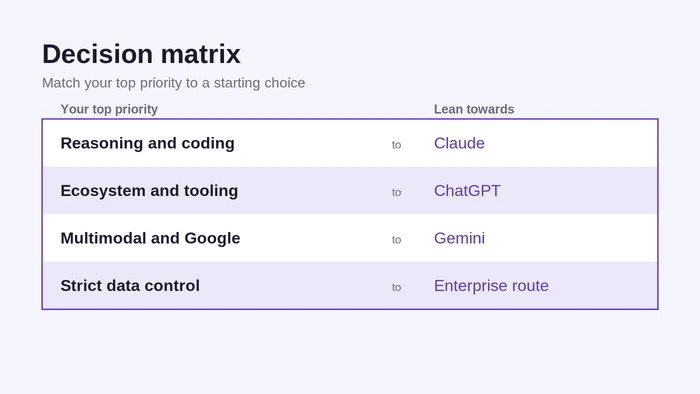
Notice that several rows point to the enterprise route on any provider rather than a single brand. For strict data residency, controllable agents at scale, or a regulated sector, the deciding factor is the contract, the region and the controls, not the logo. The more your priorities lean to security and control, the less the brand matters and the more your architecture does.
How Mobilions Helps Businesses Choose the Right AI Stack
Mobilions builds AI products since 2016, with 10+ years of experience, 25+ engineers and 250+ projects delivered across 20+ countries. Independently reviewed, we score 4.8 on Clutch (35 reviews), with 98% client retention.
We are deliberately model-agnostic. Rather than pushing one vendor, we help you match Claude, Gemini or ChatGPT to your use case, your data and your stack, and we build the retrieval, guardrails and integrations that turn a model into a reliable product.
Where it makes sense, we design a multi-model setup so you are never locked to a single provider. Whether you are building an AI agent or embedding AI in enterprise software, we keep the architecture flexible and the data yours. Read our portfolio to see how we approach it. The goal is always the same: a system that works for your business today and can adopt a better model tomorrow without a rebuild.
Final Recommendation
There is no universal winner in Claude vs Gemini vs ChatGPT for business. Choose by use case first, then by where your data lives and what your stack and compliance demand. Claude leans to reasoning, coding and controllable agents; ChatGPT to the broadest ecosystem; Gemini to multimodal and the Google world.
Three principles keep you safe whatever you pick. Build through the enterprise route so data stays yours and in-region. Keep your tool and data layer model-agnostic so you can migrate as the field moves, because you will.
And start with a small pilot on real data instead of a leaderboard, because your workload, not a benchmark, decides the winner. Plan the migration path before you need it. Keep a thin abstraction over the model, version your prompts, and keep an evaluation set that lets you compare a new model against your real tasks in an afternoon. Do that, and choosing between Claude, Gemini and ChatGPT stops being a high-stakes gamble and becomes a routine, reversible engineering decision.
Want help choosing and building on the right AI model for your business? Contact us for an honest, model-agnostic recommendation. 4.8 on Clutch (35 reviews), 10+ years of experience, 250+ projects delivered.
Frequently Asked Questions
1. Which AI model is best for business?
There is no single best. For business builds, Claude leans to reasoning, coding and controllable agents, ChatGPT to the broadest ecosystem and tooling, and Gemini to multimodal work and the Google stack. Choose by your use case, your data and your existing platform, not by a leaderboard.
2. Should I build my product on Claude, Gemini or ChatGPT?
Match the model to the primary use case, then keep the architecture model-agnostic so you can switch. A stable interface over the model lets a better or cheaper option next year be a configuration change rather than a rebuild, which is the safest way to commit to any of the three.
3. Which LLM is best for coding and software development?
Claude has a strong reputation for accurate code and agentic engineering tasks, though all three are highly capable. What matters more is context window, reliable tool calling and how the model fits your codebase and CI, so evaluate against your real repositories rather than a benchmark.
4. Which AI model is best for building AI agents?
For agents, prioritise tool and function calling, instruction-following and easy human-in-the-loop control. Claude is often favoured for careful, controllable agents, ChatGPT offers mature tooling, and Gemini fits inside Google services. Keep the tool layer model-agnostic so you can swap the reasoning model later.
5. Which model is best for customer support and internal knowledge?
The model matters less than the retrieval. Use RAG so the model answers from your own documents rather than its general training. All three support RAG well, so choose the model that integrates cleanly with where your data already lives, and keep the knowledge base in your own storage and region.
6. How do I handle GDPR and the EU AI Act with these models?
Use the enterprise route, where the provider commits not to train on your data and offers EU data regions and a data processing agreement. Add least-privilege access, logging and human review for sensitive actions. If your system supports decisions, the EU AI Act adds obligations by risk category. This is not legal advice.
7. Can I use more than one AI model (multi-model strategy)?
Yes, and many businesses do. Routing each task to the model that suits it, behind a stable internal interface, avoids betting the company on one provider and lets you use cheaper models for routine work. It also makes switching or adding a model a configuration change rather than a project.
8. How do I avoid vendor lock-in with an LLM?
Put an abstraction layer between your application and the model, keep prompts and the data pipeline provider-neutral, and keep a migration plan you actually test. Then a price change, an outage or a better model is a manageable switch, not a rebuild of your product.
9. What does it cost a business to build on an LLM?
Not a subscription but token cost at scale plus the engineering to build and run the system. All three offer cheaper and premium models, and integration, data pipelines, guardrails and maintenance usually cost more than the tokens. Budget the whole system and use smaller models for routine work.
10. Can I switch AI models later?
Yes, if you design for it. Keep a thin abstraction over the model, version your prompts, and maintain an evaluation set that compares a new model against your real tasks quickly. Done that way, changing models becomes a routine, reversible engineering decision rather than a high-stakes gamble.
Tushar Patel is a software and AI strategist at Mobilions in Amstelveen, with 10+ years helping businesses build custom software, mobile apps and AI solutions. He writes practical, senior-level guides on development, hiring, and scaling products.