How to Choose a Software Development Company: 2026 Guide
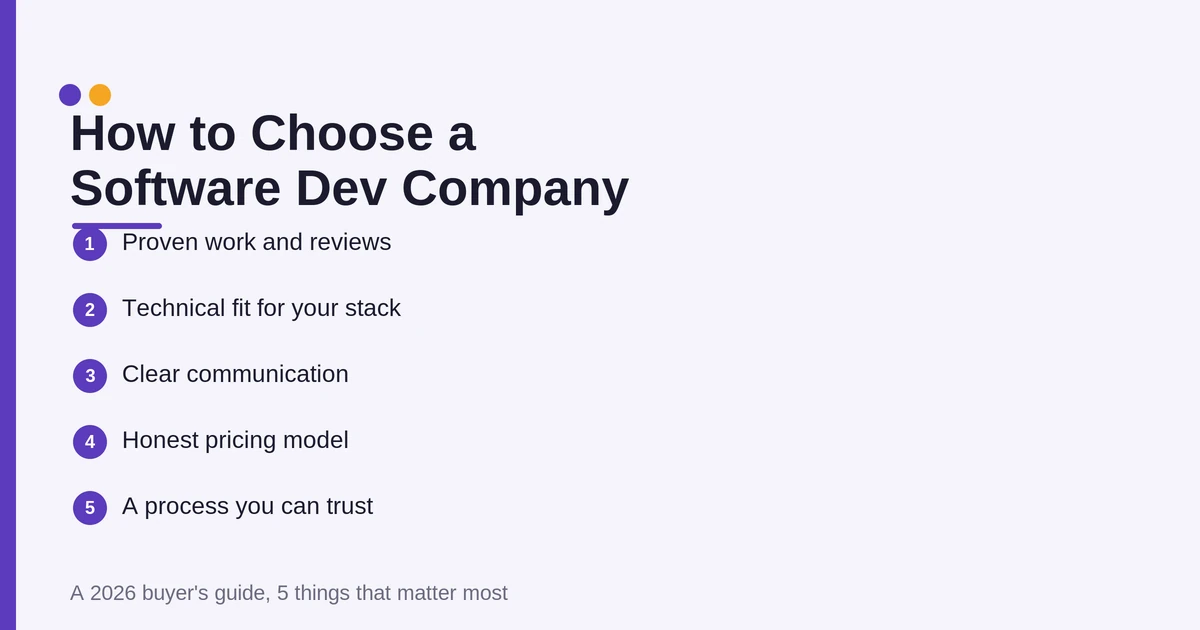
Knowing how to choose a software development company comes down to five things: proven work, technical fit, clear communication, honest pricing, and a way of working you can trust. Get those right and the rest usually follows. Get them wrong and no contract will save the project.
This guide gives you a practical way to compare firms, the questions to ask before you sign, the red flags that predict trouble, and an honest view of when a large agency is not what you need. It is written for founders and business leaders in the Netherlands and Europe who are hiring a partner, not just buying hours.
How to choose a software development company: the short answer
To choose a software development company, shortlist three to five firms, check real case studies and independent reviews, run a small paid trial or workshop, and compare how they communicate as closely as what they quote. The best partner is rarely the cheapest or the biggest. It is the one whose experience matches your problem and whose process you can live with for months.
Everything below turns that idea into concrete steps, tables, and checklists you can act on this week.
Key takeaways
- Shortlist three to five firms, then judge them on evidence rather than sales polish.
- Proven case studies and independent reviews matter more than a long technology list.
- Match the pricing model to how certain you are about scope.
- Watch for red flags like rock-bottom quotes, vague timelines, and no references.
- A short paid discovery workshop tells you more than any pitch deck.
- The right partner fits the size and stage of your project, not the other way around.
What a software development company actually does
Before you compare firms, it helps to know what a good partner really provides. Software development is not only writing code. A capable firm guides strategy, delivery, and support across the life of a product. Understanding these layers helps you judge whether a firm can carry your project from idea to launch and beyond.
Product strategy and discovery
Strong partners start by questioning the problem, not the feature list. They run discovery, map user needs, and challenge assumptions that would waste your budget. This early thinking shapes scope and saves money later. A firm that skips straight to a quote without understanding your goals is guessing, and you will pay for those guesses in rework.
Engineering and delivery
This is the core: architecture, coding, testing, and release. Good teams work in short cycles, show progress often, and keep quality visible through code review and automated tests. Ask how they plan sprints, track bugs, and decide what ships. Delivery habits separate firms that talk well from firms that build well, and the gap only shows once work starts.
Support and maintenance
Software is never finished at launch. It needs updates, security patches, and small fixes as usage grows. A partner worth keeping plans for this from day one and is clear about response times and costs. Ask what support looks like after go-live, because a build with no maintenance plan quietly becomes your problem the moment real users arrive.
Why the choice matters more than the price
Learning how to choose a software development company is less about finding the lowest quote and more about matching a team to your problem. A weak fit shows up months later as missed deadlines, rewritten code, and quiet frustration. A strong fit compounds the other way. The right partner reduces risk, protects your budget, and turns a rough idea into something people actually use.
How to build your shortlist
A good shortlist has three to five firms, no more. Beyond that, comparison turns into noise. Start with referrals from people you trust, then add firms with strong verified reviews and relevant case studies. Screen out anyone who cannot show work close to your problem, because a firm outside its depth is a risk you do not need.
Keep a simple table as you go: firm, relevant work, review score, first impression, and open questions. The act of filling it in forces honesty and stops one smooth sales call from skewing the whole decision.
How to choose the right partner step by step
The five steps below take you from a vague need to a signed partner you trust. Work through them in order. Each one narrows the field and lowers the chance of an expensive mistake.
Step 1: Define what you actually need
Before you talk to anyone, write down the problem, the outcome you want, your rough budget range, and your timeline. A firm that fits a simple mobile app may be wrong for a complex data platform. Clarity here changes how you compare firms, because it lets you judge them on the work that matters instead of on sales polish.
If you are unsure of budget, read our guide on app development cost in the Netherlands to set a realistic range first.
Step 2: Check real work, not just claims
Any firm can call itself expert. Proof is different. Look for case studies with specifics: the problem, the approach, the result, and ideally a named client. Then check independent reviews on a platform like Clutch, where feedback is verified rather than self-published.
- Ask to see work in your industry or a close one.
- Ask what went wrong on a past project and how they handled it.
- Look for clients who stayed for more than one project, since retention is a strong trust signal.
A firm that shows outcomes and admits trade-offs is safer than one with only glowing, vague praise.
Step 3: Judge technical fit
The right partner should match your stack and your problem, not just have a long technology list. Ask which languages and frameworks they use daily, how they handle testing, security, and code review, and who actually writes the code. Some firms win the pitch with seniors, then staff the work with juniors.
- Confirm the team you meet is the team you get.
- Ask about security practices and standards such as ISO 27001 if your data is sensitive.
- Ask how they document and hand over code, so you are never locked in.
Step 4: Test communication and process
Most failed projects fail on communication, not code. Before committing, judge how a firm works. Do they reply clearly and on time? Do they ask sharp questions about your business, or just nod? A short paid discovery workshop is the best test there is, because it shows you the working relationship for a small, contained cost.
Agree upfront on how you will meet, who your main contact is, and how progress is shown. A partner that works in short cycles with regular demos is easier to steer than one that disappears for a month.
Step 5: Understand pricing models
Price matters, but the model matters more. Match the pricing model to how certain you are about scope. The table below sums up the three you will meet most often.
| Model | Best for | Watch out for |
|---|---|---|
| Fixed price | Small, well-defined projects | Change requests cost extra, less flexible |
| Time and materials | Evolving scope, ongoing work | Needs trust and active oversight |
| Dedicated team | Long-term products | You manage priorities, they supply the team |
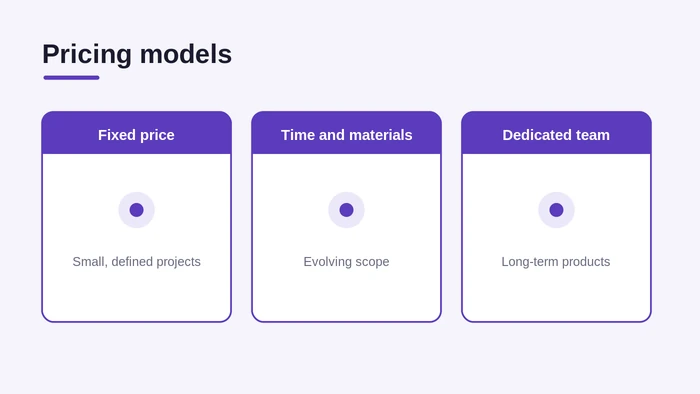
Fixed price gives certainty when the scope is clear. Time and materials fits work that will evolve. A dedicated team suits a long product roadmap. For that last model, our guide on how to hire dedicated developers explains the details.
Step 6: Run a small paid trial
Before a full commitment, buy a small, contained piece of work. A paid discovery workshop, a technical spike, or a first sprint shows you the team in action for a low, bounded cost. You see how they plan, communicate, and handle feedback. It is the cheapest insurance you can buy against a bad multi-month decision.
Treat the trial as a two-way interview. You are testing them, and a good firm is testing whether your project fits its strengths. If either side hesitates after a trial, that is useful information, not a failure. Better to learn it in a week than in a quarter.
A quick comparison checklist
Once you have a shortlist, score each firm against the same criteria. The checklist below uses qualitative ranges rather than fixed figures, because the right answer depends on your project. Use it to compare like with like and to spot gaps before they cost you.
| Criterion | What good looks like | Effort to verify |
|---|---|---|
| Relevant case studies | Two or more in a similar domain | Low to moderate |
| Independent reviews | Verified, recent, and detailed | Low |
| Technical fit | Daily use of your core stack | Moderate |
| Communication | Clear replies, sharp questions | Low to moderate |
| Pricing transparency | Model and assumptions in writing | Low |
| Security posture | Named standards and practices | Moderate to high |
| Retention signals | Repeat clients and long engagements | Moderate |
No firm scores perfectly. What matters is where the gaps sit and whether you can accept them. A weak review profile on a strong referral may be fine. A vague answer on security for a health or finance product is not.
Common mistakes buyers make
Many buyers approach how to choose a software development company as a pure price comparison, and that is the first mistake. The cheapest quote often hides a thin scope. Below are the errors that sink projects most often, so you can catch them early.
Chasing the lowest price
A quote far below the rest is rarely a bargain. It usually signals a misread scope, junior staffing, or costs that appear later as change requests. Compare value and clarity, not just the headline number. The real price is what you pay to finish, not what you pay to start.
Skipping references
It is tempting to trust a polished deck and move on. References take effort to chase, so many buyers skip them. That is a costly shortcut. A ten-minute call with a past client tells you more about delays, communication, and support than any sales meeting ever will.
Ignoring the working relationship
You will spend months with this team. If early emails are slow or vague, that will not improve after you sign. Treat the sales phase as a preview of delivery. How a firm behaves when it wants your business is the best behaviour you will ever see from it.
Buying more than you need
A large agency can feel like the safe choice, yet a small project may get lost inside it. Paying for scale you do not use is waste. Match the firm to the size and stage of your work, not to the size of its logo or the length of its client list.
Rushing the timeline
Pressure to start fast leads to skipped references, thin scoping, and regret. A week spent choosing well saves months of rework. Give the decision the time it deserves, and be wary of any firm that pushes you to sign before you have compared it fairly with others.
A short real-world scenario
Picture a Dutch retailer that needs a booking app. Two firms bid. One is cheaper and answers within a day, but never asks about the checkout flow. The other quotes higher, runs a paid half-day workshop, and returns with a scope that removes two costly features.
The retailer picks the second firm. The workshop already paid for itself by cutting waste, and the sharp early questions signalled a team that would push back when it mattered. Six months on, the app ships close to plan. Price lost to fit, and fit won.
Red flags to walk away from
Some warning signs predict trouble no matter how good the pitch looks. Any one of these deserves a pause. Two or more, and you should walk.
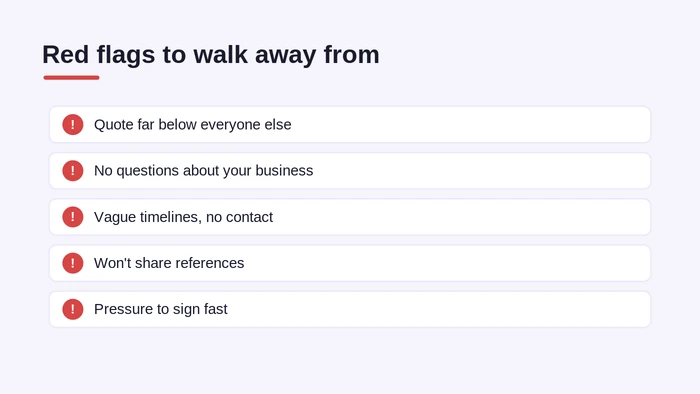
- A quote far below everyone else, which usually means a thin scope or hidden costs.
- No questions about your business, only about features.
- Vague timelines and no clear point of contact.
- Reluctance to share references or real case studies.
- Pressure to sign quickly, when good firms have a pipeline and do not need to rush you.
Questions to ask before you sign
Bring these to every shortlist call. The answers, and how freely they are given, tell you as much as the words themselves.
- Who exactly will work on my project, and what is their experience?
- Can I speak to a past client with a similar project?
- How do you handle scope changes and delays?
- What happens to the code and accounts if we part ways?
- How do you test, secure, and document what you build?
- What does support look like after launch, and what does it cost?
Signs you have found the right partner
Red flags get attention, but green flags matter just as much. A strong partner shows a pattern of good signs, not one impressive moment. Watch for the habits below across your early conversations.
- They ask harder questions about your business than you expected.
- They push back on scope when it protects your budget.
- References answer quickly and speak in specifics, not slogans.
- Estimates come with assumptions written down, not just a number.
- The people in the pitch are the people who will build the work.
One green flag is easy to fake. A consistent pattern is not. Look for firms that behave the same way in the second meeting as in the first, and that stay clear when the questions get uncomfortable.
Local, nearshore, or offshore
Location shapes cost, time zone, and oversight. It is part of the decision, not a detail. The table below shows the main trade-off for each option.
| Option | Trade-off |
|---|---|
| Local (Netherlands) | Same time zone and culture, highest rate |
| Nearshore (EU) | Small time difference, good value |
| Offshore (further afield) | Lowest rate, more oversight and time-zone gap |
Many strong partners blend models, with local project leads and a nearshore or offshore build team. That mix can hold cost down while keeping communication close. Our guide on software development outsourcing covers how that works in practice.
When you do not need a big agency (and other trade-offs)
The largest firm is not always the right one. If your project is small or early, a big agency can be slow and expensive, and your account may not get senior attention. A focused mid-size firm or a dedicated team often ships faster and cares more about the outcome.
Every choice carries a trade-off. A cheaper offshore team saves money but asks for more oversight and patience with time zones. A local partner is easy to reach but costs more. A fixed-price contract feels safe yet resists change. Name the trade-off you can live with before you sign, rather than pretending one does not exist.
There are also times to pause hiring altogether. If your requirements are still shifting weekly, a short discovery engagement beats a full build. If an in-house hire would serve a long roadmap better than an agency, say so. The honest answer is sometimes not yet.
Myths and misconceptions
A few beliefs lead buyers astray. Clearing them up makes the whole decision simpler.
Myth: the biggest firm is the safest
Size buys process and depth, but it can also bring slow decisions and junior staffing on smaller accounts. Safety comes from fit and proof, not headcount. A right-sized team that knows your domain often carries less risk than a household name with a thin bench.
Myth: a higher price guarantees quality
Price signals nothing on its own. Some expensive firms coast on reputation, and some mid-priced teams overdeliver. Judge quality by evidence: case studies, reviews, and how a team answers hard questions. Let price inform the decision, not decide it for you.
Myth: offshore always means lower quality
Location does not set skill. Many offshore and nearshore teams match local quality and communicate well. The real variable is process and clarity. A well-run distributed team can beat a disorganised local one, as long as you accept some time-zone overhead.
Myth: you must pick the firm with the longest tech list
A long list of languages and tools looks reassuring, yet it can signal a firm that spreads thin. What matters is depth in the stack your project needs, not breadth across every trend. Ask what they use daily and ship to production, not what they could use in theory.
Myth: the contract will protect you
A contract sets boundaries, but it cannot rescue a poor relationship. By the time you are reading clauses to each other, the project is already in trouble. Trust, communication, and a shared understanding of scope prevent far more problems than any clause ever will.
Summary: choosing with confidence
The decision rests on evidence, fit, and honesty. Work through the steps, use the checklist, and trust what firms show over what they claim. Keep these points close as you compare.
- Define the problem and budget before you contact anyone.
- Judge proof, technical fit, and communication above price.
- Match the pricing model and location to your project’s certainty and stage.
- Run a small paid trial to preview the real relationship.
- Walk away from rock-bottom quotes, vague timelines, and missing references.
Work with Mobilions
Mobilions has delivered 250+ projects for clients in 20+ countries since 2016, with a team of 25+ engineers rated 4.8 out of 5 on Clutch across 35 reviews and 98% client retention. If you are weighing how to choose a software development company, we are happy to be one of the firms you compare.
From our offices in Amstelveen and Ahmedabad, we build custom software for founders and teams across Europe. Explore our custom software development services or book a short discovery call to test the fit before you commit.
Frequently Asked Questions
How do I choose a software development company?
Define your problem and budget, shortlist three to five firms, check real case studies and independent reviews, run a small paid trial, and compare communication as closely as price. The best fit matches your problem and your way of working, not the biggest name or the lowest quote on the table.
What should I look for in a software development partner?
Look for proven work in a similar area, a clear technical fit, honest pricing, and strong communication. Good client retention and verified reviews matter more than a polished sales deck. Ask who will actually write your code, and confirm that the team you meet is the team you get.
How much does it cost to hire a software development company?
It depends on scope, seniority, and location. Rates range widely across local, nearshore, and offshore teams, so compare bands rather than single figures. Agree the pricing model, whether fixed, time and materials, or dedicated team, before you compare quotes, because the model shapes the final cost more than the headline rate.
What are the biggest red flags?
A price far below the rest, no questions about your business, vague timelines, no references, and pressure to sign fast. Any one of these is worth a pause, and two or more is a reason to walk away. Good firms have a pipeline and do not need to rush you.
Is offshore development a good idea?
It can be, if the firm communicates well and you accept some time-zone overhead. Many companies blend local leads with a nearshore or offshore build team to balance cost and control. Judge the process and clarity, not the location, and ask for references from similar distributed projects.
How do I compare software development quotes fairly?
Put every quote on the same scope and pricing model, then read what each one assumes. A low number with a thin scope is not cheaper once change requests arrive. Compare inclusions, support, and assumptions, not just the total, and ask each firm to explain what would push the price up.
Should I hire a local or nearshore team?
Local teams share your time zone and culture but cost more. Nearshore teams sit close in time zone and often give good value. Many buyers blend the two, with a local lead and a nearshore build team. Match the choice to how much daily contact your project really needs.
How long does it take to select a development partner?
Most buyers need two to four weeks to shortlist, review proof, run a discovery call, and compare quotes. Rushing it is the risk, not taking the time. A short paid workshop can add a week yet save months, since it reveals the working relationship before you fully commit.
Tushar Patel is a software and AI strategist at Mobilions in Amstelveen, with 10+ years helping businesses build custom software, mobile apps and AI solutions. He writes practical, senior-level guides on development, hiring, and scaling products.