App Development Cost in the Netherlands (2026): What You’ll Actually Pay
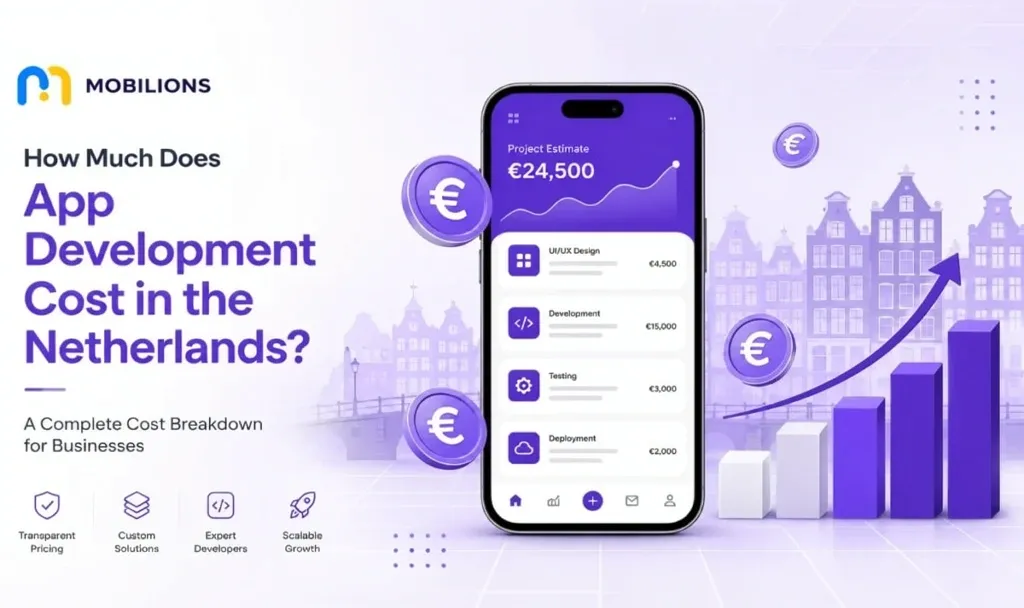
Most “app cost” articles give you a number so wide it’s useless: somewhere between five thousand and half a million euros. That’s technically true and completely unhelpful. This guide does the opposite: This guide does the opposite: it breaks down what actually drives app development cost, what a real app costs in the Netherlands in 2026
We build apps for Dutch and EU businesses every week, so these are working numbers, not a sales brochure. You’ll also find what nobody puts in their pricing pages: the hidden running costs, the timelines, and the situations where our honest advice is not to build an app at all.
The short answer
In 2026, a custom mobile app in the Netherlands typically costs between €5,000 and €150,000+, depending on complexity:
- Simple app (a few screens, one platform, basic backend): €5,000 – €25,000
- Medium app (custom features, API, two platforms, login, payments): €25,000 – €50,000
- Complex app (real-time data, AI features, integrations, high scale): €50,000 – €150,000+
A focused first version (MVP) usually starts at the lower end so you can launch, learn, and invest more once it’s proven.
How long does app development take?
Building a custom app takes 6 weeks to 6+ months in practice, depending on scope. An MVP is typically live in 6 to 10 weeks; a medium two-platform app takes 3 to 5 months; complex products with integrations, AI features or compliance requirements run 5 months and beyond.
The biggest schedule risk is rarely engineering. It’s unclear scope and slow decisions. A fixed scope agreed before the build protects both the timeline and the budget.
What actually drives the cost
App development cost isn’t about how “big” the app feels. It comes down to a handful of real factors.
1. Number of features (and how custom they are)
A login screen is cheap. A login that ties into your existing CRM, supports single sign-on, and handles role-based access is not. Every feature has a “standard” version and a “your-business” version, and the gap between them is where budgets move.
2. Platforms: iOS, Android, or both
Building separately for iOS (Swift) and Android (Kotlin) gives the deepest quality but roughly doubles the front-end work. Cross-platform tools like Flutter or React Native build both from one codebase and usually cut that part of the cost by 30 to 40%, which is why most Dutch business apps go cross-platform unless they need heavy native features.
3. The backend nobody sees
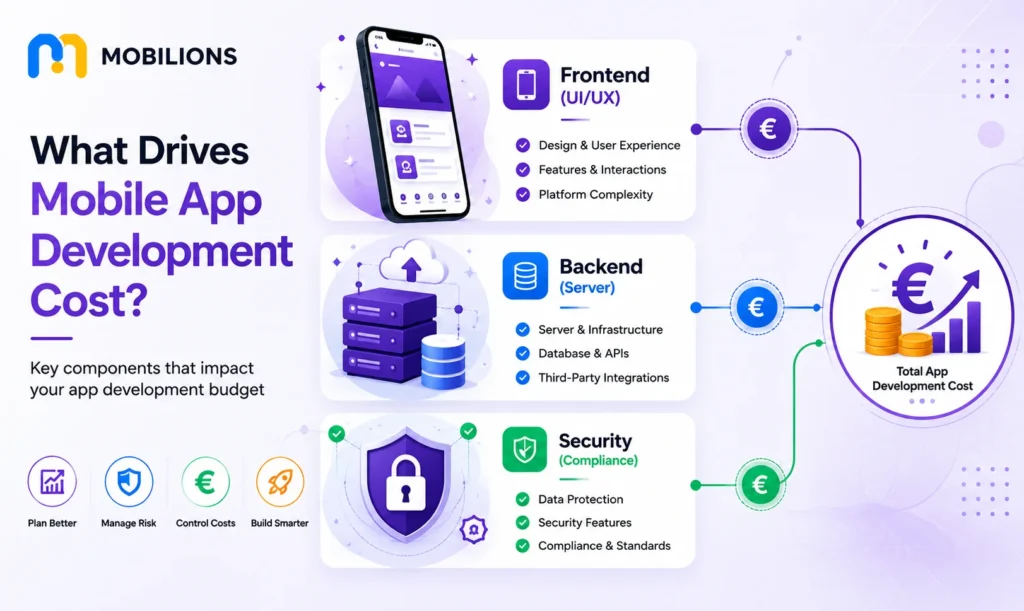
Almost every app needs a server behind it: the API, the database, authentication, and the admin panel your team uses. This is often a third of the total and is the part clients most often forget to budget for.
4. Design and UX
A template looks like a template. Real user research, a proper design system, and tested prototypes cost more upfront but save expensive rebuilds later.
5. Compliance (GDPR/AVG, and now the EU AI Act)
Any app handling Dutch users’ data must meet GDPR and the Dutch AVG. The Autoriteit Persoonsgegevens publishes the guidance that applies. If your app uses AI, the EU AI Act (key rules enforced from August 2026) adds transparency and governance requirements. Building this in from day one is far cheaper than retrofitting it after launch.
6. Who builds it
A freelancer is cheapest per hour and riskiest overall. A large agency is most expensive. A focused senior team usually lands in between, with the advantage that the same people own design, app, and backend, so nothing gets lost in handover.
Cost by app type (real ranges)
| App type | Typical range (NL, 2026) | Typical timeline |
| MVP / proof of concept | €5,000 – €20,000 | 6 – 10 weeks |
| Internal business tool | €20,000 – €30,000 | 2 – 4 months |
| Marketplace / booking app | €30,000 – €60,000 | 3 – 5 months |
| FinTech / payments app | €60,000 – €150,000+ | 4 – 7 months |
| Healthcare app (compliant) | €60,000 – €150,000+ | 4 – 7 months |
| AI-powered app | €50,000 – €150,000+ | 3 – 6 months |
These assume both platforms plus a backend, and are indications (2026 price level); a fixed quote always follows a scoped discovery. A single-platform MVP costs less.
Want to know where your idea lands in this table? Ask us for a free estimate. You’ll get an honest answer, including “start smaller” when that’s the better advice.
Where the money goes: cost breakdown by phase
| Phase | Share of budget | What you get |
| Discovery & scoping | 5 – 10% | Fixed scope, priorities, technical plan |
| UX/UI design | 10 – 20% | Researched flows, design system, prototype |
| App development | 35 – 45% | The iOS/Android or cross-platform app itself |
| Backend & integrations | 25 – 35% | API, database, admin panel, external systems |
| Testing & launch | 10 – 15% | QA, store submission, monitoring setup |
Two things stand out. The visible app is less than half the work. And skimping on the first 10% (discovery and design) is what makes the other 90% expensive.
Native or cross-platform: the cost decision
Cross-platform development builds iOS and Android from one codebase and is the cheaper route for most business apps. Native development costs more but delivers the deepest device access and performance.
| Cross-platform (Flutter / React Native) | Native (Swift / Kotlin) | |
| Codebases | One for both platforms | Two, built separately |
| Front-end cost | 30 – 40% lower | Highest |
| Performance | Excellent for most business apps | Maximum |
| Device features | Broad support | Deepest access |
| Best for | Business apps, MVPs, marketplaces | AR, heavy graphics, hardware-intensive apps |
In practice, most Dutch business cases point to Flutter or React Native; we recommend native only when the feature set genuinely demands it, advice that regularly saves clients tens of thousands of euros.
- Maintenance: budget roughly 15 to 20% of build cost per year for updates, OS changes, and fixes.
- App store fees: Apple and Google developer accounts, plus their cut on in-app payments.
- Third-party services: maps, SMS, payment gateways, AI model usage. These are monthly bills, not one-offs.
- Scaling: an app that’s cheap at 100 users can get expensive at 100,000 if nobody planned for it.
An honest proposal names these numbers before you sign, not after launch. If a quote you received doesn’t mention maintenance at all, ask why.
How to spend less without cutting corners
Five decisions keep app development cost under control without hurting quality:
- Start with an MVP. Build the core, launch, and let real usage decide what to fund next.
- Go cross-platform unless you genuinely need native depth; Flutter or React Native saves real money.
- Use one team for app + backend. Coordinating three vendors costs more than the savings.
- Fix scope before building. Most overruns come from decisions changed mid-build, not from the original plan.
- Get a fixed proposal first. A clear scope and price beats an open hourly meter.
How the process works, step by step
This is how a typical app project runs with a professional team:
- Discovery and fixed scoping
- UX/UI design and prototype
- Build: app, backend and integrations
- Testing and store submission
- Launch, monitoring and iteration
You see working software early and steer between steps, not a single “big reveal” after months of silence. Our app development approach is deliberately iterative for exactly that reason.
When you shouldn’t build an app (yet)
Sometimes the honest answer is: don’t build it yet. If the problem is unvalidated, a landing page or no-code prototype tests demand for a fraction of the price. If your users live on desktop during work hours, a web application often beats a mobile app. And if the budget only covers the build but not the year of maintenance after it, the plan needs revisiting before any code is written.
Saying this costs us projects occasionally. It also produces clients who come back, which we consider the better deal.
What this looks like at Mobilions
We usually begin with a small, fixed-scope discovery, then give you a written proposal in euros: scope and price set out plainly, no hourly meter, no surprises on the invoice. The same senior team handles app development, the backend, and, where you need it, custom software around it. If a simpler approach saves you money, we’ll say so before you commit.
Mobilions is a software engineering company founded in 2016, with 10+ years in business, 250+ projects shipped across 20+ countries, 100+ products live today, and a 4.8 rating on Clutch from 35 reviews. Our team of 25+ engineers works GDPR/AVG-compliant with EU data regions as standard, from our office in Amstelveen. You can see how we take products from idea to production in our portfolio.
Planning an app and want a real number?
Tell us what you’re building and a senior engineer will reply within one business day with an honest estimate of scope, timeline and cost, with no obligation. Get a free estimate.
Mobilions · 4.8 on Clutch (35 reviews) · 250+ projects in 20+ countries · Amstelveen office · GDPR/AVG and EU data regions as standard.
Frequently Asked Questions
How much does it cost to build an app in the Netherlands in 2026?
Most custom apps cost between €5,000 and €150,000+, depending on features, platforms, backend and compliance. A focused MVP usually starts at €5,000 to €20,000, while complex FinTech, healthcare or AI apps reach the upper end. A fixed estimate follows a short discovery call.
How long does it take to develop an app?
An MVP is typically live in 6 to 10 weeks, a medium two-platform app takes 3 to 5 months, and complex apps with integrations or compliance requirements run 5 months or more. Unclear scope and slow decisions delay projects more often than engineering does.
Is cross-platform cheaper than native app development?
Usually yes. Cross-platform tools like Flutter and React Native build for iOS and Android from one codebase, cutting front-end cost by roughly 30 to 40%. Native development with Swift or Kotlin costs more but gives the deepest device access. The right choice depends on features, performance needs and budget.
Why is the backend such a big part of app cost?
Because the app you see is only half the product. The API, database, authentication and admin panel behind it often make up a third of the total. Skipping this in your budget is the most common reason quotes feel too low at first.
What does an MVP app cost?
A focused MVP typically costs €5,000 to €20,000 in the Netherlands and is live within 6 to 10 weeks. It covers the core feature set on one or both platforms with a basic backend, so you can validate demand before investing further.
How much does app maintenance cost per year?
Budget roughly 15 to 20% of the original build cost per year. That covers OS updates, security patches, bug fixes and small improvements. Third-party services such as maps, payment gateways and AI model usage come on top as monthly costs.
Does GDPR or the EU AI Act increase app development cost?
A little, but far less than fixing it later. GDPR/AVG data handling and, for AI apps, EU AI Act transparency rules (enforced from August 2026) are cheaper to build in from the start than to retrofit after launch.
Is app development in the Netherlands more expensive than offshore?
Dutch and EU-based teams charge more per hour than offshore, but offer real-time collaboration, EU data handling and easier compliance. Many businesses land in between: an EU-based senior team with efficient delivery, which keeps total cost of ownership competitive.
Fixed price or hourly rate: which is better for an app project?
For a defined scope, a fixed proposal protects your budget and forces clarity before the build starts. Hourly works for ongoing evolution after launch. Beware of open hourly meters on loosely defined projects; that is where most overruns live.
How can I reduce my app development cost?
Start with an MVP, choose cross-platform where it fits, use one team for app and backend, lock the scope before building, and get a fixed-price proposal. These five choices remove most of the budget risk.
Tushar Patel is a software and AI strategist at Mobilions in Amstelveen, with 10+ years helping businesses build custom software, mobile apps and AI solutions. He writes practical, senior-level guides on development, hiring, and scaling products.