Hire Front-End Developers: Skills, Cost and How to Choose
To hire front-end developers well, you need to know three things: which skills actually matter, what they cost, and which hiring model fits your situation. This guide walks through all three, so you can pick the right person or team instead of the first CV that lands.
It covers the core skills to look for, real 2026 rates for the Dutch market, the difference between a freelancer, an agency and an in-house hire, interview questions, and an honest view of when you should not hire a dedicated front-end developer at all. Ready to hire directly? You can hire front-end developers through Mobilions and skip to a shortlist.
How to hire a front-end developer: the short answer
To hire a front-end developer, define whether you need a generalist or a specialist, choose a model (freelance, agency or in-house), and screen on real skills rather than buzzwords. For a short, defined job a freelancer is usually enough; for ongoing work a dedicated developer or team pays off.
Expect Dutch rates of roughly €50 to €85 per hour for a mid-level front-end developer. The rest of this guide turns that into a concrete decision, with the skills, the numbers and the trade-offs laid out.
What does a front-end developer do?
A front-end developer builds the part of a website or app that people actually see and use: the layout, the styling, the interactions and the performance. They turn a design into working, responsive screens that behave well on every device.
Good front-end work is more than making things look right. It covers accessibility so everyone can use the product, performance so pages load fast, and clean code so the next developer can build on it. When you hire front-end developers, you are really buying the quality of the user experience your customers feel every day.
Front-end sits next to two neighbours. Back-end developers build the server, database and logic behind the screen, while full-stack developers cover both sides.
Knowing where your gap is tells you who to hire. A front-end developer also lives at the design handoff, taking a Figma file and turning it into pixel-accurate, maintainable code, so an eye for design and a habit of asking the right questions early both count. In day-to-day work that means translating a design into components, wiring up state and data, testing across browsers, and watching load speed and accessibility as the product grows.
Key skills to look for when you hire front-end developers
When you hire front-end developers, screen for a core set of skills rather than a long list of trendy tools. The fundamentals below matter far more than any single framework.
| Skill | Why it matters |
|---|---|
| HTML | Structure and semantics of every page |
| CSS | Styling, layout and responsive design |
| JavaScript | Interactivity and application logic |
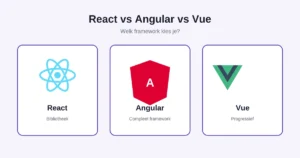
| React, Vue or Angular | Modern component-based interfaces |
| Accessibility | Usable for everyone, and legally required |
| Performance | Fast loading and smooth interaction |
| Version control with Git | Safe collaboration in a team |
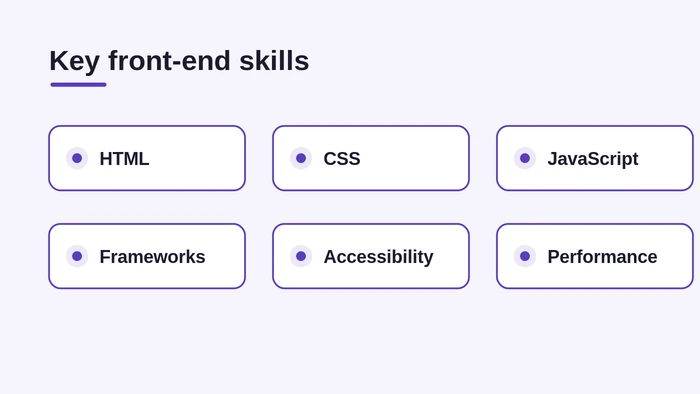
A strong front-end developer is fluent in HTML, CSS and JavaScript first, and then in one modern framework. Frameworks change; the fundamentals do not. That is why, when you hire front-end developers, testing the fundamentals in a short task beats counting the frameworks on a CV.
Someone who understands the box model, the cascade and how the browser renders a page will pick up any framework quickly, while someone who only knows one framework often struggles when it goes out of fashion. Communication matters just as much. A front-end developer works with designers, back-end developers and product people, so explaining trade-offs and taking feedback is part of the skill set, not a nice-to-have.
Hire a front-end CSS developer or a full-stack developer?## Junior, mid-level or senior: which do you need?
Not every job needs a senior, and matching seniority to the work saves money and frustration on both sides.
A junior front-end developer fits well-defined tasks under guidance and costs less, but needs review and mentoring. A mid-level developer works independently on most features and is the workhorse of a typical team. A senior sets the architecture, mentors others and solves the hard problems, and earns the higher rate when quality, performance or a design system are on the line.
A common mistake is hiring a senior for junior work, or the reverse. If you have a lead who can guide, a mid-level or junior hire stretches your budget further. If you have no one to guide them, pay for the senior who needs no guiding. For many teams the sweet spot is a strong mid-level developer with occasional senior review, which balances cost against quality.
Hire a front-end CSS developer or a full-stack developer?
If styling, layout and pixel-perfect responsive design are your priority, hire a front-end CSS developer; if you also need server logic and databases, a full-stack developer is the better fit. Most teams need one clearly more than the other, so name the gap before you write the job post.
A front-end CSS developer specialises in the visual and interactive layer: turning designs into clean, accessible, responsive interfaces with excellent CSS. This is the person you want when your product looks off on mobile, your design system is a mess, or your pages are slow because of bloated styles. If that is your pain, hire a front-end CSS developer rather than a generalist who touches everything but masters nothing.
A full-stack developer, by contrast, spreads across front-end and back-end. That breadth is useful for a small team or an early product, but it usually means less depth in advanced CSS and front-end performance.
For a larger product, a dedicated front-end development specialist alongside a full-stack developer is often the stronger combination. The rule of thumb: hire for depth where users feel it, and for breadth where they do not. If your interface is your product, that depth is not a luxury; it is the thing customers judge you on.
Ways to hire: freelance, agency or in-house
There are three common ways to hire front-end developers, and the right one depends on how long and how much work you have.
| Option | Best for | Watch out for |
|---|---|---|
| Freelancer | Short, well-defined tasks | Availability and continuity |
| Agency or dedicated team | Ongoing work or a full team | Higher day rate |
| In-house hire | Long-term core capability | Recruitment time and fixed cost |
A freelancer is fast and flexible for a bounded job, but you carry the risk if they are sick or move on. An agency or dedicated team gives you continuity, a vetted bench and someone else handling replacement and management, at a higher rate. An in-house hire makes sense when front-end is a permanent, core part of your business and you can keep that person busy and growing.
Many companies mix these. They keep one in-house lead for direction and add agency or back-end developers for peaks, so they scale without over-hiring. The mix also de-risks knowledge: if one person leaves, the work does not stop, because the partner or team carries the context.
What does it cost to hire a front-end developer?
To hire a front-end developer in the Netherlands costs roughly €50 to €85 per hour for a mid-level profile, with seniors and specialists higher and nearshore options lower.
| Model | Indicative rate |
|---|---|
| Nearshore front-end developer | €30 to €50 per hour |
| Front-end developer (NL) | €50 to €85 per hour |
| Senior developer (NL) | €110 to €140 per hour |
| Zzp average | €90 to €95 per hour excl. VAT |
| In-house, salaried | €50,000 to €80,000 per year |
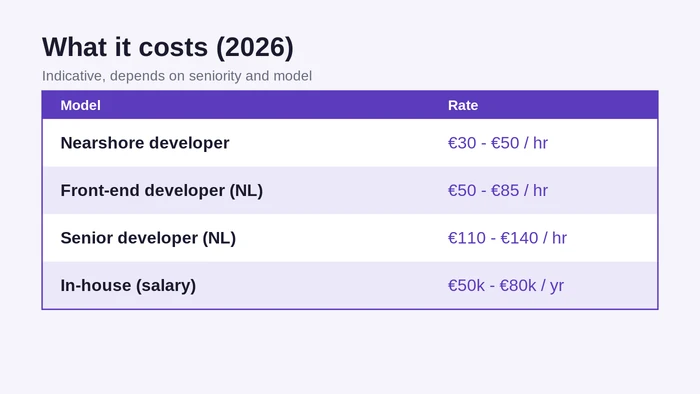
What moves the price is seniority, location and how you hire. A salaried hire looks cheaper per hour but adds recruitment, onboarding, employer costs and the risk of an empty desk between projects. A freelancer or agency costs more per hour but you pay only for the time you use.
Do not choose on rate alone. A cheap developer who needs everything reviewed and reworked is more expensive than a stronger one who gets it right the first time. Ask how someone scopes and estimates before you compare prices.
A quick example shows the gap. A salaried mid-level front-end developer at €65,000 per year costs closer to €80,000 once you add employer charges, and more once you count recruitment and the weeks a desk sits empty between projects.
A freelancer or agency at €70 per hour, used only when there is work, can be cheaper for anything short of a full-time, ongoing need. Run both numbers against your real workload before you decide. Include the softer costs too: onboarding time, management overhead and the ramp-up before a new hire is fully productive.
Freelance hiring, zzp and the Wet DBA## How long does it take to hire a front-end developer?
Hiring a front-end developer yourself takes weeks to months; through an agency or partner it can take days. The route you choose sets the pace.
A direct in-house hire means writing the role, sourcing, interviewing, testing and serving notice periods, which realistically runs four to twelve weeks. A freelancer can start within days once you have found the right one, though the finding also takes time. A partner with a vetted bench is usually fastest, because the screening is already done and you pick from a shortlist.
If speed matters, factor it into the decision. The cheapest option on paper is expensive if your project waits two months for it to start. A pragmatic middle path is to start with a freelancer or partner to keep moving, then hire in-house later once the role is clearly defined and permanent.
Freelance hiring, zzp and the Wet DBA
If you hire a freelance front-end developer in the Netherlands, the Wet DBA matters. This law targets false self-employment, where a freelancer is treated like an employee without the contract to match.
In practice, keep the working relationship genuinely independent, or hire through an agency that carries that responsibility. The rules and enforcement run via the Belastingdienst, and current labour-market context is published by UWV. This is not legal advice, but it belongs in any serious plan to hire front-end developers as freelancers.
Hiring through a partner sidesteps much of this. The developer stays on the partner’s books, you get the output, and the compliance sits with them rather than with you.
Interview questions to ask a front-end developer
Good screening beats a good CV. When you hire front-end developers, use a few sharp questions and a short practical task rather than a long checklist of tools.
- How would you make this layout responsive across devices?
- How do you approach accessibility in a component?
- How do you find and fix a slow-loading page?
- When would you not reach for a framework?
- How do you keep CSS maintainable in a large project?
- Show me something you built and the trade-offs you made
The best answers are specific and honest, including what the developer would not do. A short paid test task, close to your real work, tells you more than any interview. If someone cannot explain a trade-off in plain language, they will struggle to work with your team. Keep any test small and paid. Asking for days of free work is its own red flag, and the strongest candidates simply decline it.
Red flags when you hire front-end developers
A few warning signs separate a smooth hire from an expensive mistake. Watch for them before you sign.
Be cautious of a developer who only knows one framework and cannot explain the underlying HTML and CSS. Be careful with anyone who dismisses accessibility or performance as someone else’s job. And treat a portfolio you cannot verify, or a rate that seems too good to be true, as questions to resolve rather than details to skip.
On the hiring side, the biggest self-inflicted red flag is a vague brief. If you cannot describe the work and the skills you need in a paragraph, fix that first, or a good developer will not stay interested for long. Fix the brief and agree the scope, and you remove most of the risk before the work even starts.
A front-end hiring decision scorecard## How to write a brief that attracts the right developer
The quality of who you hire starts with the quality of your brief. A vague post attracts vague candidates; a sharp one filters for the right people.
Describe the product, the stack you use and the specific problem you want solved, not just a list of technologies. State whether you need a generalist or, for example, someone to hire as a front-end CSS developer for a design-system overhaul. Name the seniority, the engagement model and a rough timeline and budget range.
A good brief is honest about the messy parts too. Mentioning the legacy code, the tight deadline or the half-finished design system does not scare off strong developers; it attracts the ones who like solving real problems and filters out those looking for an easy ride. Spend an hour on the brief; it is the cheapest hour in the whole hiring process.
A front-end hiring decision scorecard
Most guides stop at “it depends.” This scorecard turns it into a decision. For each question, note which side you lean towards.
| Question | Points to freelance | Points to agency or in-house |
|---|---|---|
| How long is the work? | Short and defined | Ongoing |
| Do you need continuity? | Not really | Yes |
| Do you have someone to manage them? | Yes | Prefer it handled |
| Is front-end core to your business? | No | Yes |
| How fast must you scale? | Slowly | Quickly, with a bench |
Mostly left means a freelancer is the pragmatic choice. Mostly right means an agency or in-house hire will serve you better.
There is no wrong answer here, only a fit; the scorecard just makes the fit visible instead of leaving it to gut feel. A mixed result points to a dedicated developer through a partner, which gives you continuity without a permanent contract. The point is not to be clever; it is to be honest about how much steady front-end work you really have.
When you should not hire a dedicated front-end developer
Honest answer: not every situation calls for hiring your own front-end developer. Sometimes another route is faster or cheaper.
For a one-off change to an existing site, a short freelance job or your current agency is simpler than a new hire. If your product is standard and a template or no-code tool covers it, you may not need bespoke front-end work at all. And if you cannot keep a front-end developer busy and growing, a full-time hire will underuse both their time and your budget.
Hire a dedicated front-end developer when the work is ongoing, the quality of the interface matters to your business, and you have enough to keep that person engaged. As a rough guide, under a few months of work points to freelance, steady work to a hire, and a full workstream to a team.
Until then, flexible capacity is usually the smarter call. Being honest about this now is cheaper than carrying an underused salary later, and it keeps the door open to hire a dedicated developer the moment the workload justifies it.
How Mobilions helps you hire front-end developers
Mobilions helps companies hire front-end developers since 2016, with 10+ years of experience, 25+ engineers and 250+ projects delivered across 20+ countries. Independently reviewed, we score 4.8 on Clutch (35 reviews), with 98% client retention. That track record is why companies trust us to hire front-end developers on their behalf rather than run recruitment alone.
We work with an engineering team in Ahmedabad and an office in Amstelveen, so you get vetted developers at a sharp rate with a Dutch point of contact and the compliance handled for you. Whether you want to hire a front-end CSS developer for a specific project or a dedicated team for custom software or an app, we match the skills to your work.
You can start with one developer and scale to a team, swapping or adding skills as the work changes, without a new recruitment round each time. Read more about our team or browse our portfolio.
Ready to hire front-end developers without the recruitment overhead? Hire front-end developers through Mobilions, or contact us for an honest recommendation. 4.8 on Clutch (35 reviews), 10+ years of experience, 250+ projects delivered.
Frequently Asked Questions
What skills should a front-end developer have?
Look for strong HTML, CSS and JavaScript first, then one modern framework such as React, Vue or Angular. Accessibility, performance and Git are essential too. The fundamentals matter more than the framework, because someone who knows them picks up any tool quickly.
What skills should a front-end developer have?
Look for strong HTML, CSS and JavaScript first, then one modern framework such as React, Vue or Angular. Accessibility, performance and Git are essential too. The fundamentals matter more than the framework, because someone who knows them picks up any tool quickly.
How much does it cost to hire a front-end developer?
In the Netherlands, expect roughly €50 to €85 per hour for a mid-level front-end developer, €110 to €140 for a senior, and €30 to €50 nearshore. A salaried hire runs €50,000 to €80,000 per year plus employer costs. What moves the price is seniority, location and how you hire.
Should I hire a front-end CSS developer or a full-stack developer?
If styling, layout and responsive design are the priority, hire a front-end CSS developer. If you also need server logic and databases, a full-stack developer fits better. Most teams need one clearly more than the other, so name the gap before you write the job post.
Freelance, agency or in-house: which is best?
A freelancer suits short, defined tasks. An agency or dedicated team gives continuity and a vetted bench for ongoing work. An in-house hire fits long-term, core front-end work you can keep busy. Many companies mix these to scale without over-hiring.
What is the Wet DBA and does it affect hiring freelancers?
The Wet DBA targets false self-employment, where a freelancer is treated like an employee without the right contract. Keep the relationship genuinely independent, or hire through an agency that carries that responsibility. The rules run via the Belastingdienst. This is not legal advice.
How do I test a front-end developer’s skills?
Use a few sharp questions on responsiveness, accessibility and performance, plus a short, paid practical task close to your real work. That tells you more than any CV. If someone cannot explain a trade-off in plain language, they will struggle in your team.
What are red flags when hiring a front-end developer?
Be cautious of someone who only knows one framework and cannot explain the underlying HTML and CSS, who dismisses accessibility or performance, or whose portfolio you cannot verify. On your side, a vague brief is the biggest self-inflicted red flag.
How long does it take to hire a front-end developer?
A direct in-house hire realistically takes four to twelve weeks. A freelancer can start within days once found. A partner with a vetted bench is usually fastest, because the screening is already done and you pick from a shortlist.
Do I need a junior, mid-level or senior front-end developer?
Match seniority to the work. A junior fits well-defined tasks under guidance, a mid-level works independently on most features, and a senior sets architecture and solves hard problems. For many teams a strong mid-level with occasional senior review is the sweet spot.
Can I hire a front-end developer for a short project?
Yes. For a short, defined job a freelancer or an agency developer is ideal, because you pay only for the time you use and avoid the cost and delay of a permanent hire. Keep the brief clear so the work starts fast.
Tushar Patel is a software and AI strategist at Mobilions in Amstelveen, with 10+ years helping businesses build custom software, mobile apps and AI solutions. He writes practical, senior-level guides on development, hiring, and scaling products.