How to Hire Dedicated Developers: A Complete Guide

To hire dedicated developers well, you need to understand what a dedicated developer actually is, which engagement model fits your project, what it costs, and how to vet the right people. This guide walks through all of it, so you end up with a developer or team that works as a true extension of your own.
A dedicated developer works exclusively on your project for a defined or open-ended period, unlike a freelancer who splits attention across many clients. That focus is the whole point, and it changes how you hire, how you pay, and how you manage the relationship. Below are the models, the costs, a step-by-step process, and an honest look at when a dedicated developer is not the right call.
Key takeaways
- A dedicated developer works only on your project, so you get the focus of an employee with the flexibility of a contract.
- European rates run roughly €30 to €140 per hour, against an in-house salary of €50,000 to €80,000 per year plus overhead.
- Hourly, part-time and full-time models each suit a different amount of steady work.
- A vetted partner is usually faster than an in-house hire and more reliable than juggling freelancers.
- Screen on a short paid task, agree IP ownership up front, and know when a freelancer or employee fits better.
How to hire dedicated developers: the short answer
To hire dedicated developers, define your scope and required skills, choose an engagement model (hourly, part-time or full-time), pick a source (marketplace, agency or a dedicated-team partner), and vet on real skills rather than a polished profile. For most businesses, a dedicated developer or team through a partner is faster than an in-house hire and more reliable than juggling freelancers.
This guide shows you how to make that choice with confidence. Expect European rates of roughly €30 to €140 per hour depending on seniority and location.
What is a dedicated developer or dedicated team?
A dedicated developer is a software professional who works only on your project for the length of the engagement, building deep knowledge of your codebase and your business. A dedicated team is the same idea at scale: a group of developers, and often a lead, that functions as an extension of your own organisation.
How it differs from a freelancer
The difference from a freelancer is focus. A freelancer juggles several clients, so context switching and availability are constant risks. A dedicated developer’s primary context is your product, which means faster communication, better onboarding and clearer accountability.
How it differs from an in-house hire
The difference from an in-house hire is commitment and overhead. You get the focus of an employee without the recruitment, payroll and long-term fixed cost. The model sits between freelancing and permanent staff, which is exactly why it has grown.
Why hire dedicated developers?
The main reason to hire dedicated developers is focused, accountable capacity that grows more valuable over time, without the cost and delay of building an in-house team. You are paying for attention, not shared time.
The benefits are concrete. Communication is faster because the developer’s context is your codebase, not five others. Onboarding compounds, because the developer builds knowledge a rotating freelancer never accumulates. Accountability is clear, because there is no ambiguity about who owns a module or a deadline.
Speed and cost
There is a speed and cost angle too. A dedicated developer through a partner can be contributing in sprints within weeks, rather than the three to six months a standard in-house hire often takes, and you avoid recruitment fees and idle time. For many companies, that is how a serious custom software project gets staffed without a hiring freeze getting in the way.
Focus for your own team
There is a focus benefit for your own people too. By handing steady development to a dedicated team, you keep your internal staff on the work that differentiates you.
Dedicated developers vs freelancers vs in-house
The clearest way to decide is to compare the three ways of adding development capacity side by side.
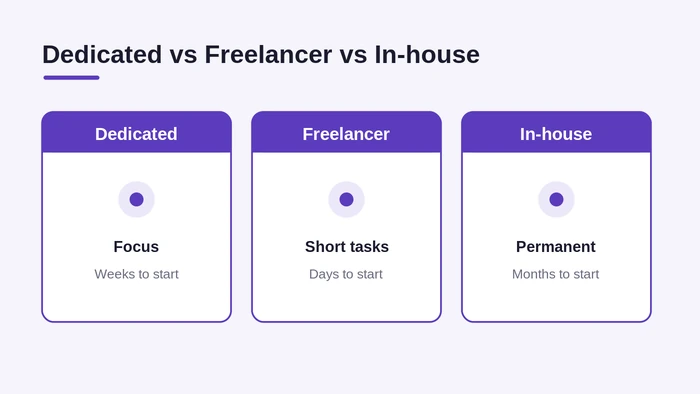
| Aspect | Dedicated developer | Freelancer | In-house hire |
|---|---|---|---|
| Focus | Your project only | Split across clients | Your project only |
| Continuity | High | Variable | High |
| Speed to start | Weeks | Days | Months |
| Fixed cost | None | None | Salary and overhead |
| Best for | Ongoing product work | Short, defined tasks | Permanent core capability |
A freelancer is ideal for a short, bounded job. An in-house hire fits a permanent, core need you can keep busy. A dedicated developer sits in the middle, with the continuity of an employee and the flexibility of an external arrangement.
The three are tools for different jobs. A mature setup often uses all three: an in-house core for direction, dedicated developers for the bulk of the build, and a freelancer for the occasional specialist task.
Engagement models: hourly, part-time or full-time
You can hire dedicated developers on an hourly, part-time or full-time basis, and the right model depends on how much steady work you have.
| Model | What it is | Best for |
|---|---|---|
| Hourly | Pay for the hours used | Variable or early-stage work |
| Part-time | A fixed share of a developer’s week | Steady but not full-time need |
| Full-time dedicated | One or more developers full-time on your product | Ongoing, serious development |
Hourly keeps things flexible when the workload is uncertain. Part-time suits a steady stream of work that does not fill a week. A full-time dedicated developer, or a dedicated team, is the model most businesses settle on for real product work, because it gives the continuity that makes the arrangement pay off.
Many companies start hourly to test the fit, then move to full-time once trust is established. A single dedicated developer suits a focused stream of work, while a small dedicated team with a lead suits a whole product or roadmap.
Where to find dedicated developers
There are three common places to hire dedicated developers, and they trade convenience against reliability. Freelance marketplaces are fast and cheap to search but put all the vetting, management and replacement risk on you. Job boards and in-house recruitment give you an employee but take months and carry fixed cost.
A dedicated-team partner or software agency sits between the two: a vetted developer or team, with someone else handling screening, replacement and management, ready in weeks.
For ongoing product work this is usually the most reliable route, because you buy not just a person but the process and continuity around them. Whether you need a full-stack, backend or frontend profile, a partner can match the skill to the work and scale the team as the product grows.
Marketplaces optimise for the lowest hourly price; partners optimise for delivered outcomes. If a project matters, the second is usually better value, because a cheap hour that produces rework is not cheap.
What does it cost to hire dedicated developers?
To hire dedicated developers in Europe costs roughly €30 to €140 per hour depending on seniority and location, with an in-house salary as the alternative benchmark.
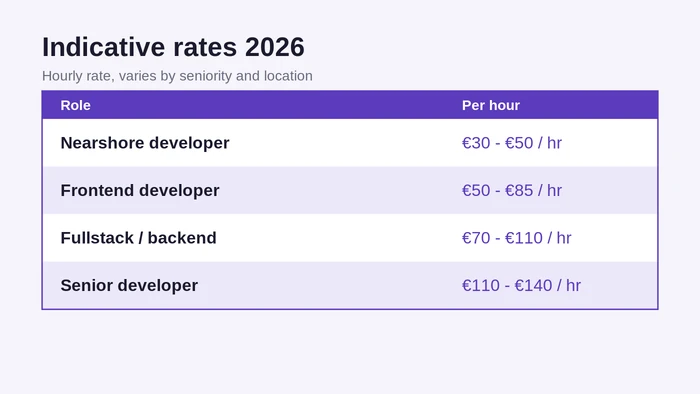
| Role or model | Indicative hourly rate |
|---|---|
| Nearshore developer | €30 to €50 |
| Frontend developer | €50 to €85 |
| Fullstack or backend developer | €70 to €110 |
| Senior developer | €110 to €140 |
| In-house, salaried | €50,000 to €80,000 per year |
These are ranges, not quotes. Treat them as a starting band to sanity-check a proposal, then expect the real number to move with scope, seniority and region.
What drives the price
For comparison, a developer on your payroll costs €50,000 to €80,000 per year plus employer charges, recruitment and onboarding, and you carry the cost if the work slows. What drives the price of a dedicated developer is seniority, location, the length of the engagement and how much management the partner takes on. The real economy is avoiding idle salary and long recruitment, not just a lower hourly rate.
Why the cheapest rate rarely wins
Do not choose on rate alone. A cheaper developer who needs constant review can cost more than a stronger one who gets it right. A senior at the top of the band who ships clean, reviewed work can be cheaper over a quarter than a mid-rate developer whose output needs redoing. Judge on delivered value per euro, not the sticker rate alone.
How to hire dedicated developers step by step
Hiring dedicated developers runs in a clear sequence, from defining the work to a productive team member.
- Write down the scope and required skills
- Choose an engagement model and budget
- Pick a source: marketplace, agency or dedicated-team partner
- Screen with a short, paid, practical task
- Onboard with access, context and a first sprint
- Review after the first sprints and scale or adjust
It starts with a clear brief, because a vague one attracts vague candidates and wastes everyone’s time. Choose the model and source that match your workload, then screen on real work rather than a CV. Good onboarding matters as much as good screening, since a developer who understands your context delivers sooner.
After a sprint or two, you will know whether to scale, and a good partner makes that a simple conversation. Keep the first engagement small on purpose. A short, defined first project lets both sides prove the fit before you commit, which is the cheapest insurance you can buy against a bad hire.
A real-world scenario: staffing a growing product
Picture a small company with a working product and a backlog that keeps growing. The founder still codes, one internal developer maintains the platform, and every new feature slips because the team is stretched thin. A permanent engineer would take months to recruit, months they do not have.
In this common situation, a dedicated developer fills the gap without a long recruitment cycle. The company starts with one full-stack developer through a partner, on an hourly model, scoped to a single feature stream. The brief is written down, access is granted, and the first sprint ships something small but real.
After two sprints, the developer knows the codebase and the review load on the internal team drops. The company moves to a full-time arrangement and adds a second developer as the roadmap grows. It works because the scope was clear, the fit was tested first, and ownership stayed with the company. The details are illustrative, but the shape of the story is typical.
How to vet a dedicated developer
Vetting is where most hiring mistakes are prevented. When you hire dedicated developers, test the fundamentals with a short practical task close to your real work, not a long list of technologies on a profile.
- A short, paid task that mirrors your actual codebase or problem
- Clear communication and the ability to explain trade-offs
- Proven experience with your stack and type of product
- References or verifiable past work
- Comfort with your tools, process and time zone
- Ownership: they treat your product as theirs
The strongest signal is how someone reasons about a real problem, including what they would not do. If a developer cannot explain a decision in plain language, they will struggle inside your team.
When you work through a partner, much of this vetting is already done. Whatever the source, do not skip the practical task. A short piece of real work tells you more about how someone thinks and handles ambiguity than any interview.
Onshore, nearshore or offshore dedicated developers?
Location changes the cost and the day-to-day of hiring dedicated developers, and it is a balance of price, time zone and communication. Onshore is the easiest to work with but the most expensive. Offshore is the cheapest per hour but adds time-zone, language and oversight overhead. Nearshore, in a nearby region, is the pragmatic middle: lower rates with a close time zone.
The right choice depends on the work. Many companies choose a hybrid: a local point of contact for direction, with the developers in a lower-cost location, which is the model we use with an engineering team in Ahmedabad and an office in Amstelveen.
Data security, IP ownership and the contract
When you hire dedicated developers, an external person works with your code and data, so put the terms in writing. Agree that everything they build lands in your own repository, under your accounts and licences, so you own the intellectual property and never get stuck if you change providers.
Where personal data is processed, work to the GDPR, keep data in the right regions, and sign a data processing agreement. The framework here is enforced by the Dutch Data Protection Authority for EU work.
If you engage independent contractors directly, factor in local rules on employment status, which in the Netherlands run via the Belastingdienst. Hiring through a partner sidesteps much of this, because the developer stays on the partner’s books and the compliance sits with them. None of this is legal advice, but data, IP and contract terms belong at the centre of the decision, not the end.
Common mistakes when you hire dedicated developers
A few warning signs separate a smooth hire from an expensive one. Be cautious of a developer or agency that quotes without understanding your scope, a rate that looks too good to be true, or a portfolio you cannot verify. Work where the code stays in the agency’s name is a red flag that costs you later.
The most common self-inflicted mistake is a vague brief, because a good developer cannot build what you cannot describe. Others include choosing on hourly rate alone, planning too little communication, and forgetting to agree ownership and maintenance up front.
A quieter mistake is skipping the small first project and committing to a long contract on day one. Another is treating a dedicated developer like a ticket queue instead of a colleague. Most of these start in the agreements and the brief, not during the build, so an hour of clarity there saves weeks of rework.
Myths about hiring dedicated developers
A few myths still push companies toward the wrong choice, so it helps to name them plainly.
The first myth is that dedicated means expensive. In practice, a dedicated developer often costs less than a permanent hire once you count recruitment, idle time and overhead, and less than a cheap freelancer once you count rework.
The second myth is that offshore or nearshore always means lower quality. Quality tracks the vetting and the process, not the postcode. A well-screened developer in a lower-cost region can outperform a poorly chosen local one.
The third myth is that you lose control when the developer is external. You keep control by writing down the scope, owning the repository, and meeting regularly. The fourth myth is that hiring is instant; even with a vetted bench, a good match and a first sprint still take real attention.
Managing a dedicated developer effectively
Hiring is only half the job; getting value from a dedicated developer depends on how you work with them. Treat them as part of the team, not a black box, and the relationship compounds.
Give clear goals and context, not just tickets, so the developer understands the why behind the work. Meet regularly with short demos, so problems surface early and direction can shift before it is expensive.
Keep the code, decisions and documentation in your own systems, so knowledge stays with you. Give feedback openly, the way you would with any colleague. Done well, a dedicated developer stops feeling external and starts feeling like your own senior engineer.
When a dedicated developer is not the right choice
Honest answer: a dedicated developer is not always the right call. For a small, one-off task, a freelancer is simpler and cheaper than setting up a dedicated arrangement.
If your need is genuinely permanent and core, and you can keep someone fully busy for years, an in-house hire may cost less over time. The trade-off is flexibility, because an employee is harder to scale down when the roadmap changes.
And if you do not yet have a clear brief or the time to collaborate, no hire will succeed, so fix that first. Hire dedicated developers when the work is ongoing, the product matters, and you want focused capacity without the overhead of building a team from scratch.
In short: a summary
A dedicated developer works only on your product, giving you the focus of an employee with the flexibility of a contract. European rates run roughly €30 to €140 per hour, against €50,000 to €80,000 a year for an in-house hire.
Define the scope, pick an engagement model, choose a source, and vet on a short paid task. Agree IP ownership and data terms in writing. Use a freelancer for short jobs, an employee for a permanent core, and a dedicated developer for ongoing product work. Manage the relationship like a colleague, and it pays off over time.
How Mobilions provides dedicated developers
Mobilions provides dedicated developers and teams since 2016, with 25+ engineers and 250+ projects delivered across 20+ countries. Independently reviewed, we score 4.8 on Clutch (35 reviews), with 98% client retention.
We work with an engineering team in Ahmedabad and an office in Amstelveen, so you get vetted dedicated developers at a sharp rate, with a European point of contact and the recruitment and compliance handled for you.
Whether you need to hire full-stack developers, a back-end or front-end specialist, or a full team for enterprise software or an app, we match the skills to your work and scale as you grow.
You can start with one developer and grow to a full team as the product does. Read more about our team or browse our portfolio.
Ready to hire dedicated developers without the recruitment overhead? Contact us for an honest, no-obligation recommendation. 4.8 on Clutch (35 reviews), 250+ projects delivered across 20+ countries since 2016.
Frequently asked questions
What is a dedicated developer?
A dedicated developer is a software professional who works only on your project for the length of the engagement, building deep knowledge of your codebase and business. Unlike a freelancer who splits attention across clients, their full focus is on your product, which improves speed, onboarding and accountability.
How much does it cost to hire dedicated developers?
In Europe, expect roughly €30 to €140 per hour depending on seniority and location: about €30 to €50 nearshore, €50 to €85 mid-level, and €110 to €140 for a senior. A salaried in-house developer costs €50,000 to €80,000 per year plus employer charges.
What engagement models can I choose from?
Hourly, part-time and full-time. Hourly keeps things flexible for uncertain workloads, part-time suits a steady but not full-time need, and a full-time dedicated developer or team fits ongoing product work. Many companies start hourly to test the fit, then move to full-time once trust is established.
Where can I find dedicated developers?
Freelance marketplaces are fast and cheap but leave the vetting and risk with you. In-house recruitment gives you an employee but is slow and fixed-cost. A dedicated-team partner sits between the two, with screening, replacement and management handled, and is usually the most reliable route for ongoing work.
How do I vet a dedicated developer?
Use a short, paid practical task close to your real work, not a long list of technologies. Look for clear communication, the ability to explain trade-offs, proven experience with your stack, verifiable references, and a sense of ownership. Through a partner, much of this vetting is already done.
Onshore, nearshore or offshore: which is best?
Onshore is easiest to work with but the most expensive. Nearshore offers lower rates with a close time zone. Offshore is cheapest per hour but adds time-zone and oversight overhead. For work needing constant coordination, nearness matters; for well-defined work, rate matters more. A hybrid is common.
Who owns the code when I hire dedicated developers?
You should, if you agree it up front. Make sure everything the developer builds lands in your own repository, under your accounts and licences, so you own the intellectual property and never get stuck if you change providers. A trustworthy partner offers full ownership by default.
When is a dedicated developer not the right choice?
For a small, one-off task, a freelancer is simpler and cheaper. For a permanent, core need you can keep fully busy for years, an in-house hire may cost less over time. And without a clear brief or time to collaborate, no hire will succeed, so fix that first.
Tushar Patel is a software and AI strategist at Mobilions in Amstelveen, with 10+ years helping businesses build custom software, mobile apps and AI solutions. He writes practical, senior-level guides on development, hiring, and scaling products.