How to Reduce Software Development Cost: 8 Proven Ways
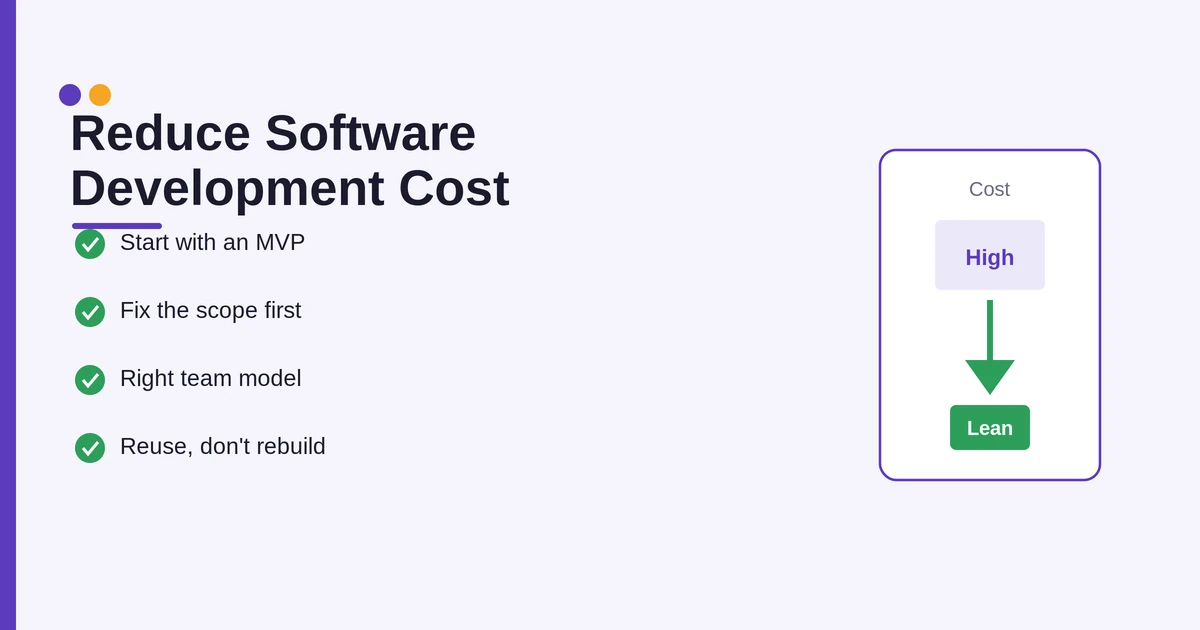
The fastest way to reduce software development cost is to build less at first, hire the right mix of people, and prevent the rework that quietly doubles budgets. You do not cut cost by paying the lowest rate. You cut it by making fewer expensive mistakes and by shipping only what earns its place.
This guide covers eight practical ways to cut your build cost without hurting quality, a step-by-step process, the false economies that cost more later, and a simple worked example. It is written for founders and business leaders in the Netherlands and Europe who want a leaner build, not a cheaper one that falls apart.
How to reduce software development cost: the short answer
To spend less, start with a small, well-defined scope, choose a team model that matches the work, reuse proven components, and keep quality high enough to avoid rework. The biggest savings come from doing less at the start and from clear communication, not from the cheapest developer you can find.
The rest of this guide turns that into eight moves, a step-by-step process, a cost comparison, and the honest trade-offs to weigh before you cut anything.
Key takeaways
- Scope discipline and less rework save more than any hourly rate.
- An MVP first protects your budget from features users ignore.
- The right team model matters more than the cheapest team.
- Reuse proven components instead of rebuilding solved problems.
- Testing and maintenance are savings over time, not wasted spend.
- Some cuts cost more later, so know when not to cut.
- Real usage, not guesswork, should decide what you build next.
What drives software development cost
Before you cut anything, it helps to know where the money actually goes. Most software budgets are shaped by a few forces, not by the hourly rate alone. Understanding them tells you which cuts are safe and which ones quietly backfire.
The good news is that these forces are all controllable. You can shrink scope, sharpen requirements, pick a fitting team and reuse proven parts. None of that needs a bigger budget, only earlier and clearer decisions. The sections below turn each force into a concrete move you can apply.
Scope and feature count
Every feature carries design, build, testing and maintenance cost for its whole life. A long feature list is the most common reason a budget grows. Trimming scope early is the cleanest saving available, because a feature you never build costs nothing to run and nothing to maintain.
Rework and unclear requirements
Rework is money spent twice. When requirements are vague, teams build the wrong thing, then build it again. Faults caught late cost far more to fix than faults caught early, a pattern seen across software projects for decades. Clear requirements are usually cheaper than clever developers.
Team composition and rates
An all-senior team is rarely the right answer, and neither is an all-junior one. Cost depends on the mix, the location and the management overhead. The right blend of senior guidance and mid-level delivery usually gives the best value for the money you spend.
Technical debt and maintenance
Shortcuts taken today become bills tomorrow. Technical debt, a term explained by Martin Fowler, is the future cost of quick fixes that later need reworking. Software also needs upkeep after launch, so maintenance belongs in the budget from the first planning session.
Communication and management overhead
Every handover, meeting and unclear message has a cost. Weak communication leads to wrong assumptions, which lead to rework. A clear brief, a single point of contact and short feedback loops keep this overhead small, which protects the budget as much as any rate card does.
1. Start with an MVP, not the full product
The single biggest way to reduce software development cost is to build a minimum viable product first. Ship the core feature that solves the main problem, put it in front of real users, and add the rest once you know what they actually use. Most teams overbuild, then discover half the features are ignored. An MVP protects your budget from that.
For a fuller view, see our guide on MVP development.
An MVP also shortens the feedback loop. Instead of guessing for months, you learn from real behaviour in weeks, then spend the rest of the budget on features the data supports. That is cheaper than building everything at once and hoping it lands.
2. Fix the scope before you build
Vague requirements are the most common reason budgets blow up. Every mid-project change means rework, and rework is where money disappears. A clear specification, agreed before development starts, prevents the endless change requests that inflate every quote. Spend time on the spec, and you spend less on the build.
Write down what the first release must do, and just as important, what it will not do yet. A short, firm scope gives every quote a stable target and stops small extras from piling up into a much larger bill.
3. Choose the right team model
You do not need an all-senior team, and you do not need to hire full-time staff for a one-off project. Matching the model to the work is a direct way to cut cost.
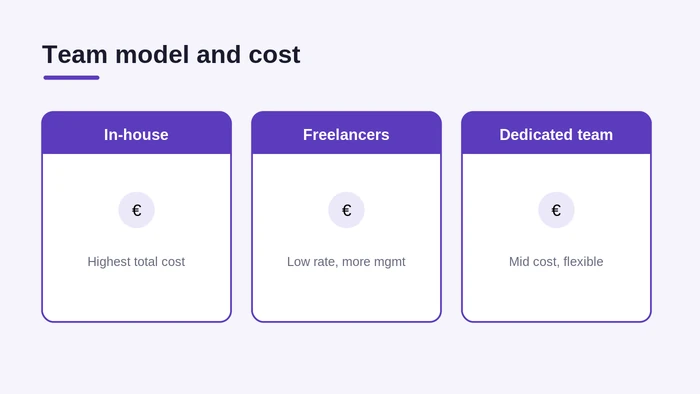
| Model | Best for | Cost effect |
|---|---|---|
| In-house hire | Long-term, ongoing product | Highest total cost with salary and overhead |
| Freelancers | Small, short tasks | Low rate, more management needed |
| Dedicated team | Ongoing product work | Mid cost, flexible, no hiring overhead |
Our guides on software development outsourcing and how to hire dedicated developers cover these models in detail.
When each model makes sense
Pick an in-house hire when the product is core and permanent. Choose freelancers for small, well-defined tasks with light coordination. A dedicated team fits ongoing product work that needs continuity without the cost and delay of permanent hiring. The wrong model, not the wrong rate, is what usually wastes money here.
Many teams also combine models over time. You might start with a dedicated team for the MVP, then add in-house staff once the product proves itself. Matching the model to the stage, not just the task, keeps cost in line as the work changes.
4. Use nearshore or offshore talent
Location changes the rate for the same skill. A capable developer in an EU nearshore hub or a strong offshore market costs less per hour than a local senior, often with no drop in quality. The saving is real when the team communicates well and works in a close or shared time zone.
Many companies blend a local lead with a nearshore or offshore build team to lower cost while keeping oversight. The key is clear scope and regular contact, so distance never turns into misunderstanding and expensive rework.
5. Reuse instead of rebuilding
Payments, login, maps, notifications and analytics are solved problems. Using proven libraries, frameworks and third-party services instead of building them from scratch saves weeks of work. Custom code should go where it creates real advantage, not where a reliable off-the-shelf component already exists.
Reuse also lowers future cost, because maintained third-party services handle their own updates and security. Every module you do not build is one you never have to test, patch or support later on.
6. Work in short cycles with regular demos
Agile delivery, with short cycles and frequent demos, catches wrong turns early. Finding a misunderstanding in week two costs far less than finding it at launch. The Agile Manifesto set out these iterative ideas, and regular check-ins keep the build pointed at what you actually need.
Short cycles also give you natural stopping points. If the budget tightens, you can pause after a finished increment with working software in hand, rather than a half-built feature that delivers nothing.
7. Do not skip testing and code quality
This sounds like it adds cost, but it removes far more. Cutting testing to save money is a false economy: bugs found in production cost many times more to fix than bugs found during development. Clean, tested, documented code also prevents technical debt, the future cost of shortcuts taken today. Quality is not the enemy of a lean budget; sloppiness is.
Automated tests pay for themselves over a project. They catch regressions before users do, reduce firefighting, and let a smaller team move safely. That steady pace is cheaper than the stop-start rhythm of chasing production bugs.
8. Plan for maintenance from day one
Software is never truly finished. Budgeting for updates and small fixes from the start avoids the expensive emergency work that comes from neglect. A maintained system stays cheap to run; a neglected one becomes a rebuild. Planning maintenance early is how you keep the total cost down, not just the build cost.
Set aside a small, steady maintenance budget rather than waiting for something to break. Predictable upkeep is far cheaper than a crisis fix, and it protects the value of everything you paid to build.
How to reduce software development cost step by step
If you want a process rather than a list, these steps put the eight moves in order. Follow them on a new project and you keep control of the budget from the very first week.
- Write the problem in one clear sentence.
- Define the smallest release that solves it.
- Agree a firm scope and mark what is out.
- Choose the team model that fits the work.
- Reuse proven components for non-core parts.
- Build the MVP in short, demoed cycles.
- Test as you go to catch faults early.
- Launch, measure real use, then plan maintenance.
Each step removes a common source of waste. Together they turn a vague, expensive plan into a lean one you can actually control from start to finish.
You do not have to follow the steps rigidly. On a small project some take an hour, while on a larger one they become full phases. What matters is the order: understand, scope, staff, build small, test, launch, then learn before you spend more.
How to reduce software development cost without hurting quality
Saving money and keeping quality are not opposites. The moves that cut cost, a tight scope, an MVP, reuse and testing, are the same ones that raise quality. You get a smaller, sturdier product rather than a large, fragile one.
The trick is to cut scope, not standards. Build fewer things, and build them properly. A short feature list done well beats a long one done badly, and it costs far less to run for years afterward.
A qualitative cost comparison
The table below compares common choices by their effect on cost, using ranges and relative labels rather than fixed prices. Actual figures depend on your scope, market and team, so treat these as direction, not quotes.
| Choice | Upfront cost | Effect on total cost |
|---|---|---|
| Full build first | Higher | Higher, pays for unused features |
| MVP first | Lower | Lower, spend follows real demand |
| All-senior team | Higher rate | Often over-specified for the work |
| Blended team | Mid rate | Lower for the same delivery |
| Local-only build | Higher rate | Higher, same skill at a premium |
| Nearshore or offshore blend | Lower rate | Lower, with good communication |
| Skip testing | Lower now | Higher later, production bugs cost more |
| Reuse components | Lower | Lower, less custom code to maintain |
The pattern is consistent. The cheaper-looking option often carries a higher total cost once rework and maintenance are counted in.
Read the table as a set of defaults, not rules. A tiny, one-off tool might justify a freelancer and light testing, while a product handling payments needs the opposite. The safe habit is to ask what each choice costs over the full life of the software, not just this month.
How much can you realistically save
The honest answer is that it depends on your starting point. A team that already scopes tightly has less to gain than one that overbuilds every release. The largest savings come from not building features users never wanted, which is why an MVP is the strongest single move.
Expect ranges, not guarantees. Scope discipline, reuse and a fitting team model together can move a project from an overrun to a comfortable budget. The saving shows up as fewer paid features and far less rework, not as a magic discount on the rate.
A worked example
Suppose a full feature set is quoted in the range of €100,000 to €140,000. By shipping an MVP first, the initial build lands in the range of €40,000 to €60,000. Real usage then shows which of the remaining features matter, and several are dropped or changed. The total spend ends well below the top of the original range, and the product fits users better.
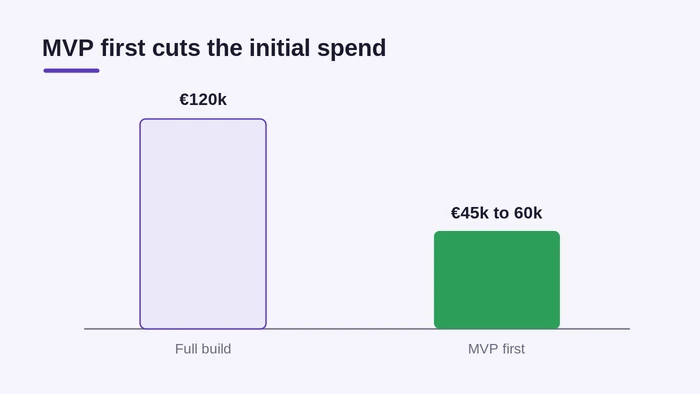
These figures are illustrative, not a quote. The point is the shape, not the exact numbers. Spending in stages, guided by real use, almost always costs less than committing the whole budget to a plan written before a single user has touched the product.
A real-world scenario
Imagine a founder with a fixed budget and a long wish list. The first plan tries to build everything at once, and the quote climbs past what the business can spend. Instead, the team defines a core release, picks a blended dedicated team, and reuses payment and login services rather than building them.
The MVP ships in weeks, early users guide the next features, and the budget stretches across two releases instead of one overrun. Nothing here is unusual. It is the ordinary result of scoping first, spending in stages, and letting real feedback decide what comes next.
Common mistakes that quietly raise the cost
Some savings cost you more later. These are the false economies that look good on the quote and turn into a bigger bill within months. Watch for them before you sign anything.
- Choosing the cheapest developer or agency on rate alone, which often means thin scope and heavy rework.
- Skipping the discovery or specification phase to start faster.
- Cutting testing and QA to hit a lower number on paper.
- Leaving out documentation, which locks you into one vendor and raises every future cost.
- Building custom versions of solved problems like payments or login.
- Adding features before real users have asked for them.
Each of these trades a smaller invoice now for a larger one later. The cheapest quote is rarely the cheapest project once the rework and support are counted.
Most of these mistakes share one root: optimising the first invoice instead of the whole project. Ask for the total cost of ownership, not just the build price, and the false economies become far easier to spot before they cost you.
When not to cut costs: the trade-offs
Cost cutting has limits, and pushing past them costs more than it saves. Some parts of a build deserve full investment. Knowing where to stop is as valuable as knowing where to save.
- Do not cut security, data protection or compliance work, especially under EU rules like the GDPR.
- Do not underfund testing on anything that touches money, health or personal data.
- Do not pick the lowest rate when the work is complex or long-term.
- Do not skip discovery on a product you do not fully understand yet.
- Do not starve maintenance, or small issues grow into a full rebuild.
The goal is a lean build, not a fragile one. A saving that raises your risk, your rework or your legal exposure is not a saving at all, just a cost moved into the future.
A useful test is to ask what breaks if a cut goes wrong. If the answer is a small delay, the saving is probably safe. If the answer is lost data, a security gap or a legal problem, keep the spend and find your savings somewhere else instead.
Myths about reducing software development cost
A few common beliefs about how to reduce software development cost push teams toward false savings. Clearing them up makes the real levers easier to see and act on.
Myth: the cheapest developer saves the most
The lowest hourly rate often carries the highest total cost. Thin experience means more rework, more bugs and more management time. Value for money comes from the right skill for the task, not the smallest number on the quote.
Myth: testing is an optional extra
Testing is not a luxury bolted on at the end. It is the cheapest place to catch a fault. Skipping it moves the same bugs to production, where they cost far more to fix and can damage trust with the users you need most.
Myth: outsourcing always means lower quality
Quality depends on the team and the process, not the postcode. A well-run nearshore or offshore team with clear communication can match local quality at a lower rate. Poor results come from weak scope and thin oversight, wherever the team happens to sit.
In short: a summary
To reduce software development cost, build an MVP first, fix the scope, choose a team model that fits, reuse proven components, and keep testing and maintenance in the plan. Avoid the false economies, know when not to cut, and let real usage guide what you build next. Less rework, not lower rates, is where the real savings live.
Build lean with Mobilions
Mobilions has delivered 250+ projects for clients in 20+ countries since 2016, with 25+ engineers rated 4.8 out of 5 on Clutch across 35 reviews and 98% client retention. From our offices in Amstelveen and Ahmedabad, we help founders reduce software development cost with a lean build that still holds up. Explore our custom software development services or book a short call to scope it.
Frequently Asked Question
How can I reduce software development cost without losing quality?
Build an MVP first, fix the scope before you start, choose a team model that fits the work, reuse proven components, and keep testing in place. The savings come from doing less and avoiding rework, not from the lowest rate you can find.
Does outsourcing lower software cost?
It can. Nearshore and offshore teams lower the rate for the same skill, and a dedicated team removes hiring overhead. The saving holds when communication is strong and the scope is clear, and it fades when oversight is weak or requirements keep shifting.
Is cutting testing a good way to save money?
No. It is a false economy. Bugs found in production cost far more to fix than bugs found during development, so skipping testing usually raises the total cost. Testing is the cheapest place to catch a fault, not an optional extra to trim away.
What is the biggest driver of software cost?
Scope and rework. The more features you build, and the more you change mid-project, the higher the cost climbs. Controlling both, with a firm spec and a short first release, is the most reliable way to keep the total down.
How much can an MVP approach save?
It varies by project, but building only the core first often cuts the initial spend by a large margin and prevents paying for features users never adopt. Seen as a range rather than a fixed figure, the saving is usually substantial and repeatable.
Does a lower hourly rate mean a cheaper project?
Not always. A low rate paired with thin experience often means more rework, more bugs and more management time, so the total rises. The cheapest project comes from the right skill and a clear scope, not from the smallest rate on the quote.
Should a startup outsource or hire in-house to save?
For a first product, a dedicated or blended team usually costs less than permanent hires, because it removes recruitment, salary and overhead while keeping continuity. Hire in-house once the product is core, ongoing and large enough to keep a full team busy.
How do I keep maintenance costs low after launch?
Plan for maintenance from day one, keep the code clean and documented, and reuse well-supported components. Budget a small, steady amount for updates rather than waiting for emergencies. A maintained system stays cheap to run, while a neglected one drifts toward a costly rebuild.
Tushar Patel is a software and AI strategist at Mobilions in Amstelveen, with 10+ years helping businesses build custom software, mobile apps and AI solutions. He writes practical, senior-level guides on development, hiring, and scaling products.