Cost to Hire Node js Developer Talent: Full Rates Guide
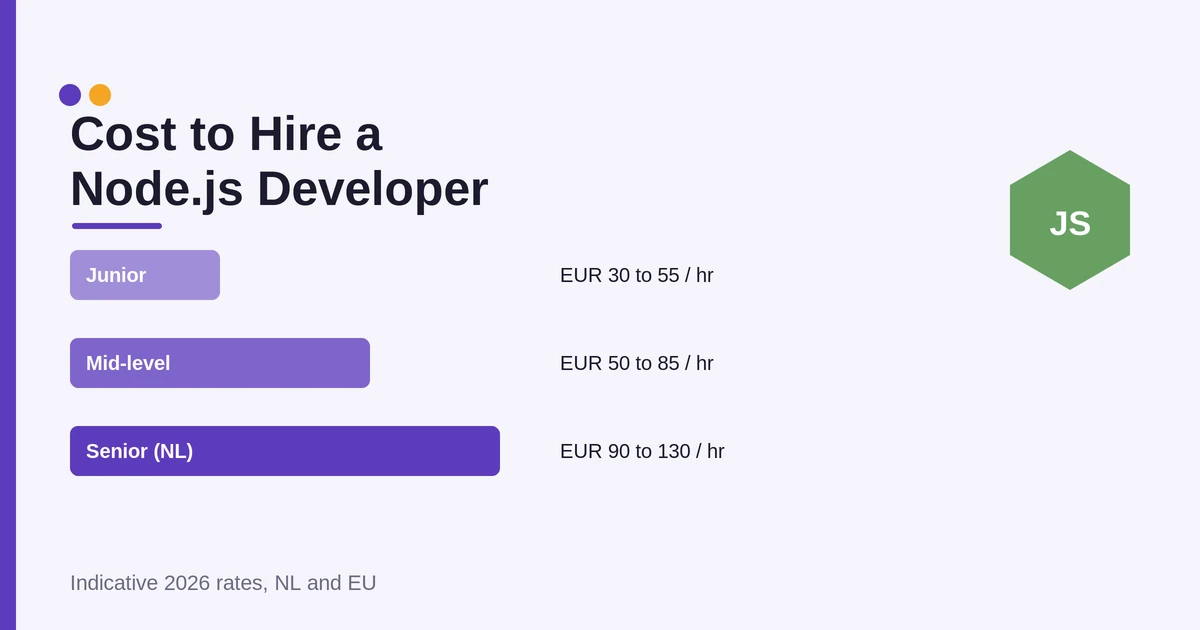
The cost to hire Node js developer talent ranges from roughly €30 to €130 per hour, or about €55,000 to €85,000 per year for an in-house hire, depending on seniority, location, and how you engage them.
The short version is simple. Nearshore and junior developers sit at the low end of that band. Senior specialists in the Netherlands sit at the high end. A salaried hire lands in the middle once you add the hidden costs of employment that most rate guides quietly skip.
This guide breaks the number down by seniority and by location. It compares freelance, agency, and in-house options. It shows the full cost of an employee, not just the salary, and then gives you concrete ways to spend less without buying trouble. Figures are indicative for the Dutch and European market and vary by scope.
Key takeaways
- Hourly rates run from about €30 to €130, driven mostly by seniority and location.
- An in-house salary of €55,000 to €85,000 hides another 25 to 35 percent in employer costs.
- Nearshore developers in the EU offer the best balance of rate, time zone, and quality.
- Freelance suits short tasks, a dedicated team suits ongoing products, in-house suits a permanent core need.
- The cheapest rate is rarely the cheapest outcome once rework and risk are counted.
What it costs to hire Node js developer talent: the short answer
To hire Node js developer talent in the Netherlands, expect roughly €50 to €110 per hour for a typical mid-level to senior profile, or €55,000 to €85,000 per year for an in-house hire before employer costs. Nearshore developers start around €30 to €55 per hour.
Those two numbers, an hourly rate and a salary, are just two ways the same cost shows up. What you pay depends on three things: seniority, location, and whether you hire freelance, through an agency, or in-house. Everything below turns that range into a decision you can defend to finance.
Why the range is so wide
The gap between €30 and €130 per hour is not random. A junior in a lower-cost region and a senior specialist in Amsterdam do very different work at very different risk levels. The rate reflects experience, scarcity of the skill, and where the developer is based. Narrowing your own range starts with being honest about which profile the task actually needs.
A simple rule helps here. The more your product depends on the code being correct, the further up the range you should look. A marketing microsite and a payment backend are not the same risk, and they should not carry the same budget or the same seniority.
Node.js developer rates by seniority
The clearest way to understand the cost to hire Node js developer profiles is by seniority, because experience is the single biggest driver of rate. Node.js is an open-source runtime for server-side JavaScript, documented at nodejs.org, and the depth of that knowledge is what separates a junior from a senior.
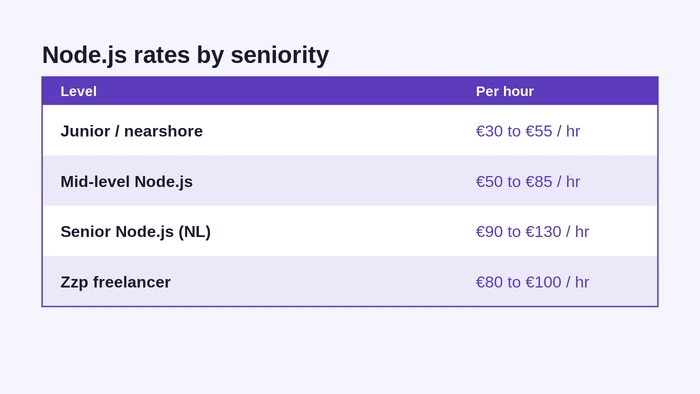
| Level | Indicative hourly rate (NL) |
|---|---|
| Nearshore or junior | €30 to €55 |
| Mid-level Node.js developer | €50 to €85 |
| Senior Node.js developer (NL) | €90 to €130 |
| Zzp freelancer average | €80 to €100 excl. VAT |
What a junior developer handles
A junior developer handles well-defined API endpoints, small fixes, and clear tasks under guidance. The rate is low, but so is the scope. Juniors need review, so you should factor in a more senior person’s time. For a first product or a security-sensitive backend, a junior working alone is usually a false economy.
What a mid-level developer handles
A mid-level developer works independently on most backend features. They ship endpoints, integrations, and database work without hand-holding, and they know when to ask for help. Most business backends are built well by a strong mid-level developer with occasional senior review. That blend keeps the cost reasonable while protecting the parts users feel.
What a senior developer handles
A senior developer owns architecture, performance, security, and the tricky asynchronous work Node.js is known for. They cost the most per hour, but they prevent the expensive mistakes: a data model that will not scale, a login flow with holes, a queue that falls over under load. On core systems, that judgment pays for itself.
Cost by location: nearshore, in-house and offshore
Location moves the cost as much as seniority does. The same skill costs very different amounts depending on where the developer sits, so this is one of the first levers to pull.
| Location | Indicative rate | Trade-off |
|---|---|---|
| Offshore (further afield) | Lowest | Time zone, communication, oversight |
| Nearshore (EU) | €30 to €55 per hour | Small time difference, good value |
| Netherlands | €50 to €130 per hour | Local, same time zone, highest rate |
Offshore
Offshore is the cheapest per hour, but it adds the cost of bridging time zones and heavier oversight. If the work needs a lot of back and forth, that overhead can erase the saving. Offshore works best for well-specified, self-contained tasks where a clear brief removes most of the daily coordination.
Nearshore
Nearshore is the pragmatic middle. You get lower rates with a shared or close time zone, so a question asked in the morning is answered the same day. For most Dutch and European teams, nearshore hits the best balance of price, communication, and quality, which is why it appears throughout this guide.
Local (Netherlands)
A developer in the Netherlands is the most expensive option and the easiest to manage. Same time zone, same working culture, easy to meet in person. For regulated work, close collaboration, or a role that sits inside your team every day, the premium can be worth it. For routine build work, it rarely is.
Freelance, agency or in-house
How you engage a developer changes both the rate and the risk. Each model suits a different stage of a product, so the right choice shifts as the work changes.
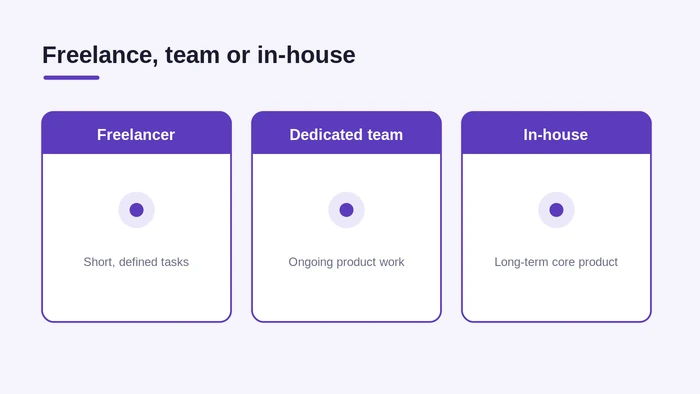
| Model | Best for | Cost note |
|---|---|---|
| Freelancer (zzp) | Short, defined tasks | Higher hourly, no employer costs, you manage it |
| Agency or dedicated team | Ongoing product work | Mid to high, but includes management and cover |
| In-house employee | Long-term, core product | Salary plus 25 to 35 percent employer overhead |
A freelancer is flexible but leaves you to manage the work, and carries no cover if they leave mid-project. An agency or dedicated team costs more per hour but supplies management, backup, and a wider skill set. An in-house hire suits a long-term core product, once you can keep them busy.
A qualitative comparison
Rates alone do not decide the cheapest route. Speed to start, management load, and continuity matter just as much. The table below compares the three models on the factors that move total cost, using ranges and plain labels rather than invented figures.
| Factor | Freelancer | Dedicated team | In-house |
|---|---|---|---|
| Hourly rate | Medium to high | Medium | Lowest per hour, highest total |
| Time to start | Fast | Fast | Slow, recruit and onboard |
| Management overhead | You carry it | Shared with provider | You carry it |
| Continuity and cover | Low | High | Medium |
| Best fit | Short tasks | Ongoing product | Permanent core role |
Read the table as a whole, not column by column. A freelancer with a high hourly rate can still be the cheapest choice for a two-week job, because you pay nothing between projects. An in-house hire with the lowest hourly rate can be the most expensive for occasional work, because you pay for every gap.
A salary is not the full cost of an in-house hire. Dutch employer costs add a large layer on top, and they are easy to forget when you compare a salary against an hourly rate.
- Employer taxes and social contributions, roughly 25 to 35 percent above salary.
- Holiday allowance (vakantiegeld), pension, and paid leave.
- Recruitment, onboarding, equipment, and software licences.
- Downtime between projects, which you still pay for.
A salary of €65,000 to €75,000 can cost €85,000 to €100,000 once these are counted. That is why an hourly rate that looks higher on paper is often cheaper overall for anything short of full-time, ongoing work. The comparison only holds when you keep an employee genuinely busy.
What drives a Node.js developer’s rate up or down
Two developers with the same job title can cost very different amounts. Three factors explain most of the gap, and understanding them helps you predict a quote before you ever receive it. Once you can read a quote in these terms, you stop comparing raw hourly figures and start comparing value, which is where the real savings live.
Seniority and specialism
Experience is the biggest lever, but specialism sharpens it. A developer who has handled high-traffic APIs, payment flows, or real-time systems commands more than a generalist. If your product needs that specific experience, the premium is fair. If it does not, you are paying for skills the work will never use.
Location and market demand
Where the developer sits sets a baseline, and local demand moves it. Backend developers stay in steady demand, as broad developer surveys such as the Stack Overflow Developer Survey show year after year, which keeps senior rates firm in the Netherlands. Nearshore markets ease that pressure without moving the work far away.
Engagement model and contract length
A longer commitment usually lowers the hourly rate. A developer or provider will often offer a better rate for a three-month booking than for a few scattered days, because steady work is worth more than an uncertain schedule. If you know the work is coming, saying so up front is one of the simplest ways to bring the rate down.
How to hire Node js developer talent, step by step
A clear process keeps the cost predictable and the quality high. These steps work whether you hire freelance, through an agency, or in-house.
- Step 1. Write the scope first. List the features, integrations, and the definition of done before you talk to anyone.
- Step 2. Match seniority to the task. Decide which parts truly need a senior and which a mid-level can own.
- Step 3. Choose the model. Short task, freelancer. Ongoing product, dedicated team. Permanent core role, in-house.
- Step 4. Shortlist and check real work. Look at code, past backends, and references, not just a CV.
- Step 5. Run a small paid test. A short, paid task shows more than any interview ever will.
- Step 6. Agree the terms in writing. Rate, scope, and review points, all settled before the work starts.
What to check before you sign
Ask to see how the developer handles errors, security, and testing, not just features that work on a happy path. Confirm who reviews the code and how progress is reported. A short paid trial on a real ticket tells you more than a portfolio, and it costs far less than a bad hire discovered three months in.
A real-world scenario
Say you need a Node.js backend for a new product, about four months of work, mid-level with senior review. Here is how the cost might break down, as a planning frame rather than a quote you can hold anyone to.
- Mid-level developer, nearshore, four months in the €55 to €65 per hour band: about €38,000 to €42,000.
- Senior review, a few hours a week across the project: about €6,000 to €9,000.
- Total for the build phase: roughly €44,000 to €51,000.
An in-house hire for the same period would cost a similar amount in salary and overhead, but it leaves you with a permanent cost after the project ships. The scenario is a way to think about the mix, not a fixed price. Your scope, seniority split, and location decide the final figure.
One more point on the scenario. If the same product needed ongoing changes after launch, a dedicated team on a rolling basis would usually beat both a fresh freelancer each time and a permanent hire you cannot keep fully loaded. The right answer depends on how much work follows the first release.
How to reduce the cost to hire Node js developer talent
You can lower the cost without cutting into quality. Each of these levers reduces spend by removing waste, not by buying weaker work.
- Match seniority to the task, so you do not pay senior rates for junior work.
- Use nearshore talent for EU rates with a close time zone.
- Hire a dedicated team instead of building an in-house function for a single project.
- Fix the scope first, because a clear spec prevents the change requests that inflate every bill. See how to reduce software development cost.
- Weigh the wider model. Our guide to software development outsourcing explains when it pays off.
- Compare related roles. Our cost to hire a Flutter developer guide uses the same method for mobile.
Common mistakes when hiring a Node.js developer
Most cost overruns come from a handful of avoidable errors. None of them are about the rate itself, which is exactly why they catch people out.
- Hiring on rate alone. The lowest hourly figure often hides slow delivery or code you pay to rewrite.
- Skipping the scope. Vague briefs turn into change requests, and every change request is billed.
- Buying seniority you do not need. A senior on junior tasks is money burned.
- Ignoring code review. One reviewer catching problems early is cheaper than fixing them in production.
- Forgetting the hidden employer costs when comparing an in-house salary to an hourly rate.
- Choosing offshore for work that needs constant back and forth, then paying for the coordination anyway.
The most expensive mistake
The costliest error is treating a security-sensitive backend as routine work. Node.js backends handle your data, your logins, and your integrations. A weak hire who ships insecure or slow code creates a bill you pay later, in incident response, lost trust, and rewrites. The saving on the rate never covers it.
Myths about Node.js developer costs
A few beliefs push teams toward the wrong decision. Here are the common ones, and what actually holds true once you look closely.
Offshore is always cheaper
Offshore has the lowest hourly rate, but total cost includes coordination, rework, and delay. For self-contained work it can win. For anything that needs daily collaboration, the hidden overhead often closes the gap with nearshore, and sometimes moves past it.
A senior is always worth it
Seniors prevent expensive mistakes, but not every task carries that risk. Paying senior rates for routine endpoints is waste. The skill is to place senior time where the risk lives, in architecture, security, and performance, and let a mid-level handle the rest of the build.
In-house is cheaper long term
In-house can be cheaper, but only when you keep the person fully busy. Add employer costs, downtime, and recruitment, and a half-used employee costs more than a dedicated team you scale up and down. The break-even point is steady, full-time work, not occasional bursts.
When not to hire, and the trade-offs to weigh
Hiring is not always the right first move, and the cheapest option is not always the right one. Being honest about the trade-offs saves money and regret in equal measure.
Do not rush a permanent in-house hire for a project with an end date. You will carry the salary long after the work is done. A dedicated team or freelancer fits fixed-term work far better. Equally, do not hand a core, security-critical backend to the cheapest junior you can find. Match the spend to the risk the code carries.
There are also times to pause hiring entirely. If your scope is still shifting, lock it down before you pay anyone by the hour, or you will fund the indecision. If the work is tiny, a fixed-price task may beat any hourly arrangement. The goal is to buy the right amount of skill, no more and no less.
Summary: what the cost really comes down to
In short: the cost to hire Node js developer talent comes down to three levers, seniority, location, and engagement model. Set the seniority to match the risk, use nearshore rates where you can, and pick the model that fits the length of the work. Do that, and you land near the lower end of the range without shipping weaker software.
Frequently asked questions
How much does it cost to hire Node js developer talent?
Roughly €30 to €130 per hour, depending on seniority and location, or about €55,000 to €85,000 per year for an in-house hire before employer costs. Nearshore and junior developers sit at the low end, while senior developers in the Netherlands sit at the high end of that band.
Is it cheaper to hire freelance or in-house?
For short or one-off work, freelance is usually cheaper because you avoid employer overhead like taxes, pension, and paid leave. For long-term, ongoing product work, an in-house hire can be more economical, but only once you keep that person fully busy across projects rather than paying for idle time.
What is the hourly rate for a senior Node.js developer in the Netherlands?
A senior Node.js developer in the Netherlands typically costs €90 to €130 per hour, or €80 to €100 excluding VAT as a zzp freelancer. The exact rate depends on specialism, demand, and how long you book them, with longer commitments usually earning a lower hourly figure.
How can I reduce the cost of hiring a Node.js developer?
Match seniority to the task, use nearshore talent for EU rates with a close time zone, hire a dedicated team instead of a full in-house function for one project, and fix the scope before you start. A clear specification prevents the change requests that inflate almost every bill.
Should I hire one Node.js developer or a team?
For a small, defined task, one developer is fine. For an ongoing product, a small team with a lead gives you cover, code review, and a wider skill set. That often works out at a better total cost than a single senior hire who quietly becomes a bottleneck.
What is the difference between nearshore and offshore Node.js developers?
Nearshore means a developer in a nearby country with a close time zone, usually within the EU for Dutch teams. Offshore means further afield, with the lowest rate but a larger time difference. Nearshore trades a slightly higher rate for easier communication and faster daily collaboration.
Do Node.js developer rates change with project length?
Yes. A longer, steady commitment usually earns a lower hourly rate, because predictable work is worth more to a developer than a few scattered days. If you know several months of work are coming, saying so up front is one of the simplest ways to bring the rate down.
Is hiring the cheapest Node.js developer a good idea?
Rarely. Node.js backends handle your data, logins, and integrations, so weak or insecure code costs far more to fix than a stronger developer costs to hire. For anything core to your product, match the spend to the risk. Save on routine work, not on the parts users and regulators feel.
Hire Node.js talent with Mobilions
Mobilions has built Node.js backends for clients in 20+ countries since 2016. Our team of 25+ engineers has delivered 250+ projects, and we hold a 4.8 out of 5 rating on Clutch across 35 reviews, with 98% client retention. We work from Amstelveen and Ahmedabad.
If you want to hire Node js developer talent without the overhead of recruiting one yourself, our team can supply the skill on a model that fits your project. Explore our backend developer hiring options, or book a short call to scope the work.
Tushar Patel is a software and AI strategist at Mobilions in Amstelveen, with 10+ years helping businesses build custom software, mobile apps and AI solutions. He writes practical, senior-level guides on development, hiring, and scaling products.