Custom Software vs Off the Shelf: How to Choose the Right Fit
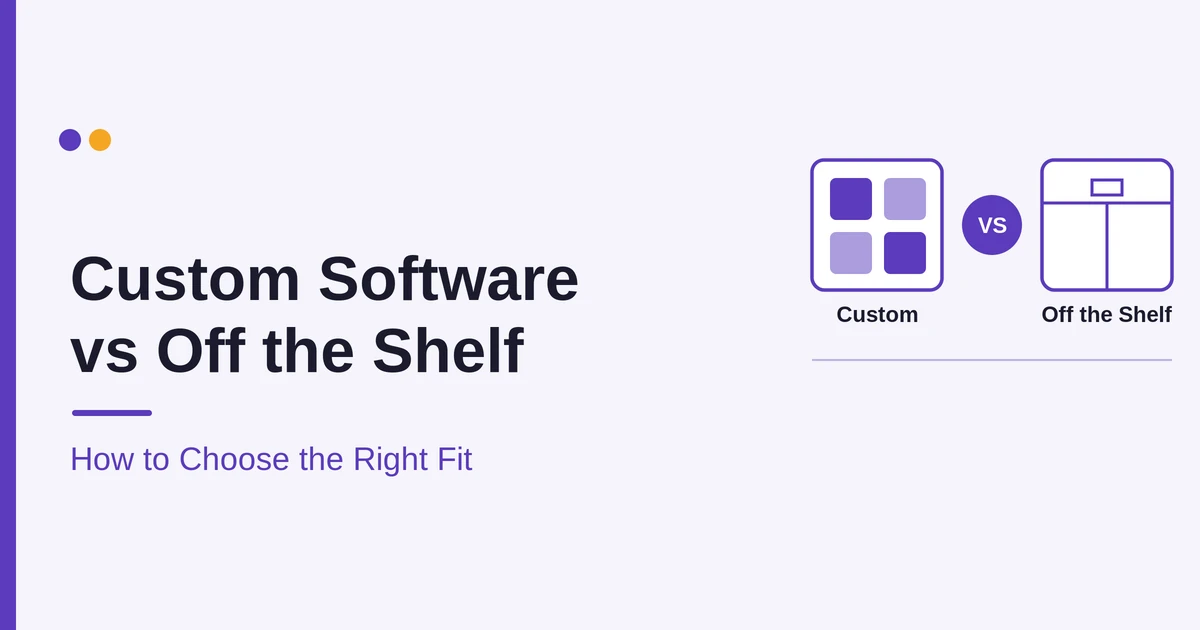
Custom software vs off the shelf is the build-versus-buy question almost every growing business hits: do you buy a ready-made product or have software built around your own processes? The short answer is that off the shelf wins on speed and low upfront cost, while custom wins on fit, ownership and long-term value.
This guide gives you the full custom software vs off the shelf comparison, a decision scorecard you can actually use, a 3-year and 5-year cost breakdown, a GDPR and EU AI Act section, and an honest view of when each option is the smarter choice. Prices and figures below are illustrative for the European market in 2026 and vary by scope, users and integrations. Use them to reason, not as a quote.
Custom software vs off the shelf: the short answer
Custom software is built specifically for one organisation, so it fits your exact processes and you own the code. Off-the-shelf software is a ready-made product sold to many companies: cheaper and faster to start, but you adapt to it and pay ongoing licence fees.
Choose off the shelf for standard needs and speed. Choose custom for unique processes, ownership and scale. Choose a hybrid of the two when part of your work is standard and part is a genuine differentiator. The rest of this guide helps you decide which of those three describes you.
What is custom software?
Custom software, also called bespoke or tailor-made software, is developed from the ground up for a single business and its specific workflows. Instead of forcing your team to work the way a generic product expects, the software is shaped around how you already operate.
That control extends to the parts that matter most. You own the source code, you decide the roadmap, and you can integrate deeply with the systems you already run. If your product is a mobile experience, custom development also covers the app layer, which we cover in app development.
The trade-off is a higher upfront investment and a build period measured in months rather than days. For organisations with a genuine competitive process or complex integrations, that investment usually pays back through efficiency and the absence of per-seat subscription fees. This is the core of any serious custom software development decision.
There is a strategic angle too. When the software is yours, the process it encodes is yours, and competitors cannot simply buy the same advantage off a shelf. For a differentiating workflow, that exclusivity is often the real return, not just the efficiency.
What is off-the-shelf software?
Off-the-shelf software is a commercial product built for a broad market and sold, leased or licensed to many customers at once. Familiar examples include tools for CRM, accounting, project management and email. You configure it, pay a subscription, and start using it quickly.
The appeal is real. You get low upfront cost, fast deployment, a proven product tested by thousands of users, and updates handled by the vendor at no extra effort on your side. For a standard need, that is often exactly what a business should buy.
The limit is fit. A product built for everyone rarely matches any one company exactly. So you adapt your process to the tool, live with features you never use, and depend on the vendor for changes, pricing and continuity. Studies repeatedly show most teams use only a fraction of the features they pay for, which is money spent on capabilities that deliver no value.
There are hidden costs too. Connecting a packaged product to your other systems can add up to 40% on top of the licence price, prices rise at renewal, and if the vendor changes direction or discontinues the product, you absorb the disruption. None of this makes off the shelf a bad choice, but it belongs in the comparison.
Custom software vs off the shelf: side-by-side comparison
Here is the custom software vs off the shelf comparison across the factors that actually affect your operations and budget.
| Aspect | Custom software | Off-the-shelf software |
|---|---|---|
| Upfront cost | Higher | Lower |
| Long-term cost | Lower, no per-seat fees | Grows with users and add-ons |
| Time to launch | Months | Days to weeks |
| Fit to your process | Exact | Approximate |
| Flexibility and scalability | High, built in | Limited by the vendor |
| Integrations | Built to fit your systems | Often an extra cost |
| Data and code ownership | You own it | Vendor-controlled |
| Security profile | Unique, less targeted | Common, a frequent target |
| Updates and maintenance | You or your partner | Handled by the vendor |
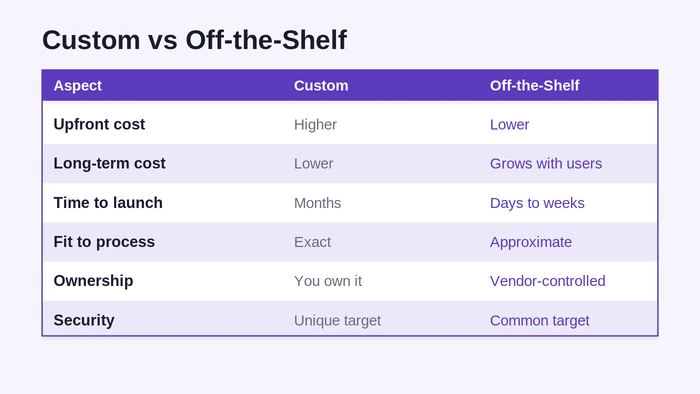
Bottom line of custom software vs off the shelf: off the shelf is the faster, cheaper start; custom is the better long-term fit when your processes are a differentiator or your integration and ownership needs are high. The next sections turn this table into a real decision.
Cost comparison: upfront price vs total cost of ownership
The sticker price misleads people. Off-the-shelf software looks cheaper because you see a small monthly fee, while custom software shows a large number on day one. The honest comparison is total cost of ownership over the years you will actually use the system.
Off-the-shelf cost is mostly recurring. Think per-user subscriptions, paid add-ons, integration work and price increases you do not control. Every extra seat and every renewal adds to the bill, and the vendor sets the direction.
Two hidden costs deserve a line of their own. Integration with your existing tools can add up to 40% beyond the licence, and because a generic product ships features for everyone, most teams actively use only a small share of what they pay for. This is where the custom software vs off the shelf maths tilts over the years.
Custom cost is mostly upfront. You pay for the build, then maintenance of roughly 15 to 20% of the build cost per year. For a custom build, a useful anchor is a senior developer rate of €70 to €130 per hour on the European market, and where the system runs on managed cloud services you add predictable hosting.
Because one cost is recurring and the other is upfront, the two lines cross at some point. Below that point off the shelf is cheaper; above it, custom is. The next section shows where that crossover tends to sit.
3-year and 5-year TCO comparison
To make the crossover concrete, here is an illustrative scenario: a team of 50 users, an off-the-shelf price of €60 per user per month, and a custom build of €80,000 with maintenance at roughly 17.5% per year. These are example figures to reason with, not a quote.
Over three years, off the shelf is still cheaper:
| Cost item | Off-the-shelf | Custom |
|---|---|---|
| Setup or build | €5,000 | €80,000 |
| Subscriptions, 3 years | €108,000 | none |
| Maintenance, 3 years | included | €42,000 |
| 3-year total | €113,000 | €122,000 |
Over five years, the lines cross and custom pulls ahead:
| Cost item | Off-the-shelf | Custom |
|---|---|---|
| Setup or build | €5,000 | €80,000 |
| Subscriptions, 5 years | €180,000 | none |
| Maintenance, 5 years | included | €70,000 |
| 5-year total | €185,000 | €150,000 |
The pattern is consistent. The more users you have and the longer you keep the system, the sooner custom wins on cost. For a small team or a short horizon, off the shelf usually stays cheaper. Run the same table with your own user count, price and build estimate before you decide, because the crossover point moves with every one of those inputs.
One more point on the numbers. Custom software typically reaches return on investment within two to three years for the right use case, mostly by removing subscriptions and the manual work that spreadsheets and glue-code hide. Off-the-shelf keeps its low entry price, but the meter never stops running.
The build-vs-buy decision scorecard
Most articles on custom software vs off the shelf end at “it depends.” This scorecard turns that into an answer. For each question, note whether your situation points left or right.
| Question | Points to off the shelf | Points to custom |
|---|---|---|
| Is your core process standard or a differentiator? | Standard | A differentiator |
| How fast do you need it live? | Weeks | Months is acceptable |
| Budget shape | Low upfront, subscription is fine | Capital available upfront |
| Integrations required | Few or none | Many or complex |
| How important is owning the code and data? | Low | High |
| Expected growth and scale | Modest or predictable | High or uncertain |
| Compliance demands | Standard | Strict or sector-specific |
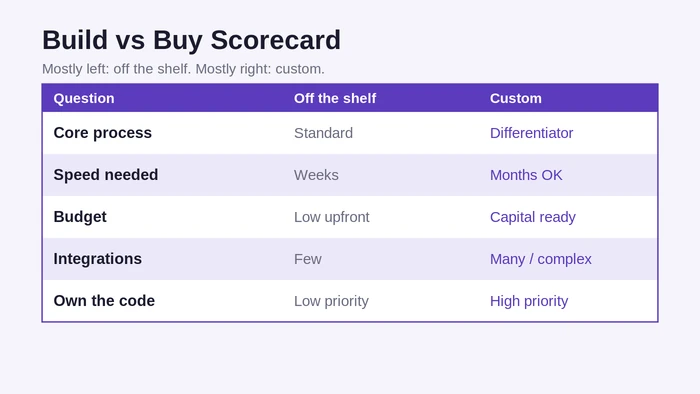
Tally your answers. Mostly left means off-the-shelf is likely the smart, economical choice. Mostly right means custom will fit better and pay back over time. A roughly even split points to the hybrid approach further down this guide.
The scorecard is deliberately simple because the decision usually is, once you separate what is standard from what is special. If you want a second opinion on where you land, an experienced partner can run it with you against real numbers.
When off-the-shelf software is the right choice
In the custom software vs off the shelf debate, off the shelf is the right call more often than software vendors admit. Choose it when the fit is good enough and speed matters more than perfection.
- Your process is standard, not a competitive edge
- You need something live in weeks, not months
- Upfront budget is tight and a subscription is acceptable
- A proven product already covers most of your needs
- Your team is small and integration needs are light
- You want the vendor, not your business, to own maintenance
If several of these describe you, buying is usually the faster route to value. Paying to rebuild what a good product already does well is rarely worth it, and the honest recommendation is often to buy and move on.
When custom software is the right choice
Custom software earns its higher upfront cost when a generic product would hold your business back. The clearest signal is that your core process is a differentiator you do not want to hand to a tool your competitors also use.
Choose custom when you have many or complex integrations, when owning the code and data matters for control or compliance, or when you expect growth that off-the-shelf pricing would punish. In regulated sectors such as fintech, the ability to control security and data handling end to end is often decisive.
Custom is also the answer when the honest truth is that no product on the market actually fits, and you are already paying for three tools plus manual work to bridge the gaps. A common trigger is the moment a subscription renewal lands and you realise you are paying more each year for software that still does not quite fit. That is often the point where building starts to make financial sense.
A concrete example helps. A logistics firm running a standard CRM, a separate planning tool and a spreadsheet to bridge them pays three subscriptions plus hours of manual reconciliation every week. Replacing that with one custom system removes the licences and the manual work at once, and usually pays back within a couple of years.
Signs you have outgrown off-the-shelf software
Most businesses do not decide between custom software vs off the shelf on day one; they grow into it. A few signals tell you the fit has run out.
You are paying for several overlapping tools and still bridge them by hand. Your team maintains workarounds and spreadsheets to make the software behave. Renewal prices climb faster than the value you get. You cannot get a change you need because it is not on the vendor’s roadmap. And your best process, the one that wins you customers, is squeezed into a tool that treats you like everyone else.
One or two of these is normal. Several together is the market telling you it is time to look at custom or a hybrid.
The hybrid approach: the best of both
Build versus buy is not always binary. Many of the strongest setups are hybrid: keep off-the-shelf products for standard, non-differentiating work, and build custom only where you compete or where nothing fits.
A typical hybrid keeps a proven CRM or accounting package and adds a custom layer, integration or portal on top. You get fast, cheap coverage for the commodity parts and tailored software exactly where it moves the needle.
It also spreads cost and risk. You build less, so you spend less upfront while still fixing the parts that hurt. If your scorecard came out mixed, hybrid is usually the answer, and it is how a lot of mature software landscapes are actually run.
For example, a retailer might keep an off-the-shelf webshop and accounting suite, then build a custom inventory and fulfilment layer that ties them together and matches how the business actually ships. The commodity parts stay cheap and proven; the part that decides customer experience is tailored.
Data ownership, GDPR and the EU AI Act
For European businesses, the custom software vs off the shelf decision is not only about features and cost. It is about who controls your data and where it lives. With custom software you own the code and can host data within EU regions, and where personal data is processed you put a data processing agreement in place. The framework here comes from the Dutch Data Protection Authority, which enforces the GDPR.
Off-the-shelf SaaS often stores data on the vendor’s terms, sometimes outside the EU, which can complicate GDPR compliance and data residency. That does not rule it out, but it is a question to ask before you sign, especially in regulated sectors.
Data residency is becoming a board-level question, not just an IT one. Knowing exactly where your data sits, who can access it, and under which contracts, is far easier when you own the system and choose the region it runs in. That clarity is one of the quieter reasons European firms lean custom for sensitive workloads.
If the software includes AI features, a second rule applies. The EU AI Act sets transparency and risk obligations per category. Custom builds let you design for those obligations from the start, and an experienced AI development partner can build the guardrails in. With a SaaS product you inherit whatever the vendor decides. None of this is legal advice, but it belongs in any serious build-versus-buy decision in Europe.
Common mistakes in the build-vs-buy decision
In projects we see the same avoidable mistakes on both sides of the custom software vs off the shelf choice. Each one is cheap to prevent once you know to look for it.
The first is comparing only the sticker price instead of the multi-year total cost of ownership. The second is buying off the shelf for a process that is actually your competitive edge, then quietly losing that edge to every competitor using the same tool.
The third is building custom for something a proven product already does perfectly well, which wastes months and money. The fourth is forgetting integration and maintenance in the budget, on either path. And the fifth is treating the decision as permanent: many businesses start off the shelf to move fast, then build once the fit and the numbers justify it.
How Mobilions approaches custom software
Mobilions builds custom and enterprise software since 2016, with 10+ years of experience, 25+ engineers and 250+ projects delivered across 20+ countries. Independently reviewed, we score 4.8 on Clutch (35 reviews), with 98% client retention.
Our starting point is not “always build.” We help you run the scorecard and the total cost of ownership honestly, and if a proven product is the better answer, we will say so. When custom or a hybrid is the right fit, we build software you own, hosted in EU regions, designed around your process.
Our author and point of contact on these topics is Tushar Patel, writing from Mobilions’ delivery practice, and you can read more about our team. Explore enterprise software development or browse our portfolio to see what we have built.
Not sure which side of custom software vs off the shelf you land on? Get a free build-vs-buy assessment and an honest recommendation. Contact us to talk it through. 4.8 on Clutch (35 reviews), 10+ years of experience, 250+ projects delivered.
Frequently Asked Questions
What is the difference between custom software and off-the-shelf software?
Custom software is built specifically for one organisation, so it fits your exact processes and you own the code. Off-the-shelf software is a ready-made product sold to many companies: faster and cheaper to start, but you adapt to it and pay ongoing licence fees.
Is custom software more expensive than off-the-shelf?
Upfront, yes. Over time, not always. Off-the-shelf cost is recurring (per-user subscriptions), while custom is mostly upfront plus 15 to 20% maintenance per year. For larger teams and longer horizons, custom often becomes cheaper on total cost of ownership, typically around year four or five.
When should I choose off-the-shelf software?
Choose off the shelf when your process is standard, you need something live in weeks, budget is tight, and a proven product already covers most of your needs. If the fit is good enough, buying is the faster route to value.
When is custom software worth it?
Custom is worth it when your core process is a differentiator, you have complex integrations, owning the code and data matters, you expect strong growth, or no product on the market actually fits and you already pay for several tools plus manual work.
Is custom software more secure?
It can be. Custom software is a less common target than widely used products and can be built to your exact compliance needs. Off-the-shelf products are patched by the vendor but are a frequent target once a vulnerability is public. Security depends on how well either is built and maintained.
Who owns the code in custom software?
You do. With custom development the source code, repository and accounts are yours. With off-the-shelf software you licence the product and depend on the vendor’s terms, roadmap and pricing.
Can I switch from off-the-shelf to custom later?
Yes, and many businesses do. A common path is to start off the shelf to move fast, then build custom once the fit and the numbers justify it, often migrating data into a new system built around your process.
How long does custom software take to build?
It depends on scope. A focused first version can take a couple of months, while a complete platform with many integrations and compliance needs takes longer. Working in sprints gives you a usable build early and lets you adjust scope.
The main ones are integration (which can add up to 40% beyond the licence), paid add-ons, price increases at renewal, and paying for features you never use. Over several years these can exceed the upfront cost of a custom build.
Can custom and off-the-shelf software be combined?
Yes. A hybrid setup keeps proven off-the-shelf products for standard work and adds custom software only where you compete or where nothing fits. It spreads cost and risk while still fixing the parts that matter most.
Tushar Patel is a software and AI strategist at Mobilions in Amstelveen, with 10+ years helping businesses build custom software, mobile apps and AI solutions. He writes practical, senior-level guides on development, hiring, and scaling products.