Software Development Outsourcing: Models, Costs and How to Choose
Software development outsourcing means handing the building of your software to an external partner instead of doing everything with in-house staff. The short version: you gain speed, scalability and access to skills you do not have, but you need clear requirements, good communication and ownership of the code to make it work.
This guide explains the models, gives indicative rates for 2026, and helps you choose with a decision table. You will also read when you should not outsource, the common mistakes to avoid, and the myths worth ignoring. The figures below are indicative and vary by role, model and location.
Software development outsourcing: the short answer
Software development outsourcing is having software built by an external team or agency rather than by your own employees. You pick an engagement model, from extra capacity to a full team, and pay for the hours or the result.
It fits well when you want to scale quickly, lack specific skills, or want to keep fixed costs low. The right model and location then decide how much you save and how smoothly it runs. This guide covers all of them so you can make the call with your eyes open. Nothing here is theory; it is how outsourcing works in practice. Rates range widely by location, from roughly €30 per hour nearshore to €140 for a senior developer.
Key takeaways
- Outsourcing gives you capacity and skills without the fixed cost of permanent staff.
- Four models exist: staff augmentation, dedicated team, project-based, and end-to-end.
- Location sets the trade-off: onshore is closest, nearshore balances rate and time zone, offshore is cheapest per hour.
- European rates run roughly €30 to €140 per hour, depending on seniority and location.
- Judge on total cost and communication, not on the hourly rate alone.
- Agree code ownership, data terms and maintenance before the build starts.
- Keep it in-house when the software is your core advantage, or when your requirements are still unclear.
What is software development outsourcing?
Software development outsourcing is contracting an external party to design, build and maintain your software. Instead of hiring developers as permanent employees, you work with an agency or an external team that supplies the capacity and expertise you need.
How it differs from hiring a freelancer
Outsourcing differs from hiring a single developer. When you hire, you add people to your own team and manage them yourself. When you outsource, you place a larger share of the work, and often the management, with the partner. Which of the two fits depends on how much you want to and can steer yourself.
A freelancer suits a small, contained task with light oversight. A partner suits a larger build where you want a team, a process, and someone accountable for delivery. The more moving parts a project has, the more a structured engagement pays off.
It is not all or nothing
Outsourcing is not all or nothing. You can outsource a small part of your software and keep the rest in-house, or hand over a complete product. Most companies start small and expand the relationship as trust grows, which keeps risk low while they learn how the partner works.
Why outsource software development?
The main reason to outsource software development is access to capacity and expertise you do not have in-house, without the fixed cost of permanent staff. For a startup or an SMB, that is often the difference between shipping and not shipping.
The benefits are concrete. You scale up or down in weeks instead of months, and pay only for what you use. You get experienced specialists for exactly the skills your project needs. And you keep your own team small and focused on your core business. That focus is often worth as much as the cost saving, because it lets your best people spend their time where it matters most.
There is a speed advantage too. An experienced partner already has the people, the processes and the tooling in place, so you do not lose months to recruitment and onboarding. That is why many growing companies have part of their custom software built rather than assembling a whole team first.
Outsourcing also spreads risk: you are not committing to permanent salaries for work that may be temporary. For many companies the strategic gain is focus. By handing the build to a partner, you keep your own people on the work that differentiates you, while the partner supplies the engineering, which is often the fastest route from idea to a working product.
The 4 models of software development outsourcing
Software development outsourcing does not happen in one way. There are four common models, and the choice decides how much you steer yourself.
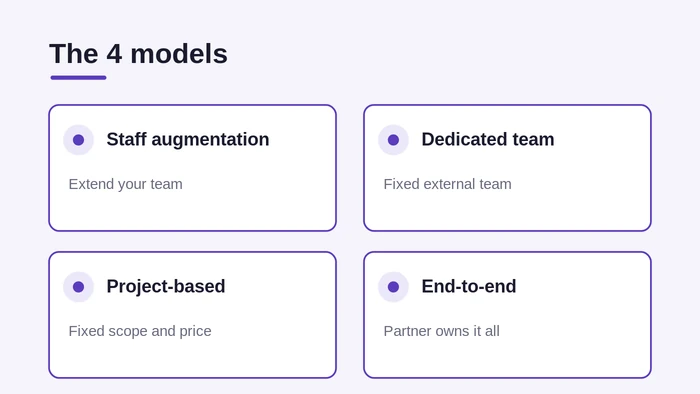
| Model | What it is | When to choose it |
|---|---|---|
| Staff augmentation | External developers extend your team | You have a team but lack capacity |
| Dedicated team | A fixed external team works long-term on your product | Ongoing development with your own roadmap |
| Project-based | Fixed scope and price, delivered as a finished product | A clearly defined project |
| End-to-end product | The partner owns it all, from strategy to maintenance | You lack the technical capacity entirely |
Staff augmentation
Staff augmentation adds external developers to your existing team. You keep control and manage the work day to day, while the partner supplies the people. It is the most flexible model and the easiest to scale up or down, which suits a team that has capacity gaps but strong technical leadership.
Dedicated team
A dedicated team is a fixed group that works long-term on your product. It gives continuity and knowledge retention, because the same people learn your systems and stay with them. This fits ongoing development where you own the roadmap but want the hiring and retention handled for you.
Project-based and end-to-end
Project-based work has a fixed scope and price, delivered as a finished product, and suits a sharp, self-contained build. End-to-end fits when you mainly want a result and prefer to hand the technology over, from strategy to maintenance. Many companies shift from one model to another as they grow, so pick for where you are now, not forever.
If you are unsure which model fits, look at how much you want to steer and how long the work runs. Short and self-managed points to staff augmentation or project-based. Long-term and hands-off points to a dedicated or end-to-end team.
Onshore, nearshore or offshore?
Besides the model, you choose a location, and that choice is about the balance between price, time zone and communication. Local is the most expensive but the closest; offshore is the cheapest but needs the most bridging.
| Location | Indicative rate | Trade-off |
|---|---|---|
| Onshore (your own country) | Highest | Same time zone, easiest to work with |
| Nearshore (nearby region) | €30 to €50 per hour | Small time difference, strong value |
| Offshore (further afield) | Lowest | Time zone, language and oversight |
Offshore is cheapest per hour but adds the cost of bridging time zones and heavier oversight, which can erase the saving if the work needs constant back and forth. Nearshore is the pragmatic middle: lower rates with a shared or close time zone. A local partner costs the most but is the easiest to work with day to day.
A common answer is a hybrid: a local point of contact with a team at a lower-cost location. A practical rule: the more a task needs daily coordination and quick decisions, the more time zone and language matter. The clearer and more self-contained the work, the more you can optimise for rate.
What does software development outsourcing cost?
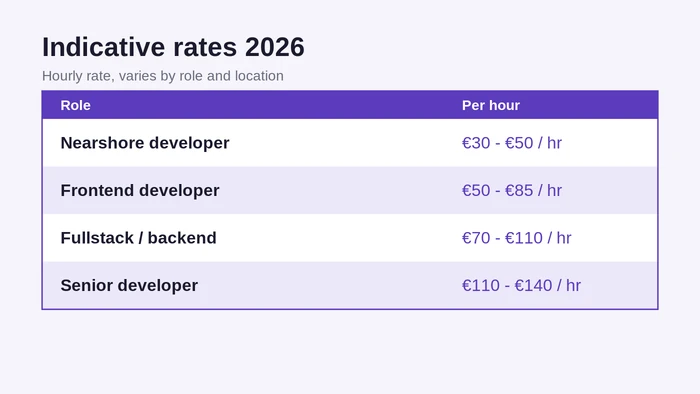
Software development outsourcing costs, in Europe, roughly €70 to €130 per hour for an average developer, with real spread by role and location.
| Role or model | Indicative hourly rate |
|---|---|
| Nearshore developer | €30 to €50 |
| Frontend developer | €50 to €85 |
| Fullstack or backend developer | €70 to €110 |
| Senior developer | €110 to €140 |
| In-house, salaried | €50,000 to €80,000 per year |
What drives the price
For comparison, a developer on your own payroll costs €50,000 to €80,000 per year plus employer charges, recruitment and onboarding. What drives the outsourcing price is seniority, location, the length of the engagement and how much management the partner takes on.
Do not judge on hourly rate alone. A cheap rate that leads to rework or delay costs more than a higher rate that gets it right the first time. Always ask how a party scopes a project before you compare on price, and price the whole engagement, including the coordination time your side will spend.
A worked cost example
Suppose you need two developers for six months. On your own payroll that quickly runs to well over €80,000 in salary, plus recruitment, onboarding and employer charges, and you carry the risk if the work dries up.
Outsourced, you pay only for the period you use the capacity and scale down when the project ends. For temporary or peak capacity, that comparison usually favours outsourcing. For a permanent, full-time need you can keep busy, an in-house hire can still win.
So run the numbers against your own workload. Include the soft costs on both sides: management and onboarding for a hire, coordination for a partner. That keeps the comparison honest instead of flattering one side.
Outsourcing vs hiring in-house
Short answer: hire in-house when software is a permanent, core capability you can keep busy; outsource when you want a result, flexible capacity, or skills you do not have.
| Aspect | Hiring in-house | Software development outsourcing |
|---|---|---|
| What you get | Employees on your payroll | A team or project at a partner |
| Management | You manage them | The partner manages, or shared |
| You need | Own leadership and process | Clear goals and communication |
| Cost shape | Salary plus employer costs | Team or project budget |
| Best for | Long-term, full-time need | Ongoing or defined build work |
Many companies combine the two. They keep a small in-house core for direction and use an outsourcing partner for peaks and for skills that do not justify a permanent hire. If you need to add capacity fast, you might hire full-stack developers or back-end developers to extend your team while a partner handles a larger build.
How to choose an outsourcing model
Most guides end at “it depends.” This table turns the decision into an answer. For each question, note which way you lean.
| Question | Points to in-house or augmentation | Points to full outsourcing |
|---|---|---|
| Do you have technical leadership? | Yes | No |
| Is the work temporary or ongoing? | Small and temporary | Large or ongoing |
| Do you have the skills in-house? | Mostly | Barely |
| Budget shape | Hourly per person | Team or project budget |
| How important is fast scaling? | Less | Very |
Lean mostly left and you are well served by building in-house or augmenting your team. Mostly right means full outsourcing fits better. A mixed picture points to a hybrid, where you keep the core and outsource the rest. The table gives you a direction, not a verdict, so confirm it with a short first engagement before you commit to a long one.
How to outsource software development step by step
A software development outsourcing engagement runs in five steps in practice, from first call to ongoing maintenance.
- Discovery and goals
- Scope, model and rate agreed
- Onboarding and access to systems
- Build in sprints with regular demos
- Launch, maintenance and further development
It starts with a conversation about what you want to achieve and which systems already exist. Then you fix the scope, the model and the rates, so both sides know where they stand. A good partner invests in onboarding, because a team that understands your context delivers usable work sooner.
During the build you work in short sprints with regular demos, so you always see progress and can adjust. After launch, software still needs maintenance, so agree up front who does it. Maintenance is not an afterthought; it is where a lot of software quietly fails, so name an owner and a budget for it from the start.
Whether you outsource the app, the backend or the cloud and DevOps around it, the rhythm is the same, and clear scope at the start saves weeks of rework later. A good rule for the whole engagement: the more you fix up front about goals, scope and agreements, the smoother the rest runs. The hours you spend on preparation you earn back several times over during the build.
Software development outsourcing for startups and SMBs
For startups and SMBs, outsourcing is often the most realistic way to build serious software. Standing up an in-house team is slow and expensive, while outsourcing gives you experienced developers without the fixed cost.
As a smaller company, focus on flexibility and an honest point of contact. You rarely have a large IT function to manage a partner, so choose one that thinks along, makes the scope clear and delivers in small steps. Start with a defined first project, build trust, and expand from there. That keeps you in control and the risk contained, even with a small team.
A real-world scenario
The following scenario is illustrative, not a real client, and the figures are ranges rather than exact numbers. It shows how the models and locations fit together in practice.
Picture an early-stage company with one technical founder and a working prototype. They have paying users and a roadmap, but not the people to build it out. Hiring a full team would take months and lock in salaries before revenue is steady.
Instead they start with staff augmentation: two nearshore developers at roughly €30 to €50 per hour, extending the founder’s work for a defined first release. Once the product proves itself, they move to a dedicated team for continuity, keeping the founder on architecture and product direction.
The lesson is not the numbers, which vary widely, but the sequence. Start small and self-managed, prove the partner, then expand the model as the work and the trust grow. That path keeps early risk low and avoids paying for a large team before the product needs one.
Data security, IP ownership and compliance
Outsourcing means an external party works with your data and code, so put the agreements in writing. Where personal data is involved, build to the GDPR, keep data in the right regions, and sign a data processing agreement.
The framework here is enforced by the Dutch Data Protection Authority for EU work. If your software includes AI features, the EU AI Act adds obligations by risk category.
Just as important is ownership of the code. Agree that everything the partner builds lands in your own repository, under your accounts and licences, so you never get stuck on intellectual property if you change providers. This is not legal advice, but data and IP belong at the centre of any serious outsourcing decision, not the end.
A trustworthy partner offers these terms as standard. Data residency is increasingly a board-level question, not just an IT one. Knowing exactly where your data sits and who can access it is far easier when the contract is explicit and the partner works in the regions you require.
When not to outsource software development
Honest answer: outsourcing is not always the best choice. In a few cases you are better off keeping it in-house.
If the software is your core product and biggest competitive advantage, you often want to build that knowledge in-house rather than give it away. If you do not yet have clear requirements, outsourcing frequently fails, because a partner cannot build what you cannot explain, so work that out first.
Outsourcing is also risky if you have no time for collaboration, because a good result needs regular contact between you and the partner. And for a small, one-off change to existing software, a single freelancer or your current agency is usually simpler than a whole outsourcing engagement.
Myths and misconceptions
A few myths make outsourcing look worse, or easier, than it is. Clearing them up helps you plan with realistic expectations.
The first myth is that outsourcing is always cheaper. It often lowers cost, but a low rate with weak communication can cost more once you count rework and management time. The saving is real only when scope and contact are handled well.
The second myth is that you lose all control. With staff augmentation or a dedicated team, you keep the roadmap and the day-to-day steering. Control is a choice of model, not something you give up by outsourcing at all.
The third myth is that offshore always means lower quality. Quality tracks the team and the process, not the postcode. The real cost of distance is coordination and time zones, which you manage with clear scope and regular demos.
The fourth myth is that you can hand over a vague idea and get finished software back. You cannot. A partner builds what you can explain, so the clearer your requirements, the better the result, whichever model you pick.
Common mistakes in software development outsourcing
The same avoidable mistakes come up again and again in software development outsourcing, and they are cheap to prevent once you know them.
The first is unclear requirements. Most failed engagements start with a scope that was never written down. The second is choosing on hourly rate alone, without weighing quality and communication.
The third is planning too little collaboration, so the result drifts from what you meant. The fourth is forgetting to agree ownership and maintenance. And the fifth is picking the cheapest offshore option without counting the extra time to bridge distance. All of these start at the beginning, in the agreements, not during the build. The lesson is simple: an hour spent on a clear scope and solid agreements saves weeks of rework later, whichever model and location you choose.
How to choose an outsourcing partner
When you choose a party to outsource to, look at the points that separate a successful engagement from a failed one:
- Ownership of the code, repository and accounts stays with you
- A demonstrable track record in your kind of software
- A single point of contact and clear communication
- Transparent rates and an honest scope estimate
- Clear agreements on data, IP and compliance
- A way of working in sprints with visible interim results
Watch for red flags too. A party that quotes without understanding your scope pushes the risk onto you. A rate that looks too good usually is.
And work where the code stays in the agency’s name costs you twice later. Ask for references and, where possible, speak to a past client. A partner that is proud of its work will happily connect you; one that hesitates is telling you something. Those few checks at the start are the cheapest insurance you will buy in the whole engagement.
Summary
In short: outsourcing gives you skills and capacity without permanent salaries, as long as you set it up with care. Pick the model that matches how much you want to steer, and the location that matches how much daily coordination the work needs.
Compare on total cost and communication, not on the hourly rate alone, and settle code ownership, data terms and maintenance before the build begins. Start with a small first project, prove the partner, then scale the relationship as trust grows.
Why Mobilions
Mobilions builds software for companies that want to outsource since 2016, with 25+ engineers and 250+ projects delivered across 20+ countries. Independently reviewed, we score 4.8 on Clutch (35 reviews), with 98% client retention.
We work with an engineering team in Ahmedabad and an office in Amstelveen, so you combine a sharp rate with a European point of contact and work that meets the GDPR. Whether you need a single skill or a full team for enterprise software or an app, we match the model to your work.
You can start with one developer and scale to a full team as the work grows, adjusting the model and seniority to what you actually need. Read more about our team or browse our portfolio. The aim is a partnership that fits how you work, delivers software you own, and scales with you as your needs change.
Thinking about software development outsourcing and want to know what fits your situation? Contact us for an honest, no-obligation recommendation. 4.8 on Clutch (35 reviews), 250+ projects delivered, 20+ countries.
Frequently Asked Questions
What is software development outsourcing?
Software development outsourcing is having software built by an external team or agency rather than by your own employees. You pick an engagement model, from extra capacity to a full team, and pay for the hours or the result. It fits when you want to scale fast, lack skills, or keep fixed costs low.
What does software development outsourcing cost?
In Europe, roughly €70 to €130 per hour for an average developer. Nearshore runs €30 to €50, and a senior €110 to €140. A salaried in-house developer costs €50,000 to €80,000 per year plus employer costs. Seniority, location, engagement length and how much management the partner takes on set the price.
What are the four models of software development outsourcing?
Staff augmentation, where external developers extend your team; a dedicated team, a fixed external team working long-term; project-based, with a fixed scope and price; and end-to-end, where the partner owns everything from strategy to maintenance. The model you choose decides how much you steer the work yourself.
Onshore, nearshore or offshore: which is best?
Onshore is easiest to work with but the most expensive. Nearshore offers lower rates with a close time zone. Offshore is cheapest per hour but adds time-zone, language and oversight overhead. For work that needs constant coordination, nearness matters; for well-defined work, the rate matters more.
Is outsourcing cheaper than hiring in-house?
For short or uncertain work, usually yes, because you pay only for what you use and avoid recruitment and idle time. For a permanent, full-time need you can keep busy, an in-house hire can be cheaper because you avoid the agency margin. The deciding factor is how much steady work you have.
Is it safe to outsource software development?
Yes, if you set it up well. Work to the GDPR where personal data is involved, keep data in the right regions, and sign a data processing agreement. Agree security and access up front, and choose a partner that offers these terms as standard rather than as an add-on.
Who owns the code when you outsource software development?
You should, if you agree it. Make sure everything the partner builds lands in your own repository, under your accounts and licences. Then you never get stuck on intellectual property if you change providers. A trustworthy partner offers full code ownership by default, not as a paid extra.
How do I avoid an outsourcing project failing?
Most failures start with unclear requirements. Write the scope down, plan regular contact, choose on quality and communication rather than on rate alone, and agree ownership and maintenance before you start. An hour spent on a clear brief saves weeks of rework later in the build.
Tushar Patel is a software and AI strategist at Mobilions in Amstelveen, with 10+ years helping businesses build custom software, mobile apps and AI solutions. He writes practical, senior-level guides on development, hiring, and scaling products.