Most “app cost” articles give you a number so wide it's useless — somewhere between five thousand and half a million euros. That's technically true and completely unhelpful. This guide does the opposite: it breaks down what actually drives the price, what a real app costs in the Netherlands in 2026, and where teams quietly overspend.
We build apps for Dutch and EU businesses every week, so these are working numbers, not a sales brochure.
The short answer
In 2026, a custom mobile app in the Netherlands typically costs between €20,000 and €150,000+, depending on complexity:
- Simple app (a few screens, one platform, basic backend): €20,000 – €40,000
- Medium app (custom features, API, two platforms, login, payments): €40,000 – €90,000
- Complex app (real-time data, AI features, integrations, high scale): €90,000 – €150,000+
A focused first version (MVP) usually starts at the lower end so you can launch, learn, and invest more once it's proven.
What actually drives the cost
Price isn't about “how big” the app feels. It comes down to a handful of real factors.
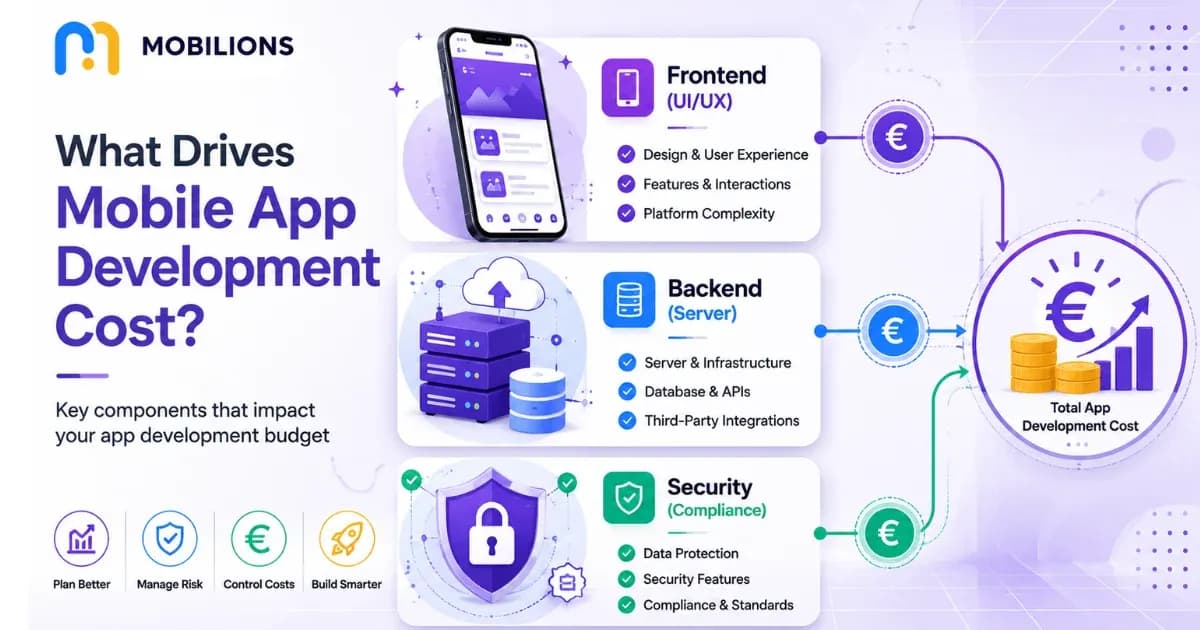
1. Number of features (and how custom they are). A login screen is cheap. A login that ties into your existing CRM, supports single sign-on, and handles role-based access is not. Every feature has a “standard” version and a “your-business” version, and the gap between them is where budgets move.
2. Platforms: iOS, Android, or both. Building separately for iOS (Swift) and Android (Kotlin) gives the deepest quality but roughly doubles the front-end work. Cross-platform tools like Flutter or React Native build both from one codebase and usually cut that part of the cost by 30–40% — which is why most Dutch business apps go cross-platform unless they need heavy native features.
3. The backend nobody sees. Almost every app needs a server behind it: the API, the database, authentication, and the admin panel your team uses. This is often a third of the total and is the part clients most often forget to budget for.
4. Design and UX. A template looks like a template. Real user research, a proper design system, and tested prototypes cost more upfront but save expensive rebuilds later.
5. Compliance (GDPR/AVG, and now the EU AI Act). Any app handling Dutch users' data must meet GDPR and the Dutch AVG. If your app uses AI, the EU AI Act (key rules enforced from August 2026) adds transparency and governance requirements. Building this in from day one is far cheaper than retrofitting it after launch.
6. Who builds it. A freelancer is cheapest per hour and riskiest overall. A large agency is most expensive. A focused senior team usually lands in between, with the advantage that the same people own design, app, and backend — so nothing gets lost in handover.
Cost by app type (real ranges)
| App type | Typical range (NL, 2026) |
|---|---|
| MVP / proof of concept | €15,000 – €30,000 |
| Marketplace / booking app | €40,000 – €90,000 |
| FinTech / payments app | €60,000 – €150,000+ |
| Healthcare app (compliant) | €60,000 – €150,000+ |
| AI-powered app | €50,000 – €150,000+ |
| Internal business tool | €25,000 – €70,000 |
These assume both platforms plus a backend. A single-platform MVP costs less.
The hidden costs people forget
- Maintenance: budget roughly 15–20% of build cost per year for updates, OS changes, and fixes.
- App store fees: Apple and Google developer accounts, plus their cut on in-app payments.
- Third-party services: maps, SMS, payment gateways, AI model usage — these are monthly bills, not one-offs.
- Scaling: an app that's cheap at 100 users can get expensive at 100,000 if nobody planned for it.
How to spend less without cutting corners
- Start with an MVP. Build the core, launch, and let real usage decide what to fund next.
- Go cross-platform unless you genuinely need native depth — Flutter or React Native saves real money.
- Use one team for app + backend. Coordinating three vendors costs more than the savings.
- Fix scope before building. Most overruns come from decisions changed mid-build, not from the original plan.
- Get a fixed proposal first. A clear scope and price beats an open hourly meter.
What this looks like at Mobilions
We usually begin with a small, fixed-scope discovery, then give you a written proposal in euros — scope and price set out plainly, no hourly meter, no surprises on the invoice. The same senior team handles app development, the backend, and, where you need it, custom software around it. If a simpler approach saves you money, we'll say so before you commit.
Want a fixed number for your app? Tell us what you're building and we'll send a written proposal in euros.
Frequently Asked Questions
How much does it cost to build an app in the Netherlands in 2026?
Most custom apps cost between €20,000 and €150,000, depending on features, platforms, backend and compliance. A focused MVP usually starts at €15,000–€30,000, while complex FinTech, healthcare or AI apps reach the upper end. We share a fixed estimate after a short discovery call.
Is cross-platform cheaper than native app development?
Usually yes. Cross-platform tools like Flutter and React Native build for iOS and Android from one codebase, cutting front-end cost by roughly 30–40%. Native (Swift/Kotlin) costs more but gives the deepest device access. The right choice depends on your features, performance needs and budget.
Why is the backend such a big part of app cost?
Because the app you see is only half the product. The API, database, authentication and admin panel behind it often make up a third of the total. Skipping this in your budget is the most common reason quotes feel “too low” at first.
Does GDPR or the EU AI Act increase app development cost?
A little, but far less than fixing it later. GDPR/AVG data handling and, for AI apps, EU AI Act transparency rules (enforced from August 2026) are cheaper to build in from the start than to retrofit after launch.
How can I reduce my app development cost?
Start with an MVP, choose cross-platform where it fits, use one team for app and backend, lock the scope before building, and get a fixed-price proposal. These five choices remove most of the budget risk.