Containerization & Orchestration with Docker and Kubernetes
The classic excuse, "it works on my machine", stops being a problem when your app ships in a container. Containers package the code and everything it needs to run into one consistent unit that behaves identically on a laptop, a test server and production. We containerise apps with Docker and orchestrate them at scale with Kubernetes.
Start Your Project- Senior engineer replies within 24 hours
- NDA on request
- No obligation
Describe your project
Share a few details and our team will reach out to you within 24 hours.
The Problem Containers Solve
Containers — package once, run anywhere, scale on demand.
For years, software teams struggled with applications behaving differently across development, testing, and production environments. Small differences in dependencies, configurations, or system settings often led to unexpected issues and time-consuming troubleshooting.
Containers solve this problem by packaging applications and everything they need to run into a single, portable unit. The result is consistent performance across every environment, from a developer's laptop to production.
Containers also make scaling much easier. Instead of upgrading servers, businesses can simply run more container instances as demand grows, creating a flexible and efficient foundation for modern cloud infrastructure and the rest of our DevOps services.
Why Containers Matter for Your Product
Beyond ending environment bugs and making scaling simple, containers bring a set of practical advantages that compound over the life of a product.
Universal consistency
Runs identically on every machine and in every environment
Scale out, not up
Scales by running more copies, not by buying bigger servers
Fast deploys and rollbacks
Faster deploys and near-instant rollbacks to a previous version
Lower hosting cost
Better use of server resources, which lowers hosting cost
Isolated failures
Isolation between services, so one failure stays contained
Cloud portability
Portable between cloud providers, reducing lock-in
That last point is worth dwelling on. Because a container is self-contained and standardised, a containerised application is far easier to move between cloud providers than one wired directly into a single provider's services. If your circumstances change, the container that ran on one cloud will run on another with far less rework. It is not magic portability, but it is a meaningful reduction in how locked-in you are.
Docker and Kubernetes
Docker packages applications into portable containers, while Kubernetes automates deployment, scaling, and management. Together, they create a reliable, scalable, and efficient foundation for modern cloud-native applications.
Docker (Containerization)
Docker is how an application becomes a container in the first place. It is the foundation of modern deployment: almost every containerised system in the world starts with a Docker image. We containerise your application by writing clean, efficient Docker images that build quickly, stay small, and carry exactly what the app needs and nothing more. A well-built image is the difference between fast, reliable deploys and slow, bloated ones, and it is the first thing we get right before anything else.
What we deliver: clean, optimised Docker images for your application, set up to build automatically in your pipeline and ready to run anywhere.
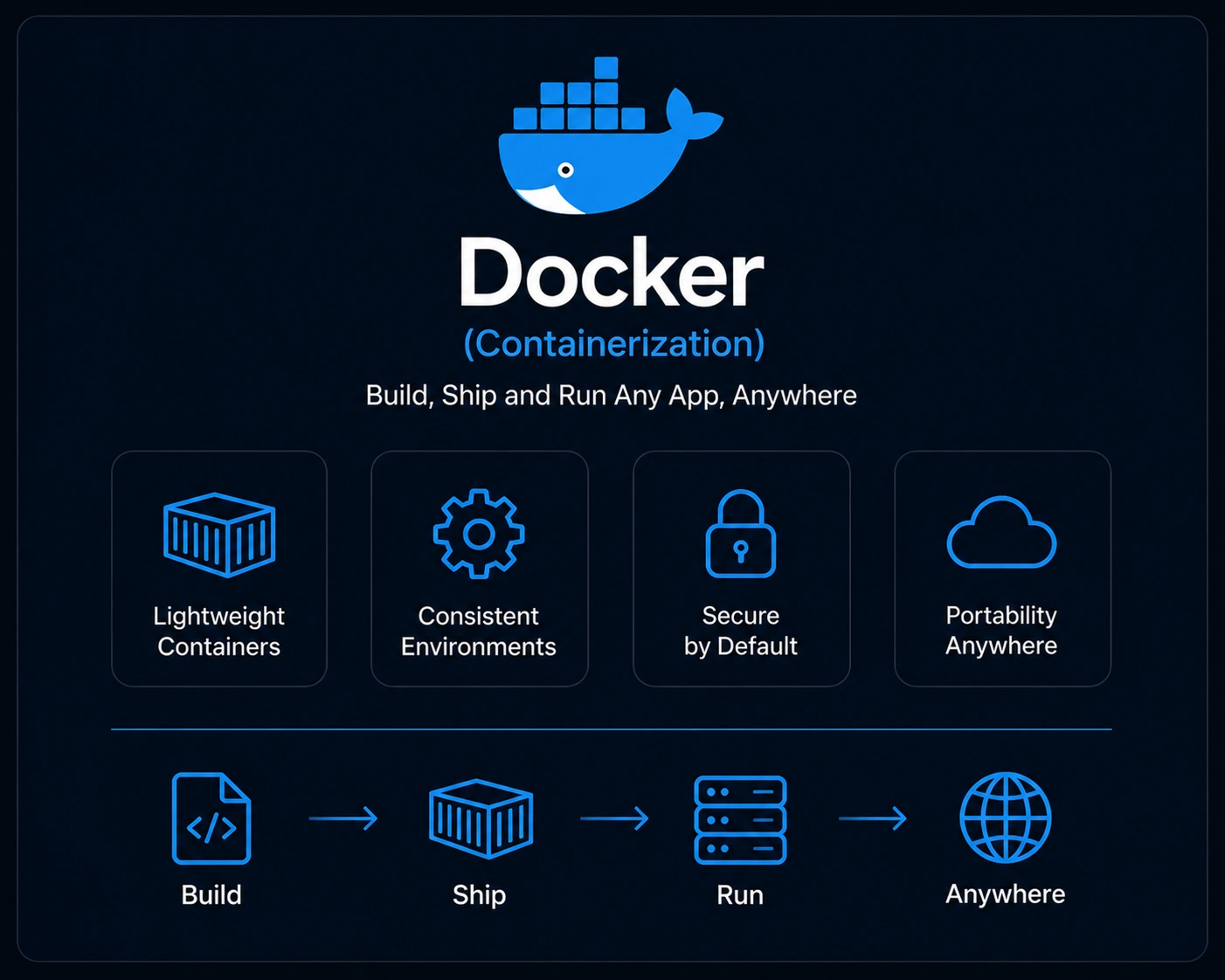
- Packages your app and all its dependencies into one image
- Identical behaviour on laptop, test and production
- Small, efficient images that build and deploy fast
- The essential starting point for any container strategy
Kubernetes (Orchestration)
Once you are running more than a handful of containers, you need something to run, scale and heal them automatically, and that something is almost always Kubernetes. It schedules containers across a fleet of servers, restarts any that crash without anyone being paged, scales the number of running copies up when load rises and back down when it falls, and rolls out new versions without taking the service offline. It has become the industry standard for running containers in production at scale, and for good reason: it automates the operational work that would otherwise consume a team.
What we deliver: a Kubernetes setup sized to your actual needs, running on managed Kubernetes from your cloud provider so you are not maintaining the cluster itself by hand.
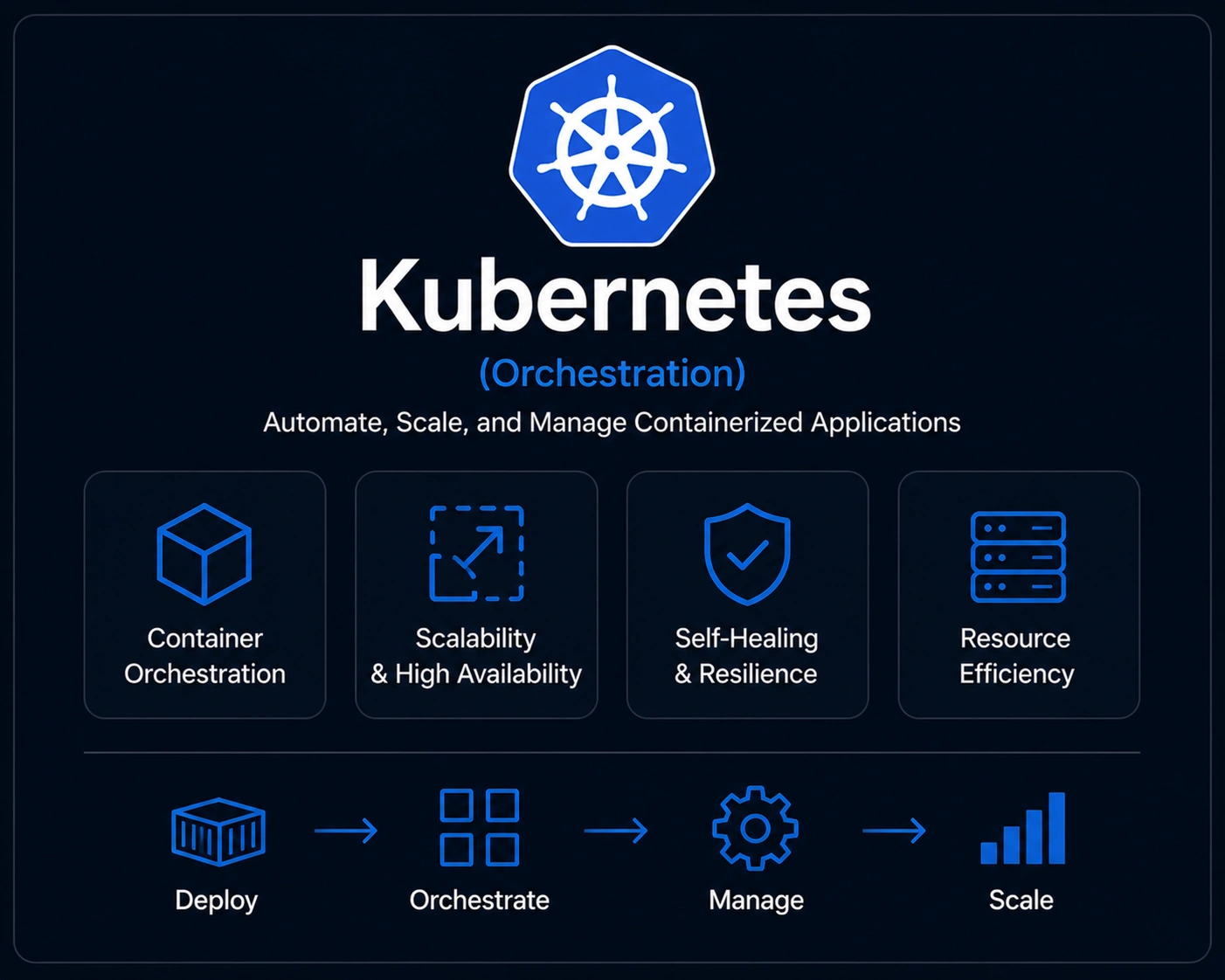
- Runs and scales containers automatically across many servers
- Self-healing: restarts failed containers on its own
- Zero-downtime rolling updates, with easy rollbacks
- Scales up under load and back down to save cost
Do You Actually Need Kubernetes?
Kubernetes is a powerful platform for managing containers at scale, but it is not always the right solution for every application. We help businesses evaluate their requirements, avoid unnecessary complexity, and choose the container strategy that delivers the best balance of performance, scalability, and operational efficiency.
Assess Your Infrastructure Requirements
We begin by understanding your application architecture, workload demands, and operational goals to identify the most suitable container strategy.
Choose the Right Level of Complexity
Not every application requires Kubernetes. We help you select the simplest solution that delivers the performance, reliability, and scalability you need.
Leverage Kubernetes Where It Matters
For applications with complex deployments, dynamic workloads, or microservices architectures, Kubernetes provides the automation and resilience needed to operate at scale.
Build for Long-Term Scalability
Our approach balances current requirements with future growth, ensuring your infrastructure can evolve efficiently as your business and technology needs expand.
How Containers Fit With the Rest of Your Stack
Containers are most effective when integrated with the broader DevOps ecosystem. Combined with cloud infrastructure, CI/CD pipelines, and automation tools, they create a reliable, scalable, and efficient software delivery workflow.
The wider DevOps picture
Containers do not work in isolation; they sit in the middle of the wider DevOps picture and connect the other pieces together. The infrastructure they run on is defined as code with Terraform. The cloud provider supplies the servers and, usually, a managed Kubernetes service so you are not running the control plane yourself. And the CI/CD pipeline is what builds the container in the first place, tests it, and deploys it to the cluster automatically every time a developer pushes a change.
How it flows in practice
In a setup we build, the typical flow is: a commit triggers the pipeline, the pipeline builds a fresh Docker image and runs the tests against it, and if everything passes, it deploys that image to a Kubernetes cluster running on managed infrastructure in your chosen cloud. Kubernetes then handles keeping the right number of copies running and rolling out the new version without downtime. Each piece has a clear job, and because we design them together, the handoffs between them are clean rather than fragile.
Frequently Asked Questions
Find answers to common questions about Docker, Kubernetes, containerization, orchestration, cloud deployments, and modern DevOps practices.
Docker packages an application into a container, a portable unit that runs the same everywhere. Kubernetes manages many containers across many servers, handling scaling, restarts and updates automatically. In short, Docker creates the containers and Kubernetes runs them at scale. Most systems use both: Docker to build, Kubernetes to orchestrate. You can use Docker without Kubernetes, but not the other way around.
Many smaller products run perfectly well on Docker alone or a simple managed container service, which is cheaper and easier to maintain. Kubernetes becomes worth its complexity when you have many services, need automatic scaling, or run across multiple environments. We recommend the simplest option that fits your situation and scale up only when you genuinely need it, rather than selling complexity you do not require.
Yes. Containerising an existing app is a common project for us. We package it into clean Docker images, sort out its configuration and dependencies, and set it up to deploy consistently across environments. From there we can add orchestration with Kubernetes if and when the scale justifies it, but the first step is simply getting the app reliably containerised.
They fit together naturally and are stronger combined. A CI/CD pipeline builds your Docker image, runs the tests, and deploys it to your cloud or Kubernetes cluster automatically. All the major clouds offer managed Kubernetes, so the container you build runs the same way in production. We connect the whole path from a developer's commit to a running container, with checks at each stage.
Containers are secure when they are set up correctly, and insecure when they are not, like most things. We use trusted base images, scan them for known vulnerabilities, keep them minimal to reduce the attack surface, and configure isolation and access controls properly. Security is part of how we build the images and the cluster from the start, not a step bolted on at the end.
Often, yes. Containers use server resources more efficiently than running each application on its own dedicated server, because many containers can safely share the same machine. And Kubernetes can scale the number of running copies down automatically when load is low, so you stop paying for idle capacity. The exact saving depends on your current setup, which we assess before promising any numbers.
It does not have to be. We containerise an existing application alongside your current setup, prove that the containerised version behaves correctly, and only then switch traffic over. Your developers do not need to become container experts overnight; we handle the container and infrastructure side and keep the day-to-day workflow as familiar as possible for the team.