Medical Translation App for Healthcare Professionals
Careslate is a HIPAA-compliant AI translation app that lets a doctor and patient who do not share a language understand each other in real time, through live two-way audio and on-screen subtitles. No account, no login, no card. A clinician opens it, picks two languages, and the conversation simply works, with medical wording kept accurate.
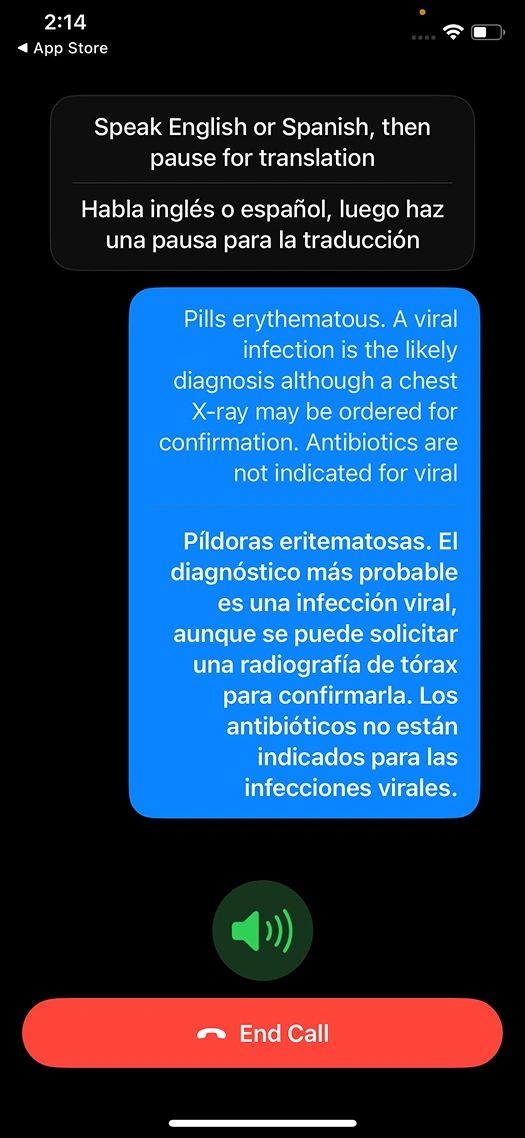
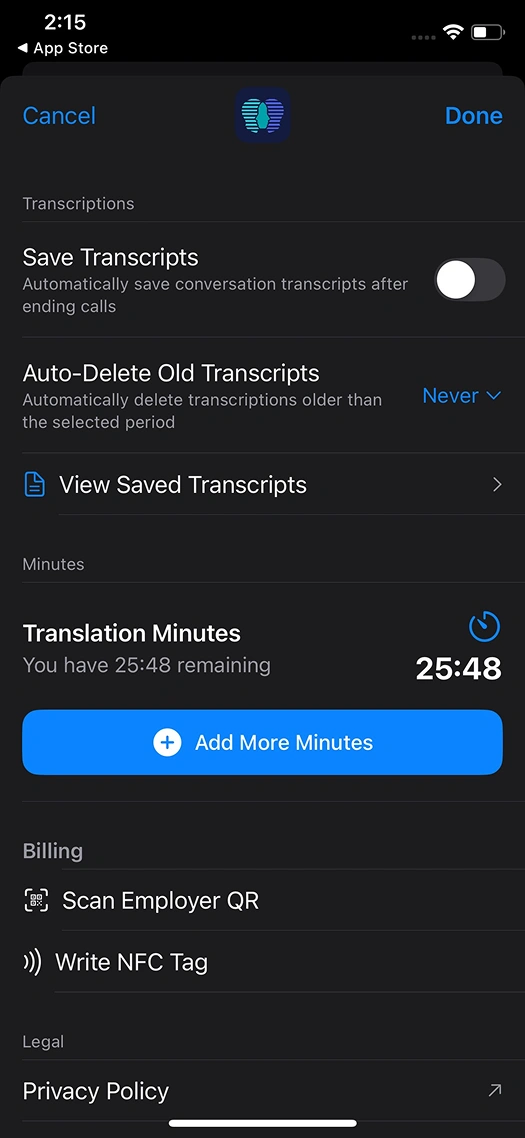
How Careslate looks in action
Real conversations between healthcare providers and patients, translated in real time with medical terminology kept accurate. The interface stays calm and uncluttered, because the exam room is stressful enough without a confusing app, and everything the clinician needs is a tap away.
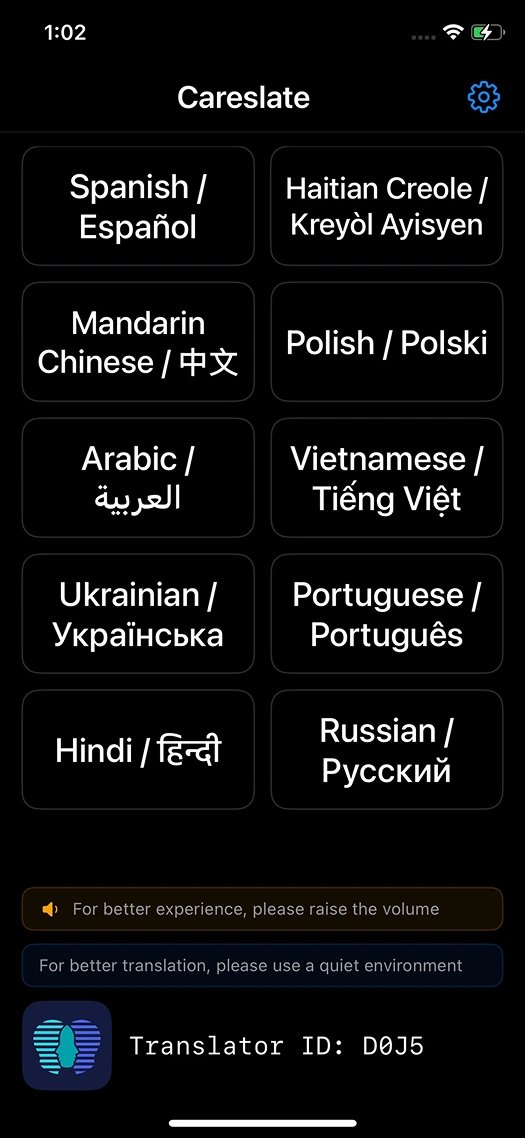
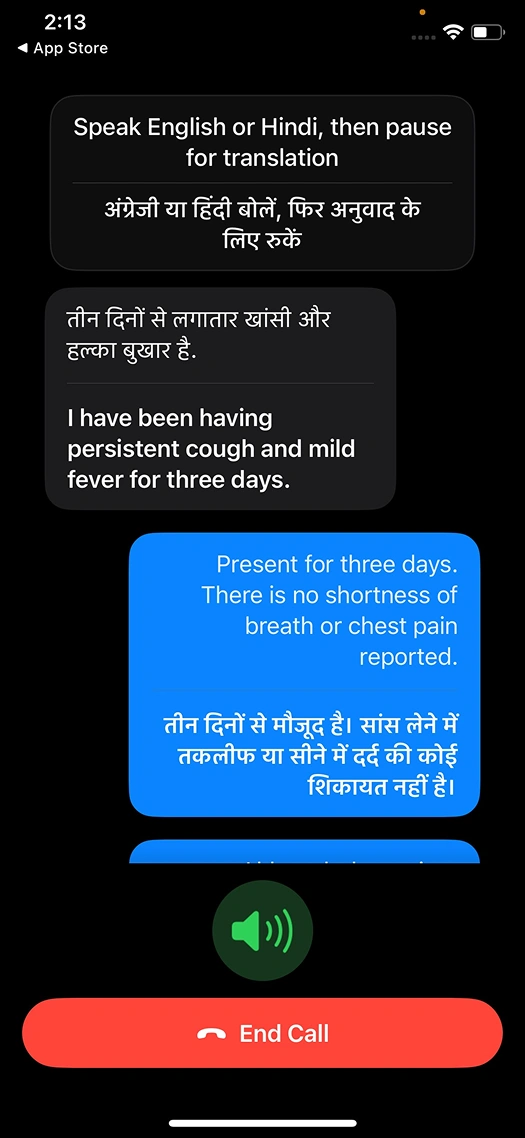
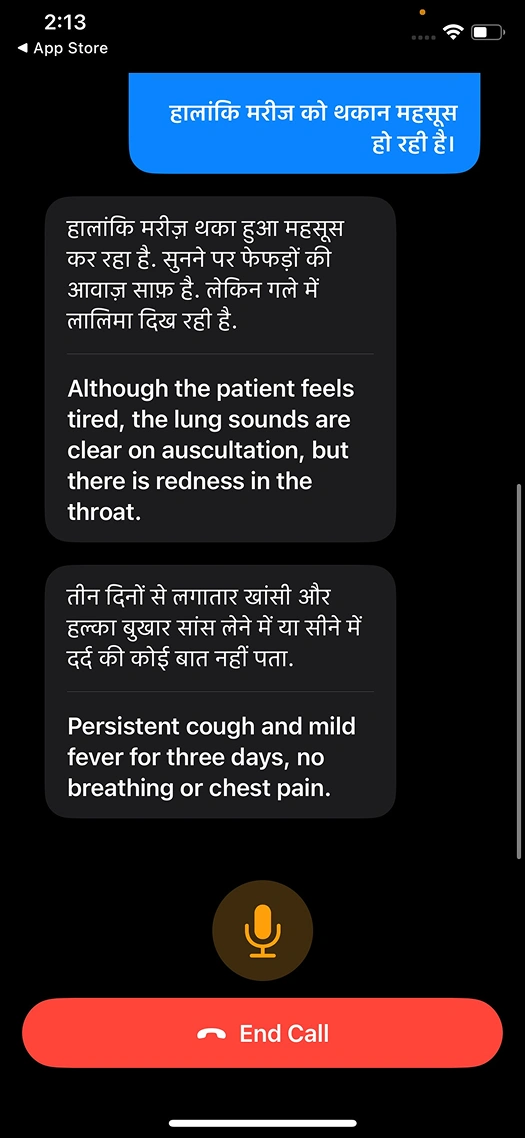
From spoken word to translated text in under three seconds
We found early that a direct audio-in, text-out approach was not dependable enough for medical use, so we built a three-stage pipeline that cleans the audio, constrains the AI, and checks the output before a single translated word reaches the doctor or the patient.

Audio capture and preprocessing
The phone microphone picks up the speech, and before anything reaches the AI the audio is cleaned: noise is reduced, volume is normalised, and the speech is split at natural phrase boundaries. A busy exam room is never quiet, so cleaning the audio first is what makes everything after it reliable.

Transcription and translation
The clean audio goes to the OpenAI Realtime API under tight prompt constraints. The model transcribes in the language spoken and translates into the target language, and nothing more: no added context, no invented advice, just a faithful translation of what was actually said.

Validation and delivery
Before any translation is shown, a validation layer checks it, comparing length ratios and flagging anything that looks off. Translations that pass are pushed straight to the chat interface over WebSocket in under three seconds, so the conversation keeps a natural pace.
Built for the exam room
Live two-way audio translation
The doctor speaks English and the patient hears Spanish; the patient replies in Spanish and the doctor reads English subtitles. Both sides update live over WebSocket connections, so it feels like a real back-and-forth conversation rather than a clumsy turn-by-turn tool.
HIPAA-compliant by design
Audio is processed in the moment and never kept as a recording. No patient health information lives on beyond the active session, and the whole thing runs on HIPAA-eligible AWS services with encryption and audit logging, so privacy is built into the architecture rather than promised on top of it.
No hallucinations in translation
Careful prompt engineering locks the AI into translation-only mode, and the validation layer compares each output against expected translation ratios, rejecting anything that adds medical advice or context that was not in the original audio. In medicine an invented line is dangerous, so the system is built to never add one.

No account required
No sign-ups, no logins, no card details. A healthcare professional opens the app, chooses two languages, and starts translating. Zero-friction onboarding was a core requirement, because nobody should be filling in a form while a patient waits.
More than ten medical languages
Careslate supports all the major world languages with awareness of medical terminology, and each language pair is checked for clinical accuracy. Selecting two languages locks the session to exactly those two, with no interference from any third.
WebSocket chat display
Translated messages appear as conversation bubbles showing both the original transcription and the translation, side by side. The chat builds itself naturally as the conversation flows, with no page refreshes and no manual checking for new messages.
Why the Realtime API alone was not enough
Direct audio-in, text-out looked great in a demo but fell apart in a real clinic. Here is what we hit, and how we solved each one.
Inconsistent live transcription
On its own, the OpenAI Realtime API gave inconsistent transcriptions during live conversation. Audio arrived in fragments, medical terms were misread, and responses lagged behind natural speech. A straight API-to-output approach simply was not dependable enough for a clinical setting.
We built our own three-stage pipeline instead of relying on direct output. Audio is captured from the microphone, passed through a preprocessing stage that cleans and segments it, then sent to the API for transcription and translation. Splitting it into three stages gave us control over audio quality, timing and error recovery at every step.
The risk of AI hallucinations
Hallucination was a serious danger. The model would sometimes produce medical advice nobody had spoken, add context that was never there, or invent terminology. In healthcare, a single mistranslation can cause real harm, so this was not a risk we could leave to chance.
We removed hallucinations through strict prompt engineering and output validation. The system prompt locks the model to translation-only, with explicit instructions never to add advice, context or terminology that was not in the source audio, and a validation layer flags any response that strays from expected translation ratios.
Keeping the two languages clean
The app had to translate strictly between the two chosen languages with no cross-interference. When a doctor picked English to Spanish, the system had to ignore background speech in other languages and never flip translation direction mid-conversation.
We solved language-pair isolation through prompt design and session architecture. Each session binds to exactly two languages at the moment it is created, the prompt states the allowed pair explicitly, and any audio that does not match the source language is filtered out before it ever reaches the AI.
A smooth real-time chat experience
Turning translated audio into a smooth chat took careful orchestration. The user speaks, the audio is captured, the AI transcribes and translates, and the result has to appear as readable chat, all within seconds and without freezing the interface.
We connected the pipeline to the frontend over WebSocket channels. As each translated segment finishes, it pushes to the client instantly, and the chat renders it as a bubble with the original and the translation side by side, so the conversation builds message by message with no refreshing or polling.
The technology behind Careslate
SwiftUI runs the native iOS app, with AVFoundation handling audio capture. The OpenAI Realtime API powers transcription and translation through our custom three-stage pipeline, and WebSocket delivers the translated messages in real time. The entire flow is HIPAA-compliant, with no patient data stored at any point.
Mobile
AI & Audio
Pipeline
Compliance
// Careslate — 3-way audio pipeline
{
  "app": "SwiftUI + AVFoundation",
  "ai": "OpenAI Realtime API",
  "realtime": "WebSocket",
  "pipeline": "3-Way (capture → clean → translate)",
  "hipaa_compliant": true,
  "hallucination_guard": true,
  "data_storage": false
}
What we learned building this app
Careslate was different because the stakes were medical. A wrong translation here is not just annoying, it is dangerous. The OpenAI Realtime API is powerful, but it is not production-ready for medical use straight out of the box.
The direct approach worked in a demo and then failed against background noise, accents and medical jargon, and our three-stage pipeline solved every problem the direct version had.
Common Questions About Medical Translation Apps
It depends on scope, but as a guide, a focused HIPAA-compliant medical translation app like Careslate typically runs from around EUR 25,000 to EUR 50,000 or more, depending on languages, integrations and compliance depth. We give a fixed estimate after a short discovery call rather than quoting blind.
It can be, when it is built for it. Accuracy comes from more than the model: in Careslate it comes from cleaning the audio first, locking the AI to translation only, and validating every output before it is shown. That combination is what makes it dependable in a real exam room rather than only in a demo.
By designing privacy in from the start. In Careslate, audio is processed live and never stored as a recording, no patient information persists beyond the session, and everything runs on HIPAA-eligible infrastructure with encryption and audit logging. Compliance is built into the architecture, not added at the end.
It is the approach we built because direct audio-in, text-out was not reliable enough. Stage one captures and cleans the audio, stage two transcribes and translates it under tight constraints, and stage three validates the result before delivery. Splitting it this way gives control over quality, timing and error recovery at each step.
It is best seen as fast, always-available support rather than a full replacement for a professional interpreter in complex or high-stakes situations. For the many everyday moments where a clinician and patient simply cannot understand each other and no interpreter is on hand, a tool like Careslate bridges the gap safely and instantly.
Through strict prompt engineering and output validation. The system prompt locks the model to translation only and forbids adding advice, context or terminology that was not spoken, and a validation layer rejects any output that strays from expected translation ratios. The goal is a faithful translation and nothing invented.
Careslate supports more than ten major world languages with medical terminology awareness, and each language pair is checked for clinical accuracy. Each session locks to exactly two chosen languages so there is no interference from any third language in the room.
Careslate took around three months from concept to a working HIPAA-compliant app. The timeline depends on the number of languages, the compliance requirements and the depth of the pipeline, and we work in two-week sprints so progress is visible throughout rather than going quiet until launch.
Building a Healthcare App with AI?
We build HIPAA-compliant mobile apps with real-time AI features. From medical translation to clinical workflows, we have shipped it.