My Meeting Card
Live check-in, GPS verification and Zoom attendance for compliance programs.
My Meeting Card replaces the paper meeting card with a phone. A participant checks in with GPS at the start of a session, and the app tracks how long they attend for the full meeting. If the meeting is on Zoom, the app schedules it and watches live presence, flagging anyone who misses a periodic check to the admin. Rehab, parole, probation and outpatient programs get a single source of truth for attendance, with the privacy controls and reliability the use case demands.
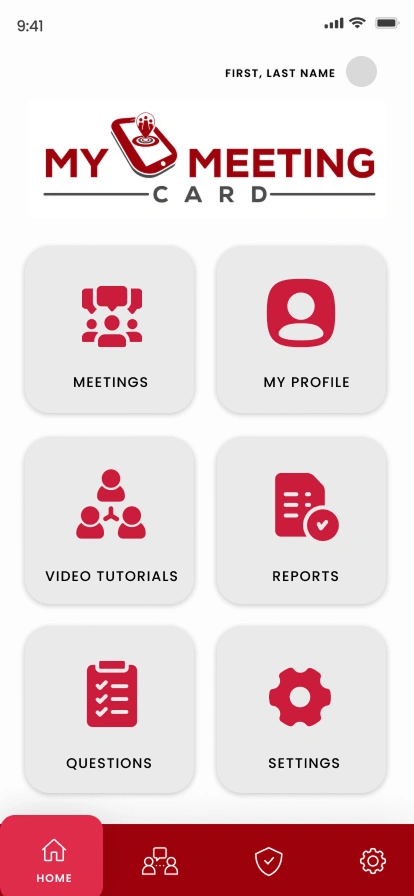
Serious, trustworthy, quiet
My Meeting Card speaks in a calm voice. The visual system uses a deep civic navy with a single verification-green accent, with no decoration and no marketing noise. Admins and participants need to trust the screen at first glance, so the screen earns that trust through clarity alone. In a compliance tool, a quiet, serious design is not a stylistic choice, it is part of how the product does its job.
One phone, one workflow: from scheduling to verification
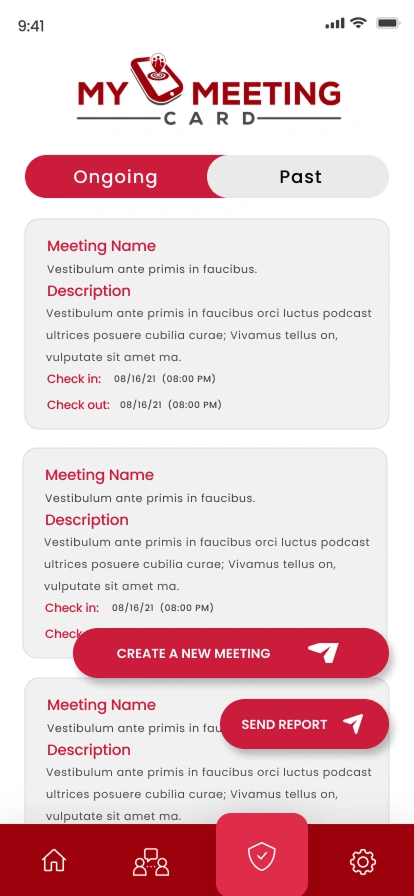
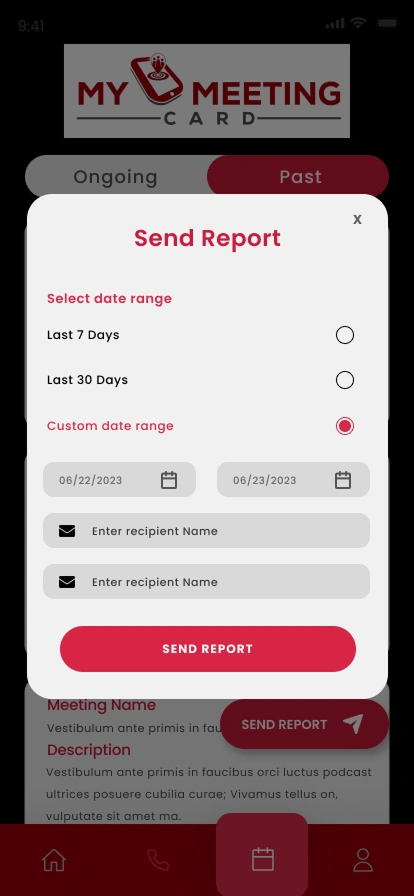
A participant never has to open a second tool, and a parole officer or counsellor does not have to juggle Zoom, a spreadsheet and a paper card. Everything, from scheduling a session to verifying who attended, lives in the same app, which is the whole point of replacing the paper card in the first place.
Built for accountability, not paperwork
Each feature answers a specific need of rehab, parole or outpatient programs. No filler, no cosmetic add-ons.

Live check-in with GPS
Device location is captured at the start of the meeting only, with accuracy tuning and anti-spoofing checks. The participant is never tracked outside the session, which keeps the verification honest while respecting privacy.
Recurring schedules
Daily, weekly or monthly, with any day-of-week combination and any window length, all covered by a single model. A program that runs on, say, Tuesdays and Thursdays is set up once rather than meeting by meeting.

Zoom integration
Zoom meetings are scheduled inside the app, and periodic presence checks flag absentees to the admin in real time. Remote attendance is verified as rigorously as in-person, without the admin watching the call themselves.

Attendance tracking
Meeting duration is logged automatically, and any discrepancy raises an alert on the admin dashboard. The record builds itself, so accountability does not depend on someone remembering to write anything down.
How it works: check in, meet, verify
Three moments make up every session on My Meeting Card.
Live GPS check-in
The participant opens the app at the start of the meeting, and GPS confirms their location at that exact moment. Nothing is tracked outside the session, so the app verifies attendance without becoming surveillance.
Zoom session monitored
If the meeting is on Zoom, the app schedules it and watches live presence, with periodic checks keeping everyone genuinely engaged rather than just logged in and walked away from.
Attendance verified
Duration is logged, any discrepancies are flagged to the admin, and the attendance record updates in real time. By the end of the session, the record is already complete and trustworthy.
Native where privacy matters, server where accountability lives
Swift on iOS and Kotlin on Android handle the GPS check-in, the camera flows and the background sync, while a Laravel backend on HostGator with a MySQL database owns the schedule, the attendance records and the Zoom monitoring logic. The split is deliberate: the sensitive, device-level work is native, and the records that have to be tamper-resistant live on the server where they cannot be spoofed from a phone.
Mobile
Backend
Infrastructure
Integrations
Real problems, real fixes
Live GPS verification had to stay accurate while protecting privacy. The app captures the check-in location at the exact moment of a meeting and must never track the participant outside that window, which is a fine line to hold in a compliance tool.
We built native iOS in Swift and native Android in Kotlin, so GPS access, background handling and permission prompts behave the way each platform expects. That native behaviour matters for a tool admins have to trust, and it keeps location capture tightly scoped to the session itself.
The Zoom integration had to feel like part of the app, not a bolt-on. Users schedule a Zoom meeting inside the app, share the link or ID, and the app watches presence during the session, pushing a user out and alerting the admin in real time when a presence check is missed.
A Laravel backend on HostGator with a MySQL database handles scheduling, attendance records, admin approvals and the Zoom monitoring logic. Nothing sensitive runs on the phone where it could be spoofed, so the monitoring is both seamless to the user and trustworthy to the admin.
Recurring meetings needed real flexibility: daily, weekly or monthly schedules with arbitrary day-of-week combinations. A parole officer running a Tuesday and Thursday program should not have to create a separate meeting for every single date.
Recurring meetings use a flexible schedule model. You pick any combination of days, set a window and set a duration, and one configuration covers daily, weekly, biweekly, monthly and custom cadences. The schedule is defined once and simply runs.
The app had to work reliably across the whole country, across different carriers, GPS accuracies and network conditions. A patchy connection should never silently drop a legitimate check-in, because in a compliance setting a lost check-in is a real problem for a real person.
A background sync queues check-ins when the phone loses signal, and drains the queue the moment the app reconnects. The admin never loses a legitimate check-in because of a cell-tower outage, so a weak signal never turns into a false compliance failure.
Frequently Asked Questions
Common questions compliance teams, program directors and founders ask before investing in an attendance verification app.
It depends on scope, but as a guide, a compliance attendance app like My Meeting Card, with GPS check-in, Zoom monitoring and recurring schedules, typically runs from around EUR 25,000 to EUR 55,000 or more. We give a fixed estimate after a short discovery call rather than quoting blind.
The app captures the device's location at the exact moment a participant checks in for a meeting, with accuracy tuning and anti-spoofing checks, and nothing is tracked outside that window. In My Meeting Card this is built natively on each platform, so location capture is accurate and tightly scoped to the session itself.
Yes. My Meeting Card schedules Zoom meetings inside the app and monitors live presence, flagging absentees in real time. The same approach can be extended to other video platforms such as Microsoft Teams or Google Meet, with the monitoring logic running on the backend rather than the phone.
With a single flexible schedule model rather than one-off meetings. You pick any combination of days, set a window and a duration, and that one configuration covers daily, weekly, biweekly, monthly and custom cadences. It means a recurring program is set up once instead of meeting by meeting.
By collecting only what is needed, when it is needed. Location is captured at check-in only and never outside the session, and the sensitive records live on a secure backend rather than on the phone where they could be tampered with. Privacy and tamper-resistance are designed in, which is essential for a regulated use case.
A native compliance app like this typically takes around four to six months from concept to launch, depending on the integrations and the reliability requirements. We work in two-week sprints with working software throughout, so progress is visible rather than going quiet until launch.
It depends on the jurisdiction and the program, and can include health-data and privacy rules as well as program-specific requirements. We design these apps with privacy and data protection built in from the start, scope data collection tightly, and build to the specific rules that apply to your program rather than a generic template.
With offline resilience. My Meeting Card queues check-ins when the phone loses signal and drains the queue as soon as it reconnects, so a legitimate check-in is never silently lost to a patchy network. In a compliance setting, that reliability is essential, because a dropped check-in has real consequences for the participant.
Planning an attendance or compliance app?
We build native apps that handle GPS, video integrations and attendance reporting in regulated spaces. If you are planning something like My Meeting Card, tell us about your program and a senior engineer will reply within one business day with an honest view of what it would take.