Scannur
Scan, catalogue and manage stock from the phone in your pocket. Warehouse teams scan a barcode and the item appears. Retail teams snap a photo and AI reverse image search finds the match. Lists, categories and stock counts all stay in one place.
Stock management on the floor usually means juggling three things: a barcode scanner for items that have codes, a clipboard or spreadsheet for counts, and a separate way to identify products that have no barcode at all. Switching between them is slow, and retyping numbers between tools is where errors creep in. Scannur replaces all three with a single app. A barcode scanner reads coded items instantly. An AI reverse image search identifies products that have no barcode. Purchase orders, stock-takes and categories all sit on top of the same item library, so there is one source of truth and nothing gets retyped.
Four Capabilities in One Native App
Scannur replaces the clipboard, the barcode scanner and the photo-search tool with a single app that runs on the warehouse floor and a Laravel backend that scales with the business. It is the kind of custom software development that maps to one team's exact workflow.
Barcode Scanning
On-device reads for EAN, UPC, Code 128, QR and Data Matrix. The camera reads, the app responds, and there are no extra taps between scanning a code and seeing the item.
Object Detection
Point the camera at a shelf and Scannur draws bounding boxes, lists what it saw and lets the operator accept or discard each detected item — useful for quick visual counts.
AI Image Search
When an item has no barcode, a photo is sent to a vision model running on AWS Lambda, and the matching catalogue item comes back in under a second. The operator accepts, rejects or edits, and the catalogue learns from every decision.
Lists & Catalogues
Purchase orders, stock-takes and receiving lists all sit on top of the item library. One source of truth means no retyping between tools — Monday's stock-take flows into Friday's order without anyone re-entering a number.
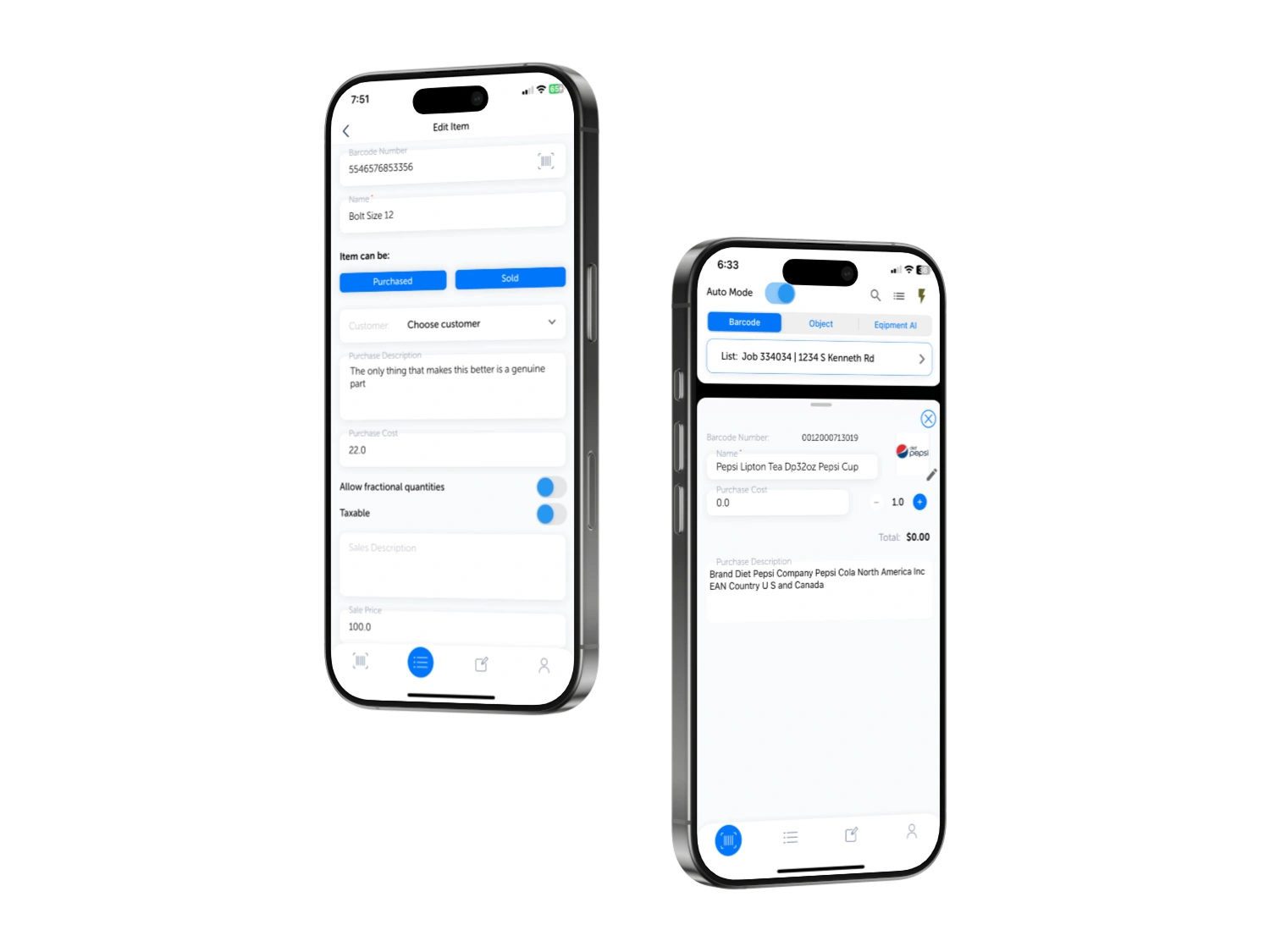
Edit and scan, in parallel.
A manager edits an item on the left phone while a floor worker scans a barcode on the right. Both views update against the same PostgreSQL catalog in real time.
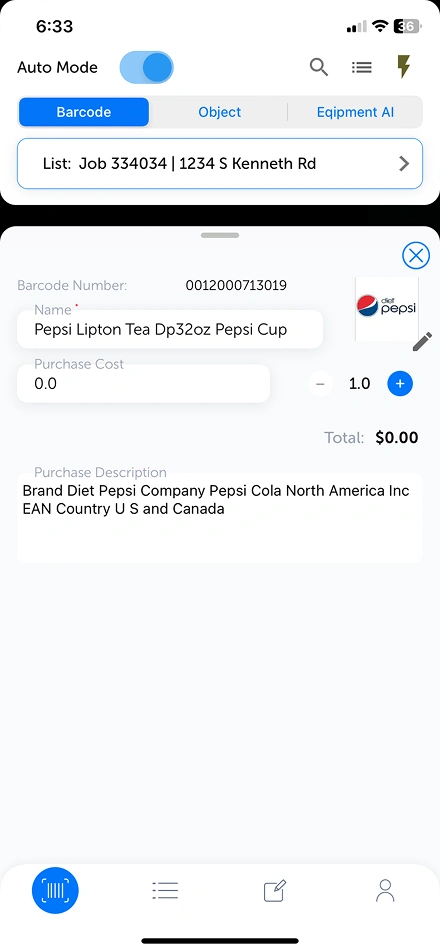
Auto Mode reads first, asks second.
Flip Auto Mode on and the camera reads every code that crosses the viewfinder. Scannur ties the code to the active list, pulls the item from the catalog and shows purchase detail and quantity controls with one tap.
- Barcode · Object · Equipment AI modes
- Quantity increment with native haptics
- Auto-link to the active job or stock list
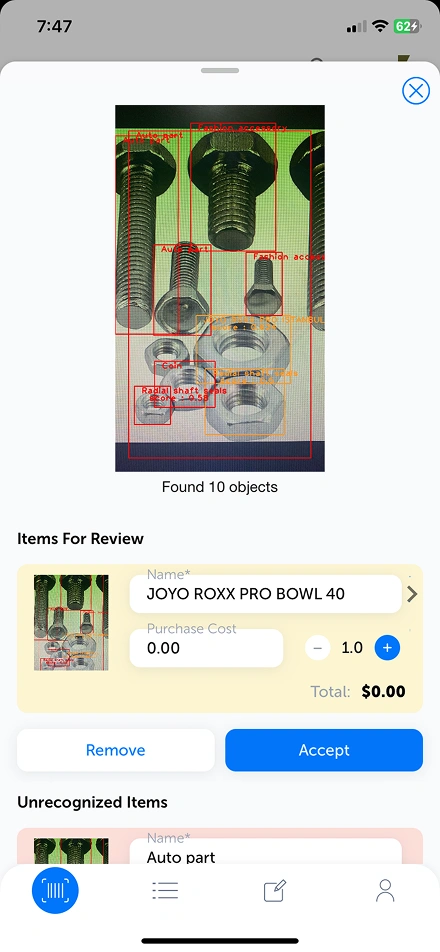
AWS Lambda finds items without a barcode.
When an item has no barcode, point the camera at it. Scannur uploads the frame to an AWS Lambda vision model, the product of focused AI development, and returns candidate matches in under a second. The operator accepts, rejects or edits. The catalog learns from every decision.
- Vision model runs on AWS Lambda
- Multiple-object detection per frame
- Accept / Remove inline review
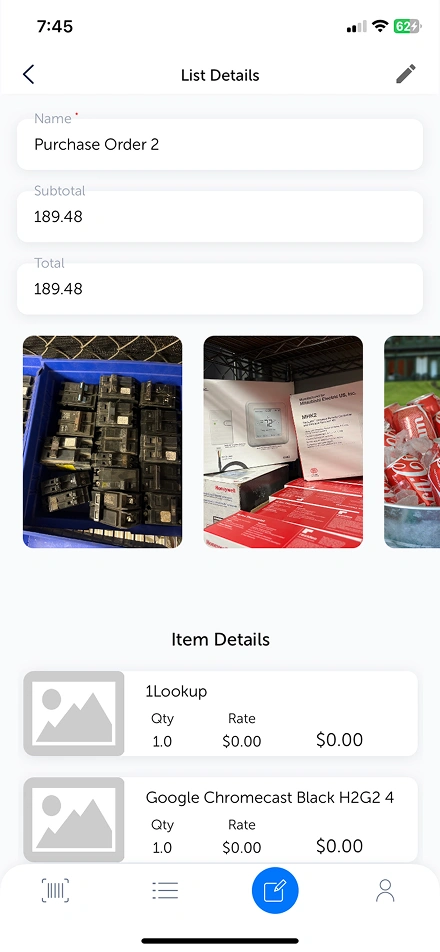
Every list is a view into the catalog.
Purchase orders, stock-takes and receiving lists sit on top of the same item library. Add a photo thumbnail. Total the cost. Share or export when the count is done. No retyping between tools.
- Live subtotal and total calculation
- Photo thumbnails per list item
- Export to CSV for downstream systems
Native Where Speed Matters, Cloud Where Scale Matters
The phones stay light because the heavy work sits on the server. The server stays simple because Lambda handles the machine learning on demand.
{
  "mobile": ["Swift", "Kotlin", "React Native"],
  "backend": "Laravel",
  "database": "PostgreSQL",
  "cloud": "AWS",
  "ml": "AWS Lambda + vision model",
  "native": true
}

// Native camera and haptics live on the phone.
// Catalogue, auth, orders and image search live on the server.Four Problems Detected. Four Fixes Applied.
Read the left column to see what the brief threw at us. Read the right column to see what we shipped to answer it.
Reverse image search had to run fast from the floor
A photo goes up, the model runs, the item comes back. A mobile phone cannot hold a model that heavy, so the work had to live on the server without making the round trip feel slow.
Barcode scanning had to feel instant everywhere
The camera reads the code, the app responds, no extra taps — and it had to run at the same speed on a kitchen label and a warehouse pallet.
One data model from 50 items to 50,000
A corner shop with 50 items and a warehouse with 50,000 had to use the same screens, and search, pagination and filtering had to stay quick at any size.
List management had to feel familiar
Anyone who has used a spreadsheet should feel at home: add items, reorder them, share the list, export the count. Simple, but not simplistic.
We kept the app native where speed matters and moved the heavy work to the cloud. A photo uploads to a vision model on AWS Lambda, which returns candidate matches in under a second. The phone stays light; the server does the lifting.
We built scanning natively. Swift runs iOS, Kotlin runs Android, and camera access, haptics and scan feedback feel right on each platform. Reads are processed on-device, so there is no network delay between scanning a code and seeing the result.
The item library indexes and caches for speed at any scale. The data model grows underneath without changing what the user sees, so a small business and a large warehouse get an identical experience that simply holds more.
List management sits on top of the library, so any list is a view into the catalogue. Sort, filter, share and export all work without double data entry, and counts flow from one list into the next without retyping.
Questions buyers ask before the demo call.
> An inventory app typically costs between EUR 35,000 and EUR 120,000, depending on features. Basic barcode scanning and lists sit at the lower end; AI reverse image search, multi-platform builds and ERP integration push it higher. Scannur, with its vision model and three scan modes, sits toward the upper range. We provide a fixed scope and price before development.
> The app sends a photo of an item to a vision model, usually running in the cloud because the model is too large for a phone. The model compares the image against the catalogue and returns the closest matches. In Scannur this round trip completes in under a second, and the operator confirms or corrects the result.
> For speed-critical scanning, native Swift and Kotlin give the best camera and haptics performance. A Laravel or Node.js backend with PostgreSQL handles the catalogue and orders, and cloud functions like AWS Lambda are ideal for running the ML on demand. That is the split we used for Scannur — native on the phone, cloud for the heavy lifting.
> A barcode-and-lists app can ship in three to four months. Adding AI reverse image search, object detection and ERP integration pushes it to five to eight months, since the vision model and integrations need their own development and testing time.
> Yes. Most ERP systems expose APIs, so the inventory app can push counts, orders and stock movements into the ERP and pull product data back. We map the fields during discovery and build a sync layer, so the app becomes the floor-level front end to the system the business already runs.
> Often, yes. Warehouses and stockrooms frequently have poor connectivity. We design for offline-first where it matters: scans and edits queue locally and sync once a connection returns, so a dropped signal never stops a stock-take. Cloud features like image search need connectivity, but core scanning keeps working.
> At minimum EAN and UPC for retail products, Code 128 for logistics, and QR and Data Matrix for internal labelling. Scannur supports all of these and more. The right set depends on your industry, which we confirm during discovery.
> Data is encrypted in transit and at rest, access is controlled by authenticated user accounts with role-based permissions, and the backend sits behind standard cloud security on AWS. For businesses with stricter requirements, we add audit logs and single sign-on integration.
Planning an inventory or productivity app?
We build native apps that run on the floor and in the office, backed by servers that scale from 50 items to 50,000.